


Sammanfattning
Politiskt våld är en viktig drivkraft bakom mänsklig mobilitet, men dess effekter varierar mellan olika kontexter, våldsformer och typer av förflyttning. Denna rapport sammanfattar en avhandling som undersöker hur och under vilka förutsättningar politiskt våld formar konfliktrelaterad mobilitet. Med utgångspunkt i fyra kvantitativa studier på olika geografiska skalor och tidshorisonter visar forskningen att en disaggregering av våld förbättrar förståelsen och förutsägelsen av mobilitet; att människor kan flytta i förväntan på framtida våld; att konflikter kan omforma befolkningsfördelningar under flera år; samt att mobilitetsreaktioner beror på överlappande påfrestningar och de resurser som finns tillgängliga för hushållen. Statsbaserat våld framträder som en särskilt konsekvent prediktor, medan effekterna av ensidigt och icke-statligt våld varierar mer mellan de studerade kontexterna. Resultaten visar också att konflikt inte alltid leder till ökad mobilitet, då det både kan begränsa och uppmuntra förflyttning. För humanitära och utvecklingsinriktade aktörer belyser resultaten värdet av att kombinera förklaring med prognostisering för att förutse nya behov, se bortom omedelbar fördrivning och beakta mer långsiktiga demografiska effekter och överlappande sårbarheter.
Maxine Leis is a Research Associate at the Center for Crisis Early Warning (CCEW), University of the Bundeswehr Munich, and a Research Fellow at the Centre for International Security at the Hertie School. She is also an Affiliated Researcher at Uppsala University’s Department of Peace and Conflict Research, where she completed her PhD in January 2026. Her research focuses on understanding and predicting conflict-related mobility, including displacement, migration and immobility, as well as the interaction between conflict and climate-related hazards. She also contributes to research on forecasting armed conflict and election-related violence. Her work has been published in outlets such as Communications Earth & Environment, Journal of Peace Research, and International Journal of Forecasting.
Background and rationale
At the end of 2025, roughly one in every seventy people worldwide, an estimated total of 117.8 million, was displaced by conflict, violence and persecution (UNHCR, 2026). Although this marked the first decline from the previous year in a decade, global displacement remained exceptionally high. Protracted crises such as in Somalia coexist with escalating ones such as in Mali. At the same time, the impacts of climate change increasingly compound existing vulnerabilities and can intensify humanitarian emergencies in already fragile and conflict-affected settings (Buhaug and Uexkull, 2021; See et al., 2026).
The headline figure, however, captures only one snippet of the bigger picture of the relationship between political violence and human mobility. Formal displacement statistics record refugees, asylum seekers, internally displaced persons and other people in need of international protection (UNHCR, 2026), yet they do not fully reflect the diversity of mobility responses that can emerge in conflict-affected settings: movements may occur not only after exposure to violence, but also in anticipation of future harm (Schon, 2015; Tai et al., 2022; Kosyakova, Kogan and van Tubergen, 2025); other conflict-related movements may be harder to distinguish from migration driven by other factors (Erdal and Oeppen, 2018; Erdal, Mjelva and Tollefsen, 2025); and some people may remain in dangerous settings by choice, while others are constrained from leaving (Carling, 2002; Lubkemann, 2008; Carling and Schewel, 2018). Political violence can also reshape population distributions gradually, with effects that extend beyond immediate displacement. I conceptualise this broader range of responses to political violence in my dissertation as conflict-related mobility.
Taking this broader perspective into account also requires a more nuanced understanding of how political violence shapes mobility. Previous research has established a robust relationship between political violence and both internal and cross-border movement, but these effects vary across contexts and forms of mobility (Davenport, et al., 2003; Moore and Shellman, 2006; Engel and Ibáñez, 2007; Melander and Öberg, 2007; Adhikari, 2013; Balcells and Steele, 2016; Turkoglu and Chadefaux, 2019). Violence differs in how it unfolds over time and across space, in the actors involved, and in whom it targets (Melander and Öberg, 2006; Braithwaite, Cox and Ghosn, 2021; Turkoglu, 2022). People may respond to direct exposure, perceived future risk, or the longer-term erosion of livelihoods and institutions, while their ability to move also depends on the resources and opportunities available to them (see also Carling, 2002; Carling and Schewel, 2018; de Haas, 2021). Understanding conflict-related mobility, therefore, requires attention to both the nature of violence and the conditions that enable or constrain movement.
Gaining a better understanding of these differences matters for humanitarian and development responses. Explanatory insights from this dissertation can shed light on how violence shapes mobility and help identify why some people move, why others remain, and how conflict affects livelihoods and institutions over longer periods. Such understanding can therefore inform responses that address not only immediate displacement, but also the broader vulnerabilities and constraints that shape mobility in conflict-affected settings. Anticipating future mobility is equally important. Forecasting tools can help identify where humanitarian needs are likely to arise or intensify, supporting preparedness, contingency planning, and the allocation of limited resources (Fontana et al., 2025; Kjærum and Madsen, 2025). This is especially relevant in a context of shrinking humanitarian budgets, where organisations face increasingly difficult choices over where and when to allocate assistance (UNRIC, 2025). Forecasts should not be treated as certain statements about the future, but as one evidence-based tool that can support decision-making under uncertainty.
For development cooperation more specifically, the challenge is therefore both explanatory and anticipatory: to understand how different forms and dynamics of political violence shape mobility and immobility, and to use that knowledge to respond earlier and plan beyond immediate displacement.
Research aim and question
Against this background, the overarching aim of this dissertation is to examine how and under what conditions political violence shapes mobility (Leis, 2025). The dissertation approaches this question from four complementary perspectives. Individually, each of the studies examines:
- whether and how temporal, spatial and actor-related characteristics of organised violence improve predictions of refugee and asylum seeker outflows (Study I);
- whether and under what conditions people move in anticipation of organised violence, rather than only in response to violence they have already experienced (Study II);
- how state-based and non-state violence reshape longer-term net migration patterns (Study III); and
- how political violence and natural hazards jointly shape household mobility, and how these effects vary with household resources (Study IV).
Together, the studies show that conflict-related mobility is shaped not simply by whether violence occurs, but by how political violence unfolds, how threats are perceived, the other pressures people face, and the contextual conditions and capabilities that enable or constrain movement. The studies span different forms of mobility, geographical scales and time horizons. Table 1 provides a more detailed overview of the four studies.
Table 1. Overview of the four studies
|
Study |
Mobility type |
Geographical and temporal scope |
Main violence focus |
|
I |
Refugee and asylum seeker outflows |
71 conflict-affected countries across Africa, the Middle East and Latin America, 1989–2024 |
Temporal, spatial and actor-related violence characteristics |
|
II |
Internal conflict-related displacement |
Somalia, 2016–2024 |
Violence risk |
|
III |
Net migration |
Africa and the Middle East, 1990-2020 |
State-based and non-state organised violence |
|
IV |
Internal and international household migration |
Bangladesh, 2011–2018 |
Political violence and natural hazards |
Source: Author’s adaptation of Table 1.1 in Leis (2025).
Approach and methods
The dissertation combines explanatory and predictive approaches to study conflict-related mobility. This reflects the complexity of mobility processes, which are often shaped by non-linear relationships, interactions between multiple factors and substantial variation across contexts (e.g. Schutte et al., 2021). Rather than treating prediction and explanation as competing goals, the dissertation uses them in complementary ways: out-of-sample predictive performance is used to assess whether theoretically informed characteristics and mechanisms provide meaningful information about mobility beyond simpler models, while explanatory analyses help examine how and under what conditions these relationships arise (Leis, 2025). Across the four studies, these approaches include regression-based analyses, machine-learning forecasting, prediction-based counterfactual simulations and interpretable machine-learning methods, applied to data ranging from country-level refugee and asylum seeker outflows to district-, grid-cell- and household-level mobility.
Results and discussion
Several common findings emerge from the dissertation. First, disaggregating political violence matters: how violence unfolds over time and space, and which actors are involved, provide important information about mobility that is lost in aggregate measures of violence. Second, the effects of different forms of political violence are not uniform. State-based violence emerges as a particularly consistent predictor across the studies in which it is examined, while the effects of one-sided and non-state violence vary across contexts and forms of mobility. Third, political violence can shape mobility through different pathways and over different time horizons: people may move in anticipation of future violence, conflict can reshape population distributions over longer periods, and in some circumstances, violence may also constrain movement. Finally, mobility responses depend on the wider context and on the capabilities and constraints people face, including environmental pressures and the resources and networks available to households. These broader patterns are further unpacked through four lessons below. Full results and methodological details for the individual studies can be found in the dissertation (Leis, 2025).
Lesson 1: How violence unfolds matters, not only whether conflict is present
The first lesson is that aggregate measures of political violence may miss important information about future mobility. The theoretical argument is that different conflict characteristics provide different signals about both current and future conflict-related insecurity. Temporally, the way violence during conflicts develops over time can shape how civilians interpret the urgency and trajectory of threat. Persistent violence can signal that insecurity is sustained rather than temporary, while escalation may indicate a worsening conflict environment. Volatility, in turn, can increase uncertainty about how violence will develop in the future. Geographically, the territorial spread and specific location of violence can alter both exposure and opportunities to move. Violence that spreads across a larger share of a country exposes more people and can reduce access to domestic safe areas. Violence near capitals or borders may also be especially consequential, although its effects can work in different directions by either increasing perceived threat or disrupting routes and infrastructure needed for mobility. At the actor level, the characteristics and relationships of conflict parties can shape both perceived threat and expectations about whether violence will persist or spread. Shifts in relative strength may alter the expected trajectory of fighting, while fragmentation can make the conflict environment more complex and unpredictable. The identity of the perpetrator may also be relevant. As such, government targeting of civilians may be especially consequential because the state is difficult to avoid and is ordinarily expected to provide protection.
Building on this, Study I examines refugee and asylum seeker outflows across 71 conflict-affected countries in Africa, the Middle East and Latin America and shows that refugee and asylum seeker outflows can be predicted more accurately when political violence is disaggregated according to how it unfolds over time and space and which actors are involved. Temporal dynamics, spatial patterns, and actor-related characteristics all add predictive information beyond simpler measures of conflict intensity. The model combining these three dimensions performs most consistently, with particularly clear gains for predicting larger refugee and asylum seeker outflows. The theory-informed models also produce more reliable prediction intervals, which is important for anticipating the range of plausible future outflows rather than only their most likely size. Temporal and actor-related dynamics are especially informative, while spatial characteristics provide somewhat smaller predictive gains. Indicators of state-based violence and government targeting of civilians also rank among the most useful predictors.
These findings suggest that people respond not simply to whether violence is present or to its overall intensity, but to changes in the broader conflict environment. A conflict that changes over time and space or involves patterns of civilian targeting may generate different mobility responses than one with a similar overall level of violence but a different trajectory or actor configuration. This increases not only our ability to improve predictions of future patterns but also adds to our understanding why similar levels of conflict intensity can be associated with very different patterns of refugee and asylum seeker outflows.
Lesson 2: People may move before violence reaches them
The second lesson is that conflict-related mobility can also be anticipatory. The theoretical argument distinguishes between observed violence and the risk of future violence. This means that civilians may infer future danger from violence occurring elsewhere by assessing both how likely violence is to reach their area and how severe its consequences could be. This perceived likelihood of future violence is shaped by observable signals such as its geographic proximity, recency and intensity, while expected consequences depend in part on patterns of civilian targeting. These assessments may increase civilians’ incentives to move before violence reaches their own area. Anticipatory responses may also differ across forms of violence, since state-based, non-state and one-sided violence can show different geographical patterns and vary in their personal relevance and expected consequences for civilians.
Against this background, Study II examines internal conflict-related mobility in Somalia between 2016 and 2024 and finds partial but robust evidence consistent with people in Somalia moving not only following violence that can be observed in their own district, but also in response to violence risk generated by events elsewhere. This relationship is strongest and most robust for state-based violence risk and, to a lesser extent, for non-state violence risk. In contrast, one-sided violence risk does not show a consistent relationship with anticipatory mobility in this setting.
These findings suggest that civilians can respond to signals about how threats are developing beyond violence that reaches them directly. In the case of state-based violence, changes in the broader conflict environment, such as major offensives and shifting frontlines, may provide relatively visible signals of a broader threat. Responses to non-state violence appear more locally bounded, becoming relevant mainly when violence occurs nearby. The absence of a consistent effect for one-sided violence also suggests that anticipatory mobility should not be understood as a uniform response to all forms of threat. How violence is interpreted may depend on the type of violence and the surrounding conflict context. The lack of a consistent effect for one-sided violence should, however, not be interpreted as evidence that civilian targeting is generally irrelevant for anticipatory mobility; in Somalia, civilian targeting may be highly selective and locally understood, while available conflict data cannot fully capture these distinctions.
Lesson 3: Conflict reshapes mobility over longer time horizons
The third lesson is that political violence can shape mobility over longer time horizons than immediate displacement. The theoretical argument is that conflict affects mobility not only through direct threats to physical security, but also through changes in the conditions that make it desired and possible to live and remain in a place. Violence can weaken political institutions and the rule of law, disrupt public services and infrastructure, and erode livelihoods and economic opportunities. These processes can accumulate over time and shape migration patterns over longer periods. State-based conflict is expected to have stronger longer-term effects because it can generate broader institutional disruption, service breakdown and livelihood erosion, while non-state violence is expected to generate more localised and less sustained effects.
Study III, which is co-authored with Kristina Petrova, Håvard Hegre, and Andreas Forø Tollefsen, examines five-year net migration patterns across Africa and the Middle East from 1990 to 2020 and estimates, using counterfactual predictions, how these patterns would differ under a hypothetical scenario without organised violence. The results indicate that both state-based and non-state violence are associated with measurable differences in predicted net migration over multi-year periods, with state-based violence having the larger estimated effect.
Importantly, these effects are not spatially uniform. The largest estimated effects at the country-level are concentrated in countries with protracted or high-intensity conflict, such as Syria and Iraq. An analysis of Syria at the sub-national level furthermore shows substantial variation in how conflict reshapes net migration across places and over time. In some areas, conflict is associated with greater net out-migration, while in others the estimated effect is smaller or even points towards less out-migration than under the peace counterfactual. These patterns may reflect several processes, including short-distance movement into relatively safer areas, disruption of mobility that would otherwise have occurred, or situations in which people are constrained from leaving despite high levels of violence. The longer-term demographic consequences of violence may, therefore, include both increased out-migration and patterns consistent with altered or constrained mobility.
Lesson 4: Overlapping pressures do not affect all households in the same way
The fourth lesson is that mobility responses can be shaped by combinations of pressures rather than by political violence in isolation. The theoretical argument builds on the “aspiration-capability” framework (Carling, 2002; Carling and Schewel, 2018; de Haas, 2021), suggesting that political violence and natural hazards can shape aspirations to move while also affecting the resources and opportunities needed to translate those aspirations into movement. Whether these pressures translate into migration therefore depends not only on exposure itself, but also on the resources and capabilities households have available to respond. When violence and extreme weather events overlap, their combined effects may also differ from their effects when experienced separately.
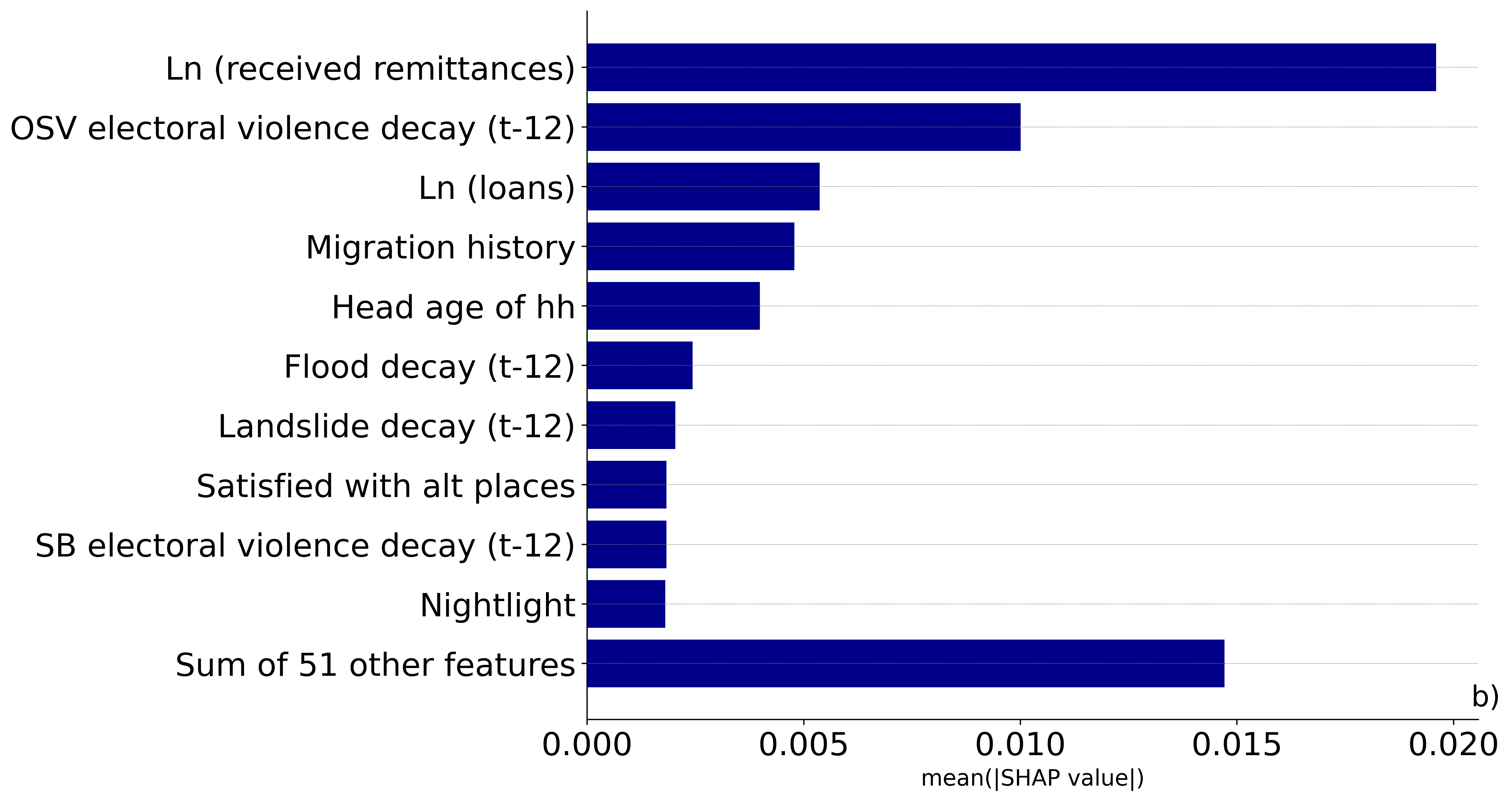
Study IV examines household migration in Bangladesh between 2011 and 2018 and shows that models incorporating both political violence and natural hazards predict mobility in Bangladesh better than models considering either type of pressure alone (Leis and Petrova, 2026). Figure 1 provides an overview of the key predictors included in the “Full Distress model” based on mean SHAP values, a model-agnostic technique for interpreting machine-learning models that measures how strongly each predictor contributes to the model’s predictions on average. In that sense, higher values indicate features that have a greater overall influence on the predicted probability of household migration. In addition to household characteristics (such as received remittances, loans and existing migration history), the figure highlights the prominent role of one-sided electoral violence and floods in the context of predicting household migration in Bangladesh.
Figure 1. Most influential predictors of household migration in Bangladesh
Source: Author’s adaptation from Figure 3 in Leis and Petrova (2026).
Note: Mean absolute SHAP values indicate the average contribution of each predictor to the model’s predicted household migration probability. Violence and natural-hazard variables are measured with a twelve-month lag.
The study also finds evidence that violence and extreme weather events interact, suggesting that their combined effects cannot always be understood by simply adding their separate effects together. At the same time, these relationships vary with household resources: remittances are associated with a higher probability of migration under some forms of violence and extreme weather exposure, while loans are associated with lower mobility following recent exposure to violence or landslides.
These findings highlight two sources of heterogeneity. First, political violence can interact with environmental pressures in ways that alter mobility responses. Second, households facing similar combinations of pressures may nevertheless respond differently depending on the resources and opportunities available to them. Conflict-related mobility therefore reflects both the combination and interaction of different pressures, and the capabilities households need to have to respond to them.
Conclusion
Overall, the dissertation shows that political violence shapes mobility in ways that are more varied than immediate displacement figures alone suggest. Conflict-related mobility can emerge in anticipation of future violence, through longer-term changes, or through the interaction of violence with other pressures such as natural hazards. At the same time, exposure to conflict-related insecurity does not automatically result in movement. Whether people can move depends on the resources, opportunities and constraints they face. The dissertation, therefore, points to the importance of understanding conflict-related mobility as a range of responses that are influenced by both the character of violence and the wider conditions in which it occurs. This reflects the dissertation’s overarching conclusion that mobility is shaped by violence characteristics, risk perception, longer-term erosion, compound pressures and the capabilities that enable or constrain movement (Leis, 2025). The findings also caution against assuming that different forms of political violence generate the same mobility responses, since their relevance varies across contexts and types of movement.
For humanitarian and development actors, this means looking earlier, beyond immediate displacement, over longer time horizons, and considering the wider context in which mobility occurs. Looking earlier begins with using more detailed information about conflict dynamics in early-warning systems. Tracking how violence evolves over time and space, and which actors are involved, can improve forecasts of large refugee and asylum seeker outflows and provide additional information for contingency planning and resource allocation. It also requires looking beyond places where violence or displacement has already been recorded. Violence developing in surrounding or connected areas may signal where mobility will occur next, allowing emerging needs to be identified before local violence is observed. Looking beyond immediate displacement means recognising that low levels of observed movement do not necessarily imply low levels of insecurity or vulnerability; conflict may also disrupt previously existing mobility corridors or leave some households with limited opportunities to move. Looking over longer time horizons means considering how violence can gradually reshape population distributions and the conditions that make it possible to remain in a place. As these effects can vary substantially within countries, recovery and development planning should also consider where populations are growing or declining over time rather than relying only on national totals. Finally, considering the wider context means recognising that violence may combine with other pressures, such as natural hazards, and that the effects of these pressures depend partly on the resources and opportunities households have to respond through movement.
For Swedish development cooperation, the findings point not to a single intervention but to several principles for how conflict-related mobility can be incorporated into analysis and programming. Development cooperation can benefit from supporting conflict and mobility early-warning systems that use more detailed information about how violence evolves; combining conflict analysis with assessments of environmental pressures and household vulnerability; and planning for demographic and development consequences that extend beyond periods of acute displacement. The findings also caution against assuming that populations who remain in conflict-affected areas are necessarily less affected than those who move.
Policy recommendations
Development cooperation efforts should incorporate the following considerations when designing forecasting tools, early-warning systems, and mobility-related programmes:
- Look beyond aggregate conflict indicators. How organised violence develops over time and space and which actors are involved can provide additional information about future mobility and directly improve forecasting models.
- Anticipate rather than only react. Organised violence in surrounding and connected areas may provide early warning signals of mobility before local violence is recorded.
- Plan beyond immediate displacement. State-based and non-state violence can reshape population distributions over several years, affect different areas within countries unevenly, and may also disrupt mobility that would otherwise have occurred.
- Account for overlapping pressures and unequal capabilities. Political violence and natural hazards can combine in shaping mobility, while household resources and opportunities can affect whether people are able to respond through movement.
- Do not equate low mobility with low vulnerability. Limited movement may in some settings reflect constrained opportunities, disrupted mobility, or limited capabilities rather than an absence of pressure.
References
Balcells, L. and Steele, A. (2016). Warfare, political identities, and displacement in Spain and Colombia. Political Geography, 51, pp. 15–29.
Braithwaite, A., Cox, J.M. and Ghosn, F. (2021). Should I stay or should I go? The decision to flee or stay home during civil war. International Interactions, 47(2), pp. 221–236.
Buhaug, H. and von Uexkull, N. (2021). Vicious Circles: Violence, Vulnerability, and Climate Change. Annual Review of Environment and Resources, 46, pp. 545–568.
Carling, J. (2002). Migration in the age of involuntary immobility: Theoretical reflections and Cape Verdean experiences. Journal of Ethnic and Migration Studies, 28(1), pp. 5–42.
Carling, J. and Schewel, K. (2018). Revisiting aspiration and ability in international migration. Journal of Ethnic and Migration Studies, 44(6), pp. 945–963.
Davenport, C., Moore, W. and Poe, S. (2003). Sometimes You Just Have to Leave: Domestic Threats and Forced Migration, 1964–1989. International Interactions, 29(1), pp. 27–55.
Engel, S. and Ibáñez, A.M. (2007). Displacement Due to Violence in Colombia: A Household-Level Analysis. Economic Development and Cultural Change, 55(2), pp. 335–365.
Erdal, M.B., Mjelva, M.B. and Tollefsen, A.F. (2025). Conceptualizing and Measuring Conflict-Related Determinants of Migration. Journal of Immigrant & Refugee Studies, pp. 1–16.
Erdal, M.B. and Oeppen, C. (2018). Forced to leave? The discursive and analytical significance of describing migration as forced and voluntary. Journal of Ethnic and Migration Studies, 44(6), pp. 981–998.
Fontana, M. et al. (2025). Anticipating human mobility: Methods, data, and policy in forecasting and foresight. Data & Policy, 7, e70.
de Haas, H. (2021). A theory of migration: the aspirations-capabilities framework. Comparative Migration Studies, 9(1), 8.
Kjærum, A. and Madsen, B.S. (2025). Pushing the boundaries of anticipatory action using machine learning. Data & Policy, 7, e8.
Kosyakova, Y., Kogan, I. and van Tubergen, F. (2025). Multidimensional effects of conflict-induced violence on wartime migration decisions: evidence from Ukraine. Journal of Peace Research, 62(6), pp. 2088–2106.
Leis, M. (2025). Signals of Violence, Patterns of Flight: Predicting and Explaining Conflict-Related Mobility. Doctoral thesis. Uppsala University.
Leis, M. and Petrova, K. (2026). Combined models of violent conflict and natural hazards improve predictions of household mobility in Bangladesh. Communications Earth & Environment, 7, 67.
Lubkemann, S.C. (2008). Involuntary Immobility: On a Theoretical Invisibility in Forced Migration Studies. Journal of Refugee Studies, 21(4), pp. 454–475.
Melander, E. and Öberg, M. (2006). Time to Go? Duration Dependence in Forced Migration. International Interactions, 32(2), pp. 129–152.
Melander, E. and Öberg, M. (2007). The Threat of Violence and Forced Migration: Geographical Scope Trumps Intensity of Fighting. Civil Wars, 9(2), pp. 156–173.
Moore, W.H. and Shellman, S.M. (2006). Refugee or Internally Displaced Person?: To Where Should One Flee? Comparative Political Studies, 39(5), pp. 599–622.
Schon, J. (2015). Focus on the Forest, Not the Trees: A Changepoint Model of Forced Displacement. Journal of Refugee Studies, 28(4), pp. 437–467.
Schutte, S., Vestby, J., Carling, J., Buhaug, H. (2021). Climatic conditions are weak predictors of asylum migration. Nat Commun 12, 2067.
See, S., Opdyke, A. and Banki, S. (2026). A review of the climate change-disaster-conflict nexus and humanitarian framing of complex displacement contexts. Climate and Development, 18(3), pp. 240–253.
Tai, X.H., Mehra, S. and Blumenstock, J.E. (2022). Mobile phone data reveal the effects of violence on internal displacement in Afghanistan. Nature Human Behaviour, 6(5), pp. 624–634.
Turkoglu, O. (2022). Look who perpetrates violence and where: Explaining variation in forced migration. Political Geography, 94, 102558.
Turkoglu, O. and Chadefaux, T. (2019). Nowhere to go? Why do some civil wars generate more refugees than others? International Interactions, 45(2), pp. 401–420.
UNHCR (2026). Global Trends Report 2025. United Nations High Commissioner for Refugees, [Online], Available: https://www.unhcr.org/media/global-trends-2025-report
UNRIC (2025). Humanitarian aid: the most vulnerable already severely impacted by budget cuts, [Online], Available: https://unric.org/en/humanitarian-aid-the-most-vulnerable-already-severely-impacted-by-budget-cuts/
About the report
Please refer to the present paper as: Leis, Maxine (2026), Signals of Violence, Patterns of Flight: Predicting and Explaining Conflict-Related Mobility, Development Dissertation Brief 2026:10. The Expert Group for Aid Studies (EBA), Sweden.
Development Dissertation Brief, 2026:10 to The Expert Group for Aid Studies (EBA)
The Expert Group for Aid Studies – EBA – is a Government committee analysing and evaluating Swedish international development aid.