


Summary
Associational power-sharing is ethnic power-sharing without ethnic parties. Long overlooked in the academic literature, it is the most common form of power-sharing in Africa. In such cases, ethnicity remains politicized but matters within rather than between political parties. Ethnic conflict is managed by reorienting political alliances away from ethnicity altogether, appeasing ethnic campaigning, reassuring against exclusion and demobilising violent actors. This brief summarises a dissertation from 2026 that conceptualises, maps, and assesses associational power-sharing, building on an original dataset of power-sharing in Africa (1990–2020) and case studies of Burundi and Mauritius. By doing so, it addresses a central question in the literature on peace and conflict research: why does ethnic power-sharing deliver peace in some divided societies but not others? While existing literature has suggested that these variations could be explained by the different logics of consociational and centripetal power-sharing – two types of power-sharing rooted in ethnically-segmented party systems – this dissertation sheds light on the potential of multi-ethnic coalitions rooted in cross-ethnic party systems. This new research shows that associational power-sharing is associated with a lower likelihood of ethnic conflict onset and longer spells of peace than its counterparts. Yet the absence of ethnic parties leaves minorities without autonomous representative channels, which can limit the quality of their political representation. The brief recommends considering associational power-sharing when designing peace agreements and constitutions in divided societies – but also accompanying them with targeted support to intra-party democracy and minority civil society organisations.
Alexandre Wadih Raffoul is Lecturer in War Studies at the Swedish Defence University. He holds a PhD in Peace and Conflict Research from Uppsala University (2026). His dissertation, The Logic of Multi-Ethnic Coalitions: Power-sharing, Party Systems, and Ethnic Conflict Management, conceptualises, maps, and assesses associational power-sharing as a tool for ethnic conflict management. He previously worked as a researcher for the Swiss Foundation for Peace (swisspeace). His work has been published in Ethnopolitics, Nationalism and Ethnic Politics, and Nations and Nationalism.
Background and rationale
Over the past decade, the world has experienced a record number of ongoing armed conflicts, and fatalities have returned to levels not seen since the Rwandan genocide in 1994 (Davies et al., 2026). Many of the deadliest eruptions of large-scale violence – in Sudan, South Sudan, the Democratic Republic of Congo, Syria, Gaza, and India – have an ethnic dimension. In such ethnic conflicts, armed organisations recruit and make claims on behalf of ethnic categories, and victims are targeted on the basis of their national, racial or religious identity. Ethnic conflict management – the effort to channel inter-ethnic struggles over power and territory into non-violent politics – is therefore at the centre of contemporary peacemaking (Wolff, 2006).
A common prescription for societies faced with politicised ethnicity is to adopt ethnic power-sharing, that is, to form multi-ethnic coalition governments where members of all major ethnic categories in the country are included and take decisions jointly (Lanz et al., 2019). Ethnic power-sharing reassures against ethnically based political exclusion, providing ground for peace and democratisation in divided societies (Cederman et al., 2022). Power-sharing arrangements have consequently become among the most common features of constitutions and peace agreements in conflict-affected societies (Strøm et al., 2017).
Yet power-sharing’s ability to deliver on its promise of peace in divided societies remains contested. While it has underpinned long-term stability in Mauritius, Northern Ireland and South Africa, power-sharing has institutionalised deficient governance and chronic instability in Bosnia and Herzegovina, Lebanon, and Iraq. In some cases, power-sharing pacts have even been followed by renewed violence, as in Rwanda (1993), Burundi (1994), and South Sudan (2015). A critical question is thus what explains these variations in the performance of power-sharing (Raffoul, 2019).
A key explanation is that power-sharing’s ability to manage ethnic conflict depends on the internal dynamics of the ruling coalition. The literature has focused on two types, each characterised by a distinct logic of ethnic conflict management (Raffoul, 2025b). Consociational power-sharing manages ethnic conflict by granting autonomous representation to every ethnic category in a post-electoral coalition of ethnic parties, within which elites negotiate solutions to inter-ethnic disputes (Lijphart, 1977). Centripetal power-sharing manages ethnic conflict by rewarding moderation: it incentivises the formation of pre-electoral coalitions of moderate ethnic parties, which can exclude ethnic hardliners from power (Horowitz, 1985; Reilly, 2001).
Although in fundamental disagreement on the best strategy for managing ethnic conflict, both approaches converge on the assumption that political parties are necessarily ethnic in ethnically diverse societies (Horowitz, 2014). Both consequently focus on multi-ethnic coalitions rooted in ethnically segmented party systems, in which most parties champion the interests of specific ethnic categories. Recent empirical findings have shown, however, that parties are often multi-ethnic – championing the interests of all ethnic categories without excluding any (Chandra, 2011) – even where ethnicity is highly politicised (Fraenkel & Crawley, 2025; Hamza & Maeda, 2025). These findings make a third type of power-sharing visible, associational power-sharing (Raffoul, 2020).
Associational power-sharing refers to multi-ethnic coalitions that emerge in cross-ethnic party systems, where most parties in both government and opposition are multi-ethnic. Put simply, associational power-sharing is ethnic power-sharing without ethnic parties. It manages ethnic conflict by reorienting political alliances away from ethnicity altogether, creating new divisions between co-ethnics and new solidarity links across ethnic categories. This restructuring of ethnic politics tends to appease ethnic campaigning, to reassure all ethnic categories against exclusion, and to raise obstacles to violent ethnic mobilisation – three mechanisms that are conducive to peace.
The dissertation summarised in this brief – entitled The Logics of Multi-Ethnic Coalitions. Power-Sharing, Party Systems, and Ethnic Conflict Management – conceptualises associational power-sharing, maps it empirically in Africa (1990–2020), and assesses its promises and challenges for the consolidation of peace in ethnically divided societies (Raffoul, 2026c). The analysis yields three findings. Associational power-sharing is the most common form of ethnic power-sharing in Africa. It is associated with a lower likelihood of ethnic conflict onset and with longer-lasting peace than its consociational and centripetal counterparts. Yet it faces a distinct challenge: representing minorities in ways that are meaningful rather than purely cosmetic.
Research aims and questions
This brief summarises the dissertation findings around three questions:
- Where and when does associational power-sharing occur in Africa?
- Is associational power-sharing associated with peace?
- What challenges does associational power-sharing create for ethnic conflict management?
The dissertation focuses on power-sharing practice rather than power-sharing institutions; de facto rather than de jure power-sharing (Bormann et al., 2019). Power-sharing as a practice is defined as a way of governing in which representatives of distinct constituencies are included in the same power organ and take decisions jointly. Power-sharing institutions, by contrast, are the formal or informal rules that mandate such practices. Power-sharing is a demanding practice (Stengers, 2010): its persistence requires constant effort by power-holders to reconcile their divergences and reach joint agreements. In the absence of elite cooperation, power-sharing governments are indeed paralysed – unable to govern and increasingly unlikely to maintain peace. Peace through power-sharing is accordingly never achieved once and for all. Its survival depends on ongoing negotiation between elites, and it remains at risk of collapse whenever elites fail to find negotiated solutions to emerging disputes (Raffoul, 2025a).
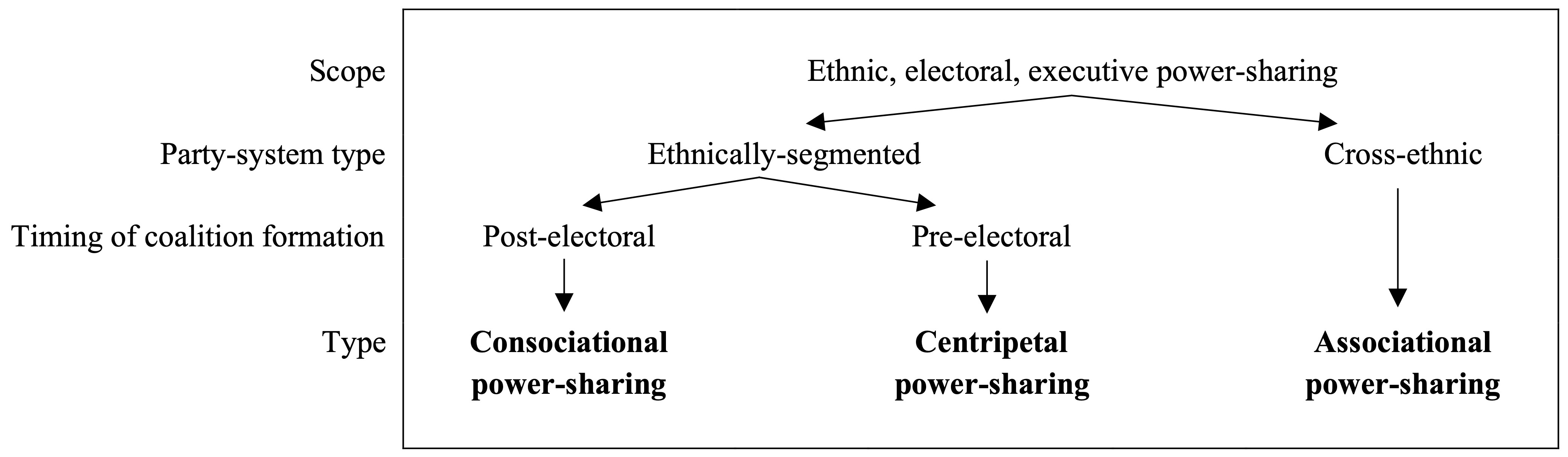
The dissertation deploys a mixed-methods research design. The quantitative analysis draws on an original dataset of all multi-ethnic coalition governments in Africa between 1990 and 2020, comprising 667 country-years across 34 countries. Africa is the region concentrating the most cases of ethnic power-sharing, and a region regularly affected by ethnic conflict. Coalition governments are identified using the Ethnic Power Relations (EPR) dataset, which provides expert-coded data on de facto access to executive power by politically relevant ethnic groups worldwide (Vogt et al., 2015). The dataset retains only relevant cases, in which ethnicity is politicised and no significant ethnic category is excluded from power. Each case is then classified as associational, consociational, or centripetal according to the logic of ethnic conflict management at play. These practical logics are indicated by two dimensions: the type of party system (ethnically-segmented or cross-ethnic) and the timing of coalition formation (pre- or post-electoral) (Figure 1). Party system type is based on original coding of every political party in the relevant cases, building on the EPR-Organisation coding scheme (Gremler & Weidmann, 2024; Vogt et al., 2021). The timing of coalition formation is derived from the Varieties of Party Identity and Organization (V-Party) dataset (Düpont et al., 2022). The data are analysed with survival models of peace duration (Raffoul, 2026b) and interactive logit models of ethnic conflict onset (Raffoul, 2026a).
The qualitative components focus on two cases of associational power-sharing: Burundi and Mauritius. In Burundi, associational power-sharing emerged from the Arusha Peace and Reconciliation Agreement (2000) and the 2005 Constitution, which brought an end to a ten-year civil war between Hutu and Tutsi and to decades of inter-ethnic massacres. The post-war institutions combined ethnic quotas in parliament with ethnic distribution requirements on electoral lists, which fostered the restructuring of political parties into multi-ethnic ones (Ndayiragije & Raffoul, 2024). In Mauritius, the run-up to independence triggered fears of permanent domination by the Hindu majority among the Creole, Muslim, and Chinese minorities. After a period of high inter-ethnic tensions and successive ethnic riots, the adoption in 1966 of an electoral system combining the block vote with multi-member, ethnically heterogeneous constituencies, gradually produced a party system composed almost exclusively of multi-ethnic parties (Carroll & Carroll, 1999). The data for Mauritius is drawn from extensive archival research in the Mauritian press and interviews with Mauritian civil society actors, while the Burundi case study builds on secondary sources.
In both cases ethnicity remains highly politicised but does not structure the party system: it matters within rather than between political parties. For instance, Mauritian parties anticipate ethnic voting and compose multi-ethnic electoral lists that closely mirror the ethnic demography of each district in order to attract the votes from every community (Couacaud et al., 2022). The dissertation uses process tracing of the founding elections in both countries to probe the causal mechanisms linking associational power-sharing to peace, and controversy mapping (Venturini & Munk, 2022) to study how minority representation functions in practice in Mauritius (Raffoul & Sookrajowa, 2026).
Figure 1: Overview of the typology of ethnic power-sharing
Source: Raffoul, 2026b.
Results and discussion
The findings relating to each of the three questions above are presented in this section.
Associational power-sharing is common in Africa
Drawing on the new dataset, the dissertation shows that associational power-sharing is the most frequent type of multi-ethnic coalitions in Africa between 1990 and 2020. Associational power-sharing occurred in 23 countries, representing 423 country-years (62% of the sample). By contrast, consociational power-sharing was present in 14 countries, for a total of 172 country-years (25%), and centripetal power-sharing in 10 countries, for a total of 91 country-years (13%). This predominance of associational power-sharing has remained stable over time (Raffoul, 2026b).
Cases of associational power-sharing span Sub-Saharan Africa (Figure 2). They are found in West Africa (Senegal, Mali, Ghana, Niger, Nigeria, Liberia, Togo, Benin, Guinea-Bissau, and Ivory Coast), in Central Africa (Cameroon and Gabon), in the Horn and East Africa (Djibouti, Ethiopia, Uganda, Burundi, and Tanzania), in Southern Africa (Botswana, Namibia, Zambia and Mozambique) and in the Indian Ocean (Madagascar and Mauritius). Durations differ widely, but long spells predominate: 11 of the 23 countries sustained the practice for 25 years or more, and in Botswana, Cameroon and Senegal associational power-sharing ran uninterrupted throughout the period covered by the data.
When multi-ethnic coalition governments are formed in Africa, they most often take place in cross-ethnic party systems. This descriptive finding – which resonates with other recent studies (Fraenkel & Crawley, 2025; Hamza & Maeda, 2025) – unsettles the long-standing assumption that African party systems are predominantly ethnically segmented (Horowitz, 2014). Moreover, the sustainability of associational power-sharing in many cases suggests that it may be a source of stability in divided societies. However, the presence of authoritarian regimes amongst the most stable cases suggests a potential tension between peace and democracy. The next two subsections explore associational power-sharing’s relationship to peace and political representation.
Figure 2. Map of associational power-sharing in Africa (1990–2020)
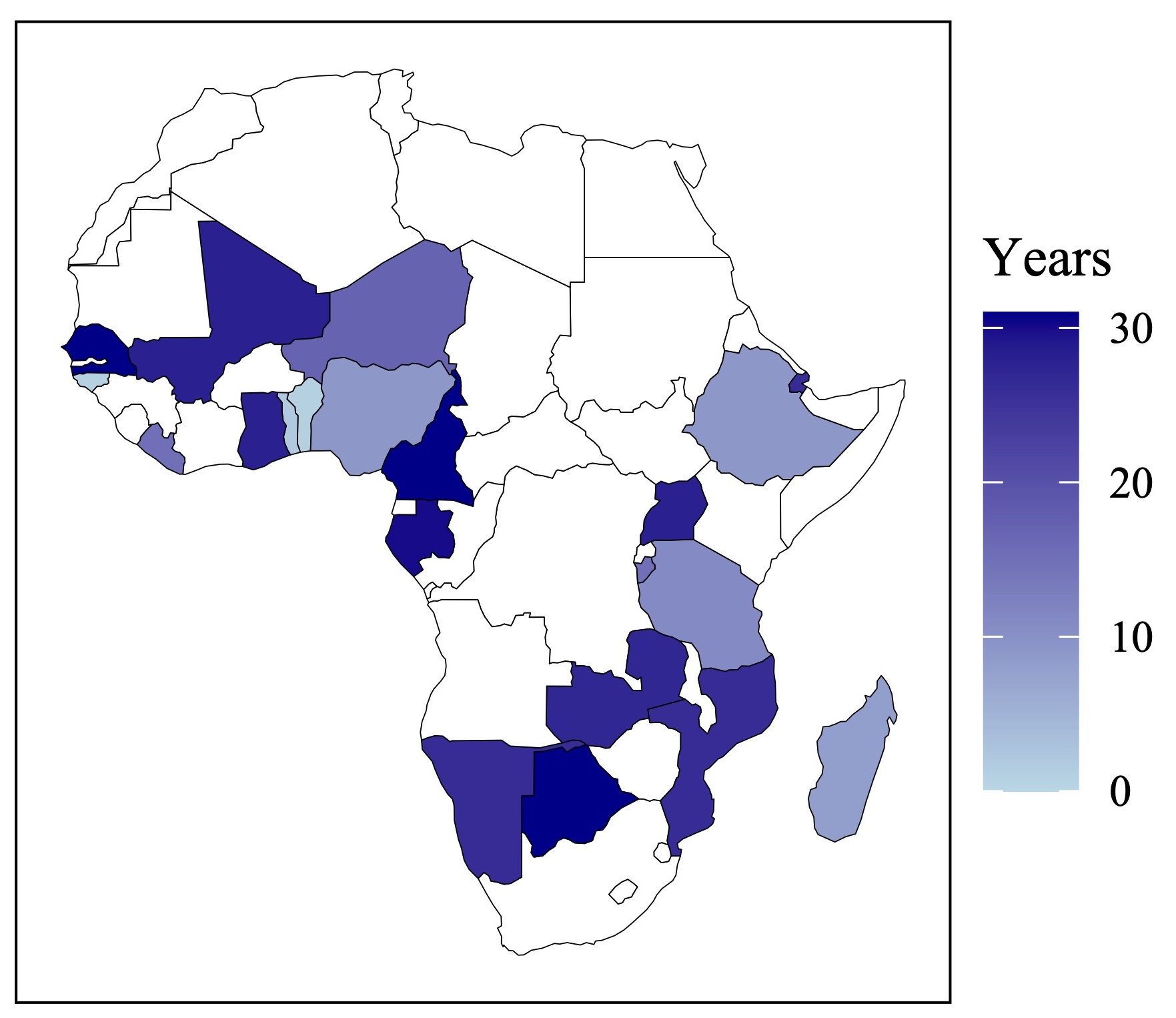
Source: Raffoul 2026b. Note: Mauritius not shown due to its size and location.
Associational power-sharing is associated with peace
The second set of findings concerns associational power-sharing’s relationship to peace. Quantitative studies establish general probabilistic patterns at the cross-national level, while case studies of “at risk” elections in Burundi (2005) and Mauritius (1976) serve to probe causal mechanisms.
At the cross-national level, the dissertation finds that, after controlling for a set of confounders, the risk of ethnic conflict onset is lower in countries using associational power-sharing than in countries that do not.[1] While the risk of ethnic conflict onset is 4.1% in country-years without associational power-sharing, it falls to 1.6% in country-years with associational power-sharing – a 61% reduction in relative risk. This association persists and even becomes stronger in contexts where ethnic conflict management is most needed, that is, in post-conflict periods and during post-conflict elections (Raffoul, 2026a).
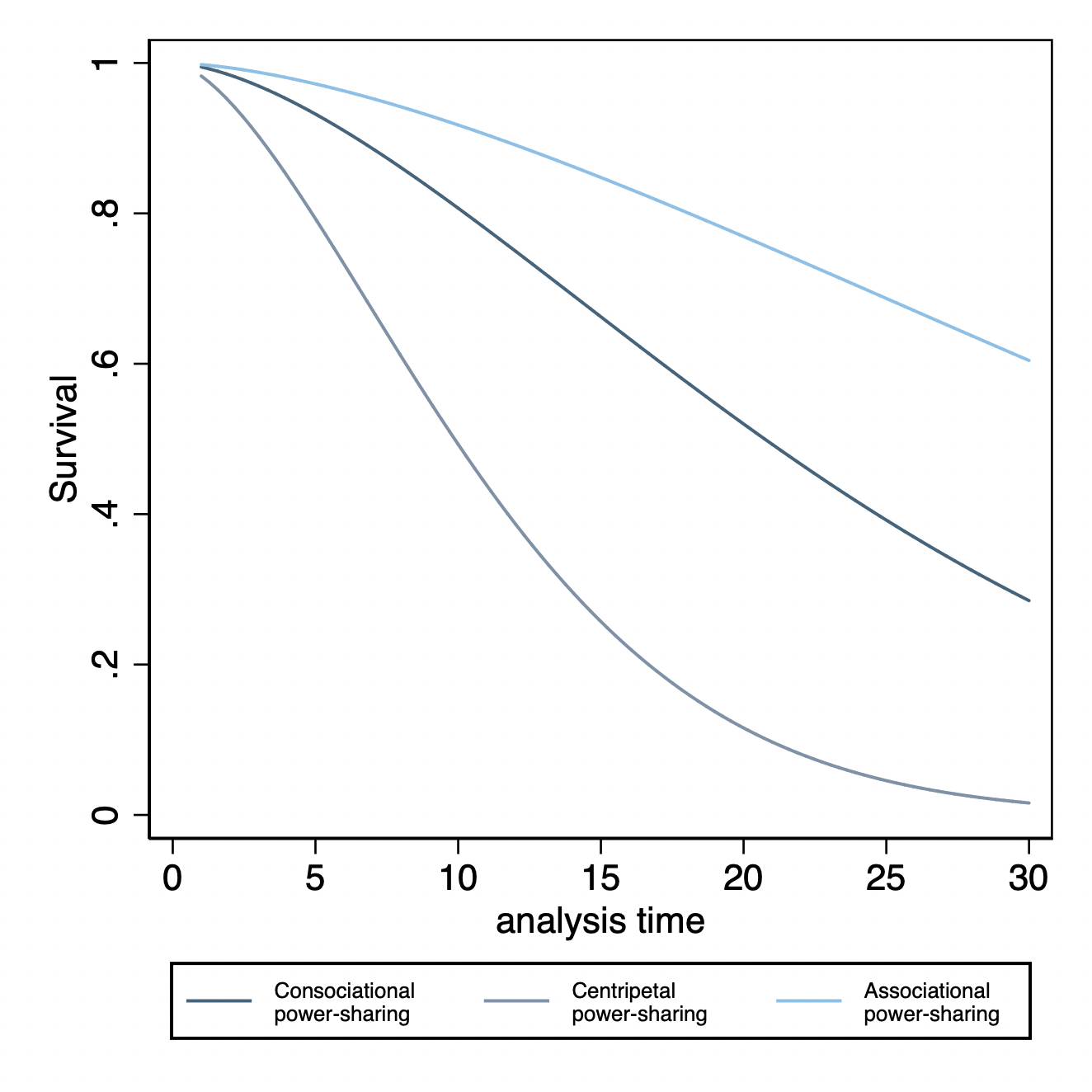
Figure 3. Predicted survival curves for associational, consociational, centripetal power-sharing, Weibull regression model
Source: Raffoul 2026b
In line with these findings, the dissertation also finds that associational coalitions are associated with longer periods of peace than consociational and centripetal coalitions, on average and controlling for relevant confounders (Figure 3). In other words, conflict onset tends to occur later (if at all) in countries that use associational power-sharing than in countries that use consociational or centripetal power-sharing, counting from the moment the coalition was formed. Ten years into a power-sharing episode, about 73% of associational power-sharing cases remain at peace, compared to roughly 44% of consociational and 41% of centripetal cases. The average observed peace duration up to the maximum observed time is about 18 years for associational, 13 years for centripetal, and 10 years for consociational power-sharing (Raffoul, 2026b).
The dissertation theorises three mechanisms through which associational power-sharing decreases the chances of an ethnic civil war breaking out: appeasement, reassurance, and demobilisation (Raffoul, 2026b).
Appeasement. Since multi-ethnic parties aim to attract votes from every community, they tend to avoid campaigning on ethnically contentious issues. Consequently, electoral campaigns tend to be less polarising in cross-ethnic party systems than in ethnically segmented ones, reducing the risk of escalation into inter-ethnic violence. In both Burundi and Mauritius, the last elections held in ethnically segmented party systems (in 1993 and 1967 respectively) had proven deeply divisive, with campaigns marked by ethnic fearmongering. Both resulted in post-electoral violence: an attempted coup and the outbreak of the civil war in Burundi; ethnic riots in Mauritius. After both countries restructured their party systems so that most parties became multi-ethnic, the electoral campaigns of 2005 and 1976 revolved around economic and governance issues – corruption, poor governance, and human rights in Burundi; economic development, wages, and land reform in Mauritius – that were far less ethnically polarising.
Reassurance. Since all major political parties are multi-ethnic in cross-ethnic party systems, voters from every major ethnic category know before elections that they will not be excluded from political power, whoever wins. These guarantees of representation, inscribed in the very structure of the party system, provide strong reassurance against a main cause of post-electoral escalation: rejection of results by losers. In both Burundi and Mauritius, the post-electoral violence observed in 1993 and 1967 resulted largely from fears of exclusion from power, exacerbated by ethnically polarised campaigns. In the subsequent elections of 2005 and 1976, held in cross-ethnic party systems, electoral results were accepted without such fears. In Burundi, Tutsi anxieties about political exclusion were appeased by the fact that formerly Hutu parties had been able to recruit and elect many Tutsi candidates. In Mauritius, the victory of the leftist Mauritian Militant Movement (MMM) was viewed as a threat to the economic interests of the sugar industry, but not as a risk of ethnic exclusion.
Demobilisation. While ethnic parties can equip rebel groups with the organisational structure, leadership, insider knowledge, and access to state resources and patronage networks necessary for violent ethnic escalation, multi-ethnic parties are less able and less willing to do so. Consequently, they tend to restrain armed groups rather than empower them. In Burundi, the ties between the former single party, the Tutsi-dominated Union for National Progress (UPRONA), and the Burundian Armed Forces, were a key enabler of the violent rejection of the 1993 electoral results. By contrast, in 2005, the former rebel group CNDD-FDD made efforts to limit the violence potential of its former combatants, absorbing them into the party and the intelligence services rather than mobilising them for violence. With no civil war behind it, Mauritius offered no former armed groups to demobilise, suggesting that the demobilisation mechanism is most relevant in post-conflict settings.
Taken together, these findings suggest that associational power-sharing and cross-ethnic party systems offer a promising avenue for managing ethnic conflict in divided societies, including in post-war contexts and during transitional elections.
Associational power-sharing faces the challenge of tokenistic minority representation
Despite these promising findings, associational power-sharing also faces a key challenge as a tool for ethnic conflict management: ensuring the substantive representation of minorities through multi-ethnic parties.
A long-running concern with multi-ethnic parties in ethnically-divided societies is indeed that they might provide inadequate channels for ethnic representation (Bogaards, 2014; Lijphart, 1977). In ethnically-segmented party systems, ethnic minorities have their own ethnic parties to channel their interests in a coalition government. In cross-ethnic party systems, however, they have no choice but to seek representation through multi-ethnic parties in which they are typically also a minority. The key risk is that minorities obtain merely cosmetic representation, where multi-ethnic parties field minority candidates to appear inclusive but do not grant them genuine decision-making power. In such cases, exclusion can hide under the pretences of inclusion (Agarin, 2020). Such a lack of meaningful representation for minorities is both a democratic concern and a threat to peace, as minorities frustrated by de facto exclusion may eventually resort to violence.
This problem is prevalent in Burundi. Already during the negotiations of the Arusha Agreement, Tutsi negotiators voiced concerns about the system of ethnic quotas promoting multi-ethnic parties, preferring a system where Tutsis would be represented by their own ethnic parties. Their key concern was that, on multi-ethnic lists, “‘unrepresentative Tutsis’ would be elected instead of Tutsis who have the confidence of the Tutsis” (Draft of the Arusha Agreement, cited in Vandeginste & Raffoul, 2023, p. 3). In other words, they feared the elected Tutsis would be selected by Hutu-dominated parties and Hutu voters, giving them limited legitimacy amongst the Tutsi themselves and a limited ability to defend Tutsi interests specifically. These concerns proved well-founded. As political competition effectively restructured itself around opposing Hutu-dominated parties, an increasing number of Tutsis elected in post-war elections were candidates on Hutu-dominated lists – raising concerns about the quality of Tutsi representation (Ndayiragije & Raffoul, 2024).
The dissertation however shows that, if such tokenism is a challenge, it is not a fate. To understand how the risk of tokenistic representation can be mitigated in associational power-sharing systems, it examines how the Mauritian Creole minority was able to achieve substantive representation against the odds in the 2000s. After decades of tokenistic inclusion in the country’s multi-ethnic parties, Mauritian Creoles – descendants of enslaved people and one of the island’s demographic minorities – succeeded in obtaining various policy concessions, most notably securing a Truth and Justice Commission on the legacy of slavery and indentured labour in 2008. The dissertation maps the controversy about the so-called malaise créole (Créole uneasiness) to study how this outcome was obtained in practice (Raffoul & Sookrajowa, 2026).
It finds that Creole activists leveraged three features of associational power-sharing to obtain representation through multi-ethnic parties. First, they used multi-ethnic parties’ recognition of ethnicity, to claim recognition for the Creoles on par with other communities. Second, they leveraged multi-ethnic parties’ dependence on minority votes to craft pre-electoral alliances with multi-ethnic parties, trading Creole votes in exchange for placing Creole demands on the electoral programmes. Third, they used the fact that both governmental and opposition parties were multi-ethnic to strategically shift alliances over time – at times collaborating with the opposition to pressure governments which they formally supported. Using these three strategies, Creole activists and politicians were able to build an increasingly broad coalition in support of the Truth and Justice Commission, leading to the adoption of the policy by consensus in 2008.
If associational power-sharing is indeed vulnerable to tokenistic representation, it nevertheless also presents some features that minorities can leverage to achieve representation of their substantive interests. What distinguishes the cases where representation becomes substantive appears to be the strength and strategic capacity of the civil society organisations that represent ethnic minorities.
Conclusion and recommendations
Why does ethnic power-sharing deliver peace in some divided societies but not others? This brief argues that one explanation lies in the logic of conflict management that underpins multi-ethnic coalitions. What matters is not only whether, but also how ethnic categories are included in government. While the literature has focused on power-sharing between ethnic parties, the dissertation sheds light on cases of ethnic power-sharing without ethnic parties – a phenomenon captured by the concept of associational power-sharing. In these cases, ethnicity remains highly politicised, but it does not structure the party system. It matters within, rather than between, political parties. The dynamic of inter-ethnic interactions is dramatically reshaped, which opens distinct opportunities for peace and development but also creates specific challenges.
By conceptualising, mapping and assessing associational power-sharing, the dissertation arrives at three main findings. First, associational power-sharing is the most frequent type of power-sharing in Africa (1990–2020). Second, it is associated with a lower likelihood of conflict onset and longer spells of peace than its consociational and centripetal counterparts, managing ethnic conflict by appeasing ethnic campaigning, reassuring voters against exclusion, and demobilising entrepreneurs of violence. Third, the very feature that gives associational power-sharing its strength – the absence of ethnic parties – sometimes deprives minorities of a representation channel of their own, exposing them to representation that is more cosmetic than substantive.
While these findings apply primarily to the region and the time frame under study, associational power-sharing as a concept and a tool for ethnic conflict management is likely to be relevant in other divided societies.
These findings lay the ground for three recommendations for development and aid practitioners.
Recommendation 1: Consider associational power-sharing as an option when designing peace agreements, constitutions, and electoral systems
When societies struggle with ethnic conflict, a typical prescription is ethnic power-sharing. This brief shows that the structure of the party system in which power-sharing coalitions are embedded is a consequential and often underappreciated design decision. Sharing power in a cross-ethnic party system is often both feasible and desirable. Accordingly, associational power-sharing should be considered when designing political institutions to manage ethnic conflict. While institutional design decisions are always context-dependent and should ultimately be taken by the conflict parties themselves, associational power-sharing is an additional option in the menu of ethnic conflict management practices available to mediators and negotiators.
Associational power-sharing can be institutionalised through two complementary principles (Raffoul, 2020). First, institutions must provide each ethnic category with credible guarantees of representation, which make it possible to reorient political alliances across ethnic lines. Second, institutions must create incentives for that reorientation by making it electorally advantageous for parties to be multi-ethnic. Alliance-shifting mechanisms of this kind – constituency pooling, ethnic distribution requirements on closed lists – merit more serious consideration as instruments of ethnic conflict management (Reilly & Nordlund, 2008). Simply removing references to ethnicity or banning ethnic parties outright does not appear sufficient to institutionalise associational power-sharing (Bogaards et al., 2013).
Syria is a case where institutions mandating associational power-sharing could be considered. Following the fall of the Assad regime, the country faces the twin challenge of drafting a new constitution and building a new party system. A highly sensitive political issue in the transition is the political party law (Khalaf, 2025). The constitutional declaration, ratified by President al-Sharaa on 13 March 2025 and building on the National Dialogue Conference held in February 2025, establishes that political parties should not be formed on regional, ethnic, or sectarian bases, but rather on a national basis (Syrian Arab Republic, 2025, p. Art. 14). This provision could be read as signalling a desire to institutionalise an associational power-sharing party system. However, if left at the level of a declaration of intent, such a constitutional provision has little chance of influencing the structure of the party system – and could even be instrumentalised to ban opposition parties. A coherent system of guarantees and incentives is needed to achieve associational power-sharing, and external support might be required to identify the best way to institutionalise it in Syria.
Recommendation 2: In cases of associational power-sharing, support intra-party democracy
Ruling jointly across ethnic lines is hard work and especially so in post-conflict contexts. Power-holders are required to show self-restraint, a capacity to compromise, and a willingness to make concessions to achieve consensual decisions. For these reasons, external mediation support for power-sharing is often needed – not only during peace negotiations, but also to facilitate the day-to-day operation of coalition governance and to defuse crises when they erupt (Lanz et al., 2019; McCulloch & McEvoy, 2019).
In cases of associational power-sharing, that support takes a specific form because the locus of inter-ethnic bargaining lies within political parties rather than between them. Critical issues include intra-party decision-making about policy platforms, leadership nomination, and electoral list composition. The quality of ethnic conflict management therefore depends to a great extent on how democratically multi-ethnic parties conduct their internal affairs. Where one community captures intra-party decision-making bodies, openly multi-ethnic parties covertly reproduce ethnic exclusion. Conversely, where internal procedures are transparent and contested, ethnic accommodation becomes a routine of party life.
Support for intra-party democracy is therefore a direct contribution to ethnic conflict management in these contexts. Since associational power-sharing is associated with peace but does not automatically lead to democratisation, such support is also an essential measure for preventing an authoritarian turn. It can take the form of capacity-building on transparent candidate selection procedures and internal dispute resolution mechanisms; independent audits of party membership and policy platforms; and support for youth and women’s party wings. This work sits primarily with democracy assistance actors. Swedish party-affiliated organisations also have a long history of providing comparable support to sister parties abroad.
Recommendation 3: In cases of associational power-sharing, support civil society organisations that represent ethnic minorities
Even when multi-ethnic parties display high levels of intra-party democracy, associational power-sharing systems may still struggle to provide meaningful representation to ethnic minorities. As this brief has shown, minorities in cross-ethnic party systems have no ethnic parties of their own and must pursue their interests through multi-ethnic parties in which they are also a minority. Their concerns are easily sidelined in parties where their votes carry little weight. Frustration with cosmetic representation through multi-ethnic parties, and the accumulation of unaddressed minority grievances, can prove destabilising in such systems.
A dynamic civil society representing ethnic minorities is, therefore, essential to prevent this sidelining and to ensure substantive minority representation. Associational power-sharing removes ethnic representation from the party system, and that representation must consequently be secured elsewhere. Through agenda-setting work, the crafting of electoral alliances, and the leveraging of peaceful protest, these organisations can ensure that minority interests are genuinely represented in government and taken up in policy. This work is essential not only from the perspective of political stability, but also for the democratic quality of polities using associational power-sharing.
In many contexts, these organisations operate in difficult conditions, with limited resources and at times under repressive governments. External support is accordingly essential to empower them and to enhance the performance of associational power-sharing. Human Rights Defender instruments, framed by dedicated EU Guidelines and rooted in long-standing Swedish expertise, are highly relevant in difficult contexts, where minority activists may require emergency funds, relocation support, trial monitoring, and embassy accompaniment. Support to minority-language and community media matters equally, whether through funding, capacity-building in investigative journalism, or assistance with journalist safety and legal defence.
Ethnic power-sharing without ethnic parties is possible, and, from the perspective of peace, often desirable. As such, associational power-sharing is now available as an additional option of ethnic conflict management practices. Yet, it promises no smooth sailing towards peace. Ruling by multi-ethnic coalition is always challenging, and associational power-sharing is no exception. External support adjusted to its specific logic and its specific challenges can thus play a decisive role in helping it realise its full potential for peace.
References
Agarin, T. (2020). The limits of inclusion: Representation of minority and non-dominant communities in consociational and liberal democracies. International Political Science Review, 41(1), 15–29.
Bogaards, M. (2014). Democracy and Social Peace in Divided Societies: Exploring Consociational Parties. Palgrave MacMillan.
Bogaards, M., Basedau, M., & Hartmann, C. (2013). Ethnic Party Bans in Africa. Routledge.
Bormann, N.-C., Cederman, L. E., Gates, S., Graham, B. A., Hug, S., Strøm, K. W., & Wucherpfennig, J. (2019). Power sharing: Institutions, behavior, and peace. American Journal of Political Science, 63(1), 84–100.
Carroll, B. W., & Carroll, T. (1999). The consolidation of democracy in Mauritius. Democratization, 6(1), 179–197.
Cederman, L.-E., Hug, S., & Wucherpfennig, J. (2022). Sharing Power, Securing Peace: Ethnic Inclusion and Civil War. Cambridge University Press.
Chandra, K. (2011). What is an ethnic party? Party Politics, 17(2), 151–169.
Couacaud, L., Sookrajowa, S. S., & Narsoo, J. (2022). The vicious circle that is Mauritian politics: The legacy of Mauritius’s electoral boundaries. Ethnopolitics, 21(1), 48–79.
Davies, S., Pettersson, T., & Öberg, M. (2026). Organized violence 1989–2025, and violent political protests. Journal of Peace Research, 63(4), 705–723.
Düpont, N., Kavasoglu, Y. B., Lührmann, A., & Reuter, O. J. (2022). A global perspective on party organizations. Validating the varieties of party identity and organization dataset (V-Party). Electoral Studies, 75, 102423.
Fraenkel, J., & Crawley, S. (2025). Does Ethnic Fractionalization Lead to Polarization? Introducing a new Dataset on Communal Party Affiliations. Ethnopolitics, (online only), 1–23.
Gremler, F., & Weidmann, N. B. (2024). Ethnic politics via digital means: Introducing the Ethnic Organizations Online dataset. Journal of Peace Research, (online only).
Hamza, A., & Maeda, K. (2025). Beyond binary: A new measure of party ethnicization. Party Politics, 13540688251376485.
Horowitz, D. L. (1985). Ethnic Groups in Conflict. University of California Press.
Horowitz, D. L. (2014). Ethnic power sharing: Three big problems. Journal of Democracy, 25(2), 5–20.
Khalaf, B. (2025, 19/05/2025). Syria awaits a political parties law. Enab Baladi. https://perma.cc/7GDX-MMXB
Lanz, D., Nathan, L., & Raffoul, A. (2019). Negotiations, Continued: Ensuring the Positive Performance of Power-Sharing Arrangements (Special Report, Issue 455).
Lijphart, A. (1977). Democracy in Plural Societies: A Comparative Exploration. Yale University Press.
McCulloch, A., & McEvoy, J. (2019). ‘Bumps in the road ahead’: How external actors defuse power-sharing crises. Journal of Intervention and Statebuilding, 13(2), 216–235.
Ndayiragije, R., & Raffoul, A. (2024). “The unloved child matures”: Power-sharing in Burundi. In E. W. Aboultaif, S. Keil, & A. McCulloch (Eds.), Power-Sharing in the Global South: Patterns, practices and potentials (pp. 285–308). Palgrave Macmillan.
Raffoul, A. W. (2019). Tackling the power-sharing dilemma? The role of mediation (report, Issue 2019/1). swisspeace.
Raffoul, A. W. (2020). The Politics of Association: Power-Sharing and the Depoliticization of Ethnicity in Post-War Burundi. Ethnopolitics, 19(1), 1–18.
Raffoul, A. W. (2025a). Practicing Power‐Sharing: How Political Adversaries (Fail to) Rule Jointly. Nations and Nationalism, (online only).
Raffoul, A. W. (2025b). Unstable Concepts, Unresolved Controversies: Reassembling Power-Sharing, Consociationalism, and Centripetalism. Nationalism and Ethnic Politics, 31(3), 313–331.
Raffoul, A. W. (2026a). Appeasement, Reassurance, and Demobilisation: How Cross-Ethnic Party Systems Prevent Ethnic Conflict Onset. In The Logics of Multi-Ethnic Coalitions. Power-Sharing, Party Systems, and Ethnic Conflict Management. Report / Department of Peace and Conflict Research 136.
Raffoul, A. W. (2026b). Associational Power-Sharing: Managing Ethnic Conflict with Cross-Ethnic Party Systems. In The Logics of Multi-Ethnic Coalitions. Power-Sharing, Party Systems, and Ethnic Conflict Management. Report / Department of Peace and Conflict Research 136.
Raffoul, A. W. (2026c). The Logics of Multi-Ethnic Coalitions. Power-Sharing, Party Systems, and Ethnic Conflict Management. Uppsala Universitet, Uppsala.
Raffoul, A. W., & Sookrajowa, S. S. (2026). Minority Representation via Cross-Ethnic Party Systems: Following the Malaise Créole in Mauritius. In The Logics of Multi-Ethnic Coalitions. Power-Sharing, Party Systems, and Ethnic Conflict Management. Report / Department of Peace and Conflict Research 136.
Reilly, B. (2001). Democracy in Divided Societies: Electoral Engineering for Conflict Management. Cambridge University Press.
Reilly, B., & Nordlund, P. (2008). Political Parties in Conflict-Prone Societies: Regulation, Engineering and Democratic Development. United Nations University Press.
Stengers, I. (2010). Cosmopolitics I & II. University of Minnesota Press.
Strøm, K. W., Gates, S., Graham, B. A., & Strand, H. (2017). Inclusion, dispersion, and constraint: Powersharing in the world’s states, 1975–2010. British journal of political science, 47(1), 165–185.
Syrian Arab Republic. (2025). Constitutional Declaration of the Syrian Arab Republic (Unofficial English translation). ConstitutionNet. https://constitutionnet.org/vl/item/constitutional-declaration-syria-2025
Vandeginste, S., & Raffoul, A. W. (2023). Mission accomplished? The evaluation of ethnic quotas in Burundi (Egmont Policy Brief, Issue 317).
Venturini, T., & Munk, A. K. (2022). Controversy Mapping: A Field Guide. Polity Press.
Vogt, M., Bormann, N.-C., Rüegger, S., Cederman, L.-E., Hunziker, P., & Girardin, L. (2015). Integrating data on ethnicity, geography, and conflict: The ethnic power relations data set family. Journal of Conflict Resolution, 59(7), 1327–1342.
Vogt, M., Gleditsch, K. S., & Cederman, L.-E. (2021). From claims to violence: Signaling, outbidding, and escalation in ethnic conflict. Journal of Conflict Resolution, 65(7–8), 1278–1307.
Wolff, S. (2006). Ethnic Conflict. Oxford University Press.
- The control variables include GDP per capita, population size, years since last conflict episode, number of previous conflict onsets, group concentration, ethnic fractionalisation, liberal democracy index, dispersive power-sharing, and former coloniser. ↑
About the report
Development Dissertation Brief, 2026:09 to The Expert Group for Aid Studies (EBA)
Please refer to the present paper as: Raffoul, Alexandre Wadih (2026), Ethnic Power-Sharing without Ethnic Parties: An Overlooked Source of Peace in Africa, Development Dissertation Brief 2026:09. The Expert Group for Aid Studies (EBA), Sweden.
The Expert Group for Aid Studies – EBA – is a Government committee analysing and evaluating Swedish international development aid.