


To what extent has Swedish support to Mozambique managed to remain relevant over decades – despite major political, economic, environmental and social shifts in that country? Has aid been both flexible and long-term enough? The current report evaluates the period 2005–2026.
Foreword by EBA
Development cooperation is necessarily a long-term undertaking, but the circumstances in which it operates can change dramatically. Mozambique illustrates this challenge. Following the 1992 peace agreement, the country experienced sustained economic growth and improvements in social conditions. Yet it remained among the world’s poorest countries, with the benefits of growth unevenly distributed.
Since the 2010s, political tensions, the 2016 hidden-debt scandal and economic setbacks have complicated development efforts. Armed conflict in the northern province, together with severe cyclones and other climate-related shocks, has intensified humanitarian needs. At the same time, major natural gas discoveries have raised both expectations and governance challenges.
Mozambique has long been a significant partner country for Sweden. Covering 2005–2026, this EBA evaluation explores whether Swedish development cooperation has adapted to profound changes in Mozambique while maintaining its long-term objectives. Its focus is on relevance and coherence: whether interventions, partnerships and forms of support have remained appropriate and mutually consistent. These are necessary, though not sufficient, conditions for achieving lasting results.
During the evaluation, the Swedish Government decided to end bilateral development cooperation with Mozambique by August 2026. The study therefore also examines how this phase-out was planned and carried out, and its implications for programmes, partner organisations and future relations between the two countries.
We hope the report will inform both reflection on Sweden’s engagement in Mozambique and wider discussions about adapting development cooperation to changing circumstances and concluding long-standing partnerships responsibly. A reference group chaired by EBA member Anna Mia Ekström has accompanied the evaluation. The authors are solely responsible for the report’s contents.
Stockholm, October 2026
Torbjörn Becker Anna Mia Ekström
Summary
This evaluation assesses Swedish development cooperation with Mozambique during the period 2005–2026. The evaluation purpose was to assess to what extent Sweden has succeeded in reconciling long-termism and flexibility in a context characterised by profound political, economic, social, environmental and security-related change. Following the Swedish Government’s 2026 decision to discontinue 50 year of bilateral development cooperation with Mozambique, during an eight month period, it also examines the design and implementation of the exit process.
After a long period of liberation war and civil war, the country enjoyed in 2005 a period of positive development. For just over a decade, Mozambique, one of the world’s poorest countries, saw a rapidly growing economy and improving social conditions. Aid was largely directed towards supporting government activities, not least in the form of budget support.
Initially, Mozambican development was well in line with Swedish development cooperation objectives, such as poverty reduction, inclusive growth and democratic progress. During the 2010s, however, political power became more centralised, new natural gas discoveries contributed to rising tensions, and civil war broke out again in 2013. A few years later, a corruption scandal at the highest level erupted when the “hidden debts” – loans that had brought no benefit to the country – were revealed.
Donor countries’ confidence in the government vanished rapidly, which contributed to the economic downturn that followed. Swedish aid was also hastily reorganised. A new peace agreement entered into force in 2018. By then, however, new fighting involving new armed actors had already broken out in the northern province of Cabo Delgado. Throughout the period studied, the need for humanitarian assistance has been extensive, also due to natural disasters and climate change. The context in which aid has been delivered has thus changed fundamentally several times.
The evaluation focuses on three interrelated questions:
- Whether Swedish development cooperation remained relevant to its objectives and to changing Mozambican realities;
- Whether it remained internally and externally coherent; and
- How the withdrawal was implemented and is likely to affect partners, programmes and Sweden’s longer-term development relationships.
Throughout the evaluation, relevance and coherence are assessed against the overarching objective of Swedish development cooperation: to contribute to improved living conditions for people living in poverty and under oppression.
The evaluation’s central analytical lens is the relationship between long-termism and flexibility, defined as the ability to maintain consistent development objectives over time while adapting strategies, aid modalities, and interventions to changing political, economic, social, and environmental conditions.
Hence, the evaluation has not assessed results or longterm impact of Swedish aid. That would have required a different approach.
Main findings
Relevance to Swedish objectives and changing Mozambican realities
The evaluation finds that the Swedish development cooperation portfolio was largely relevant to Sweden’s overarching objective of improving the living conditions of people living in poverty and under oppression, and to successive country strategies. Throughout the evaluation period, interventions remained aligned with key priorities including poverty reduction, democratic governance, human rights, gender equality, sustainable economic development, climate resilience and social inclusion. Although priorities shifted over time, their relevance to Sweden’s development objectives remained strong.
At the same time, Mozambique changed dramatically. During 2005–2010 Swedish support operated in a context of post-war optimism, strong donor confidence and declining poverty, with particularly strong alignment to national priorities, government systems and prevailing aid paradigms. Relevance weakened during 2011–2015 as governance conditions deteriorated, political tensions increased and adaptation lagged these shifts. Following the hidden debt crisis in 2016, Sweden realigned its portfolio to a more fragile environment marked by economic instability, conflict, displacement, climate vulnerability and rising poverty. The evaluation concludes that Swedish development cooperation generally remained relevant to the Mozambican context, although adaptation was not always timely and relevance became somewhat strained after 2022 as Swedish policy shifts and the planned exit increasingly influenced portfolio choices.
This adaptation was reflected in thematic priorities, geographical targeting and implementation modalities. Support increasingly focused on governance, accountability, civil society, resilience, social protection, women’s rights and populations affected by conflict and climate shocks. Programmes in areas such as sexual and reproductive health and rights, civil society strengthening, rural livelihoods and resilience-building were particularly well aligned with emerging needs. Sweden at times supported relevant programmes that were not aligned with prevailing preferences and was consequently perceived within government and in parts of the donor community as an “enfant terrible” willing to take positions others avoided.
Coherence
Internal coherence was generally strong. Swedish support maintained a consistent focus on rights, governance, gender equality, poverty reduction and inclusion. Dialogue among partners helped connect interventions, while initiatives such as the civil society support programme AGIR created synergies by addressing related issues through different partners.
External coherence was also strong but changed over time. Before 2016, it was based mainly on cooperation with the Mozambican government, donors and multilateral organisations. After the hidden debt crisis in 2016, Sweden increasingly worked through civil society and multilateral agencies, allowing it to remain coherent with its objectives while adapting to a changing context.
At the same time, the evaluation notes a growing tension between alignment with Mozambican government priorities and Sweden’s increasing emphasis on governance, rights and accountability. In several areas, Sweden deliberately prioritised support to non-state actors in order to address governance deficits and protect civic space. While justified by the context, this inevitably created trade-offs between state-building objectives and support for accountability and participation.
Poverty reduction
The evaluation finds that Swedish development cooperation remained anchored in its overarching objective of poverty reduction throughout the period, although the approaches used evolved considerably.
Early cooperation emphasised poverty reduction through state-building, service delivery and broad-based development. Over time, poverty was increasingly understood as a multidimensional challenge linked to governance, rights, inclusion, resilience, climate change and vulnerability. Sweden responded by combining institutional support with more targeted interventions for poor and vulnerable groups.
The evaluation concludes that Swedish support generally reflected Mozambique’s evolving poverty profile, including growing regional disparities, climate vulnerability and conflict-related displacement. However, reaching the poorest and most socially excluded remained a persistent challenge. More systematic use of social protection and cash transfers might have strengthened support to the most vulnerable.
The exit from bilateral cooperation
The decision to discontinue bilateral development cooperation represents a major departure from more than five decades of Swedish engagement with Mozambique. While Sida developed a formal phase-out plan and the withdrawal has been implemented in an administratively orderly manner, the evaluation finds that the process has been driven by a highly compressed timetable focused primarily on closing funding commitments. There was no strategy for managing the transition in a way that preserved development results and limited harm to partners and beneficiaries.
Partners had limited opportunities to influence the design of the exit, and the scope for adapting the process to different sectors and programmes was constrained. As a result, the consequences are likely to be uneven. Large infrastructure investments are expected to remain relatively sustainable, while civil society organisations, governance initiatives, social protection programmes, and work related to gender equality and sexual and reproductive health and rights face a substantially higher risk of disruption.
More broadly, the withdrawal raises concerns about the sustainability of results, the continuity of long-standing partnerships, and Sweden’s reputation as a predictable and long-term development partner. The abrupt nature of the exit contrasts with the flexibility and long-term perspective that characterised much of Sweden’s engagement in Mozambique.
Key explanatory factors
The evaluation suggests that Swedish development cooperation remained relevant and coherent because it combined continuity of purpose with adaptation to changing circumstances. This balance was supported by a number of institutional and operational characteristics that enabled change without losing sight of overarching objectives.
First, long-term partnerships generated trust, contextual knowledge and institutional memory. Sustained relationships with government institutions, civil society organisations and multilateral agencies provided continuity while creating a foundation for adaptation when circumstances changed.
Second, the broad nature of the country strategies proved important. They provided stable direction while leaving room for embassy staff and partners to adjust interventions in response to evolving realities. This flexibility appears to have been an important strength, although it also increased the importance of effective operationalisation.
Third, flexibility in aid modalities and partnerships was a key enabling factor. The shift from budget support towards civil society and multilateral channels after the hidden debt crisis allowed Sweden to respond to changing risks while maintaining engagement in priority areas.
Fourth, Sweden demonstrated a willingness to adapt to governance crises, conflict, climate shocks and changing poverty dynamics. The portfolio generally evolved in ways that reflected changing circumstances while maintaining a commitment to poverty reduction.
Taken together, these factors help explain what the evaluation characterises as flexible long-termism. Long-term partnerships, institutional memory and stable objectives provided continuity, while adaptive operationalisation, changing aid modalities and responsiveness to new challenges enabled flexibility. Their combination largely explains how Swedish development cooperation remained relevant and broadly coherent despite profound changes in Mozambique’s development context.
Concluding synthesis
The Mozambique experience illustrates both the value and the limits of development cooperation in contexts marked by repeated shocks, political uncertainty and persistent poverty. External assistance can strengthen resilience, protect development gains and improve living conditions, but it cannot substitute for the domestic institutions and political processes that ultimately determine long-term development outcomes.
The case also highlights a central tension between adaptation and transformation. Responding to immediate challenges is essential, particularly in fragile environments, but responsiveness alone does not address the deeper factors that generate poverty and vulnerability. The challenge is therefore not only to remain relevant to changing circumstances, but to ensure that adaptation remains connected to longer-term change.
More broadly, relevance and coherence should be seen as fundamental conditions for effective development cooperation rather than ends in themselves. Interventions are more likely to contribute to lasting outcomes when they reflect local realities, adapt to changing conditions and remain connected to broader systems and actors. At the same time, neither can compensate for weak governance, conflict or limited domestic commitment to reform.
Finally, the Mozambique experience highlights that development cooperation should be judged not only by how assistance is delivered, but also by how it ends. The sustainability of results and the strength of local ownership are often tested most clearly when external support is withdrawn. In this sense, entry, implementation and exit are all part of the same development process. The case also reflects broader shifts in international development cooperation, as long-term partnership increasingly competes with domestic priorities, fiscal pressures and geopolitical considerations. How these tensions are managed will help shape the future character of development cooperation itself – including that of Sweden.
Authors
Inge Tvedten, PhD in Social Anthropology, has combined a substantial academic publication record with more than 40 years of experience in applied research, evaluation, and aid administration, including in Mozambique. Since 2020, he has worked as an independent consultant, specialising in the integration of quantitative and qualitative methods to inform policy and programme development.
Ingela Ternström, PhD in Economics from the Stockholm School of Economics, is a Senior Evaluation Consultant with extensive experience from evaluations and quality assurance with focus on Swedish and Norwegian development cooperation and humanitarian assistance. Her work includes leading roles in several evaluations for Sida, Norad and EBA.
José Jaime Macuane, PhD in Political Science, is a governance specialist with over 25 years of experience in political economy, democratisation, public sector reform and development cooperation. He has advised governments, donors and civil society organisations on policy reform, programme evaluation and governance processes, including Mozambique’s National and Inclusive Political Dialogue.
Abbreviations
AfDB African Development Bank
AGIR Programme for Inclusive and Accountable GovernanceALCANCE Food, Climate, Agriculture, Nature and Women’s Empowerment Programme
CBO Community based organisations
CESC Centre for Civil Society Learning and Capacity Building
CSO Civil Society Organisation
CTV Centro Terra Viva (Environmental Studies and Advocacy Centre)
EBA Expert Group for Aid Studies
EDM Electricidade de Moçambique
EU European Union
FDC Foundation for Community Development
FRELIMO Frente de Libertação de Moçambique (Mozambique Liberation Front)
IATI International Aid Transparency Initiative
IESE Instituto de Estudos Sociais e Económicos (Institute for Social and Economic Studies)
IMF International Monetary Fund
JOINT Liga das ONG em Moçambique (Mozambique NGO League)
LAMBDA Associação Moçambicana para Defesa das Minorias Sexuais (Mozambican Association for the Defence of Sexual Minorities)
LDH Liga Moçambicana dos Direitos Humanos (Mozambican Human Rights League)
LNG Liquefied Natural Gas
MASC Mecanismo de Apoio à Sociedade Civil (Civil Society Support Mechanism)
MDPA Multi-dimensional Poverty Analysis
MFA Ministry of Foreign Affairs
MSEK Million Swedish Kroner
MULEIDE Mulher, Lei e Desenvolvimento (Woman, Law and Development)
MUSD Million US Dollars
NGO Non-government Organisation
ODA Official Development Assistance
OECD DAC Development Assistance Committee under the Organisation for Economic Co-operation and Development.
PAP Programme Aid Partnership
PARP Plano de Acção para a Redução da Pobreza
PARPA Plano de Acção para a Redução da Pobreza Absoluta (Action Plan for the Reduction of Absolute Poverty)
PESOE Economic and Social Plan and State Budget
PLASOC-M Plataforma da Sociedade Civil para Saúde e Direitos Humanos em Moçambique (Civil Society Platform for Health and Human Rights in Mozambique)
PQG Plano Quinquenal do Governo (Government’s Five-Year Development Programme)
PRSP Poverty Reduction Strategy Paper
RENAMO Resistência Nacional Moçambicana (Mozambican National Resistance)
SRHR Sexual and Reproductive Health and Rights
TA Tribunal Administrativo
OHCHR Office of the High Commissioner for Human Rights
UEM University Eduardo Mondlane
UN United Nations
UNDP United Nations Development Programme
UNFPA United Nations Population Fund
UNICEF United Nations Children’s Fund
WIN Women in Business
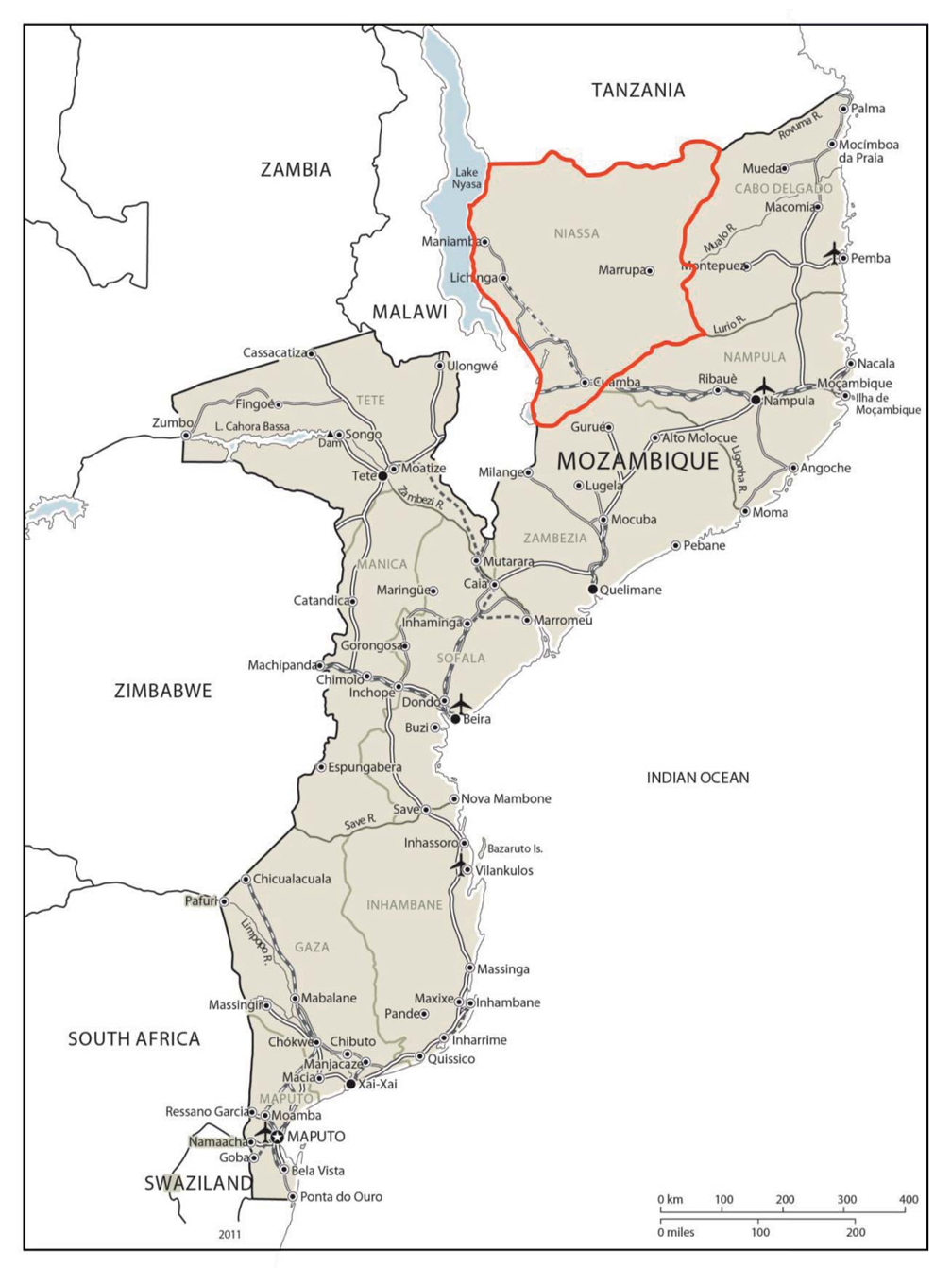
Map of Mozambique
Introduction and background
Relations between Sweden and Mozambique are rooted in a long history of political solidarity and development cooperation (Sellström 2002; SADEV 2012; Brolin 2017b; Westerlund 2020; OECD DAC 2024). During Mozambique’s struggle for independence from Portugal in the early 1970s, Sweden emerged as one of the most consistent Western supporters of the anti-colonial movement. After independence in 1975, this evolved into one of Sweden’s largest and longest development cooperation engagements in Africa, with Swedish civil society playing a central role. Early support focused on stabilising the economy and strengthening productive capacity during a period of profound political and economic transition.
During the 1980s and 1990s, Swedish support contributed to economic stabilisation, debt reduction, expanded social-sector spending, and poverty reduction. By the early 2000s, assistance had become more focused and integrated, combining support for democratic governance, economic growth, social and human development, and rural infrastructure and regional development. Sweden’s role evolved into a broader development partnership focused on poverty reduction and institutional development.
Sweden remained one of Mozambique’s key development cooperation partners until late 2025, usually ranking seventh among bilateral and multilateral donors by volume of support. Cooperation maintained a strong commitment to poverty reduction and sustainable development while adapting to changing national conditions and global agendas. Increasing attention was given to democratic governance, human rights, gender equality, climate and environmental resilience, and sustainable economic development, reflecting an effort to combine continuity with flexibility.
Mozambique experienced major political, economic, climate-related and security-related shifts (Newitt 2017; Castel-Branco and Greco 2022; Mosca and Selemane 2025), including a hidden debt crisis, armed conflicts, recurrent cyclones and extreme weather events, and changes in the political and donor landscape. These developments coincided with major fluctuations in poverty levels and distribution, partly reversing earlier gains and increasing regional inequalities. Together, they made Mozambique a particularly challenging environment for long-term development cooperation.
Against this backdrop, the Expert Group for Aid Studies (EBA) commissioned an evaluation to assess the relevance and coherence of Swedish development cooperation between 2005 and 2025, focusing on Sweden’s ability to combine long-term objectives with flexibility in a rapidly changing context (EBA 2025).
In December 2025, shortly before the evaluation began, the Swedish Government announced that bilateral development cooperation with Mozambique would be phased out and end by August 2026. The evaluation was therefore expanded to assess the design and implementation of the exit strategy and conducted while Swedish operations in Mozambique were being closed.
The purpose of the evaluation is to assess to what extent Sweden has succeeded in reconciling long-termism and flexibility in its development cooperation with Mozambique, during the widely shifting development preconditions over time. It asks if Sweden’s development assistance during 2005–2025 has remained appropriate in relation to its stated goals – including the overall objective of poverty reduction – and been able to stay relevant to context and (internally and externally) coherent despite the many political, economic, security and environmental shifts in the country. The evaluation contributes to accountability towards stakeholders in Sweden as well as in Mozambique, by increasing transparency about how Swedish development resources have been used. With the decision to discontinue bilateral aid to Mozambique, the issue of accountability towards stakeholders in Mozambique is extended to also include accountability in the exit process.
The invitation for proposals thus asks for an evaluation of relevance and coherence of the development cooperation between Mozambique and Sweden. The evaluation questions are:
- Has the Swedish development cooperation portfolio in Mozambique over time stayed relevant to its overarching objectives and to the domestic context given major shifts?
- Has the Swedish development cooperation portfolio been and remained coherent internally and in relation to other donor support to Mozambique over the given period?
- How is Sweden’s exit strategy designed and implemented, and what are the likely or actual implications of the withdrawal for the continuation of the portfolio and interventions by Mozambican and donor partners?
- What lessons can inform Swedish development cooperation ahead with Mozambique and/ or long-term cooperation with other countries that experience major political, environmental and socio-economic shifts?
- What are the lessons learned from the exit process for Sida/other similar contexts and development programmes in which Sweden is engaged?
The evaluation covers all Swedish development cooperation with Mozambique from 2005 until the exit in August 2026.
The key interfaces are between Swedish development strategies, the needs of the poor as target population, shifting development preconditions in Mozambique, and interventions of other actors. Although the evaluation questions focus on relevance and coherence of the Swedish portfolio, developing useful lessons learnt require assessment of how and why (or why not) this is so. Hence, the evaluation not only compares the characteristics of the Swedish portfolio over time with changes in Swedish strategy and local context but also studies the processes that lead to changes (or not) in the composition of the aid portfolio.
The report is structured as follows. The remainder of this chapter outlines key concepts and methodology. Chapter 2 examines the Mozambican context, including government priorities, poverty dynamics and implementation conditions. Chapter 3 presents Sweden’s overall objectives and country strategies. Chapter 4 assesses relevance, Chapter 5 coherence, Chapter 6 the exit, and Chapter 7 presents conclusions and lessons learned. Additional information is presented in Annexes 2–5.
The table overleaf provides an outline of the main components and timelines assessed in the report.
Table 1: Development over time of context, objectives, relevance and coherence.Mozambican context (Chapter 2)
|
2005–2009 |
2010–2014 |
2015–2019 |
2020–2025 |
|
Post-conflict recovery and steady progress. Aid-driven growth, improved state capacity, political stability, environmental shocks. Poverty decline, regional inequalities and rural vulnerability remain. |
Rapid growth, rising tensions and divergence. Growth, resource optimism, Rising political tensions, environmental shocks. Poverty reduction peaks, inequalities increase. |
Crisis, institutional rupture, and compounding shocks. Hidden debt revealed 2016, macroeconomic crisis, donor withdrawal, cyclones and floods. Poverty reduction trends reverse. |
Persistent fragility and fragmented recovery. Macroeconomic stabilisation, political tension, ODA fragmentation, overlapping shocks. Prolonged fragility, deepened multidimensional vulnerability, high rural poverty |
Sweden’s objectives (Chapter 3)
|
2005–2008 |
2008–2014 |
2015–2022 |
2022–2026 |
|
Poverty reduction through broad economic growth. Democracy and conflict prevention by strengthening civil society. |
Poverty reduction through budget support. Public sector efficiency and transparency. Democratic participation and human rights. Sustainable energy and natural resource use introduced. |
Improved economic and democratic opportunities for people living in poverty. Separate objective for environment and climate. Continued focus on democracy, gender equality, human rights. |
Improve lives of people living in poverty and oppression. Employment and conflict prevention new areas. Decision to exit bilateral support. |
|
General budget support |
General budget support |
Support via CSOs and other donors. |
Support via CSOs and other donors. |
Relevance (Chapter 4)
|
2005–2010? |
2011–2014? |
2015–2022? |
2023–2025? |
|
Relevant support to state systems. Strong alignment with Swedish objectives, Mozambican government systems and ODA agreements. Relevant target groups. |
Relevance on false premises. Slow adaptation to deteriorating governance reduced relevance. |
Appropriate adaptation but reduced influence. Shift from government to other partners was appropriate but reduced scope for influence. |
Relevance strained by Swedish policy decisions. Reform Agenda and exit decision reduces relevance. |
Coherence (Chapter 5)
|
2005–2014? |
2015–2022? |
2023–2025 |
|
Strong coherence via donor working groups. Broad donor coordination around budget support. Sweden takes leadership roles in donor working groups. |
Selective complementarity. Coordinates with CSOs and multilateral agencies via thematic working groups |
Fragmented, pragmatic coordination. Donor landscape splinters, lack of coherence during exit (Chapter 6). |
Key concepts
While most evaluations of development cooperation focus primarily on results, effectiveness and impact, this evaluation takes a different analytical perspective, examining how well support fits needs, priorities and context through the lenses of relevance, coherence, flexibility and long-termism. In doing so, it complements more traditional assessments of effectiveness and impact.[1]
Long-termism refers to maintaining a stable focus on Sweden’s overarching development objectives in Mozambique over an extended period. These objectives – including poverty reduction, democracy, gender equality, and sustainable development – require long time horizons. Long-termism therefore implies continuity, predictable support, and enduring partnerships, while avoiding frequent shifts in priorities in response to short-term political or economic changes.
Flexibility refers to Sweden’s ability to make adaptations in response to the volatile context in Mozambique between 2005 and 2025. Flexibility therefore involves changes in aid modalities, sectoral emphasis, partnerships, or geographic focus while maintaining commitment to overarching objectives.
The central question is whether Sweden succeeded in combining these two principles: maintaining stable long-term objectives while adapting to changing realities. Good development cooperation requires both – clear, long-term direction as well as the ability to react when the situation changes. This is assessed by analysing the relevance and coherence of Swedish development cooperation over time.Relevance and coherence are closely linked to the other OECD DAC evaluation criteria.[2] Relevance provides the foundation for judging whether interventions address important needs and priorities, while coherence can strengthen efficiency, impact and sustainability by fostering complementarities and reducing duplication. Interventions that reflect local realities, respond to evolving conditions, and recognise local definitions of priorities are more likely to have impact and contribute to sustainable outcomes.
Relevance, as defined by OECD DAC and adopted by Sida, requires responsiveness to multiple and sometimes conflicting needs, priorities and policies at global, national and local levels (OECD 2021). In practice, relevance is often treated as simple alignment with policy documents, resulting in a procedural assessment rather than an examination of whether support addresses actual needs and priorities.
In this evaluation, relevance is understood as doing what is appropriate rather than simply doing the right thing (EBA 2025:7; Samoff 2021). It therefore involves consideration of different stakeholders, including government institutions, civil society, beneficiaries and the poor as the ultimate target group. It also requires attention to how priorities shift over time and to how institutions shape opportunities for change (Cruz et al. 2023b). The invitation for proposals emphasises assessing the extent to which the Swedish portfolio remained aligned with both strategic objectives and local stakeholder needs (EBA 2025:7). This requires analysing Swedish objectives and contributions in relation to changing Mozambican priorities, policies and poverty dynamics. As stakeholders often have competing priorities, relevance does not necessarily imply agreement with all actors.
Coherence was introduced relatively recently as an OECD DAC criterion but has long been used in evaluations of humanitarian aid (OECD 2019, 2021b). It assesses whether interventions complement or undermine each other and whether they are compatible with the broader policy and institutional environment.
Two dimensions are distinguished: Internal coherence, referring to consistency between interventions and the strategies, policies and objectives of the same organisation, and external coherence, referring to compatibility with the interventions of other actors operating in the same context. Assessing coherence therefore requires a systems perspective that considers objectives, interventions, potential synergies, overlaps and gaps. It also involves examining the extent to which interventions make use of, and contribute to, existing coordination and institutional mechanisms.
The main focus is on external coherence – that is, whether Swedish interventions coordinated with, complemented, or duplicated the efforts of government institutions, civil society organisations, private-sector actors, bilateral donors and multilateral agencies.
Particular attention is given to how different forms of interaction – ranging from ‘synergy’ via ‘parallel play’ to ‘disconnect’ (Nadelman et al. 2023:2) – affected Sweden’s ability to remain relevant over time and how these relationships shaped preparedness for the abrupt discontinuation of bilateral development cooperation.
In summary, the evaluation assesses whether Sweden combined long-term strategic consistency with flexibility by maintaining relevance to changing Mozambican needs and ensuring coherence with the wider system of actors and interventions. The question becomes particularly pertinent when partners have to face the sudden discontinuation of Swedish development cooperation.
Approach and methodology
The evaluation combines a time-line approach to assess relevance and coherence and a theory of change approach to analyse how adaptation to the changing context has taken place (see Annex 2 for details on methodology). The evaluation framework includes six connected parts (see Annex 3b:1 for relevant literature):
- Contextual factors – identifying and mapping changes in local priorities, needs and preconditions for implementing development cooperation interventions in Mozambique.
- Long-term strategic objectives – showing Sweden’s development cooperation strategies for Mozambique and how it relates to Sweden’s main policy intentions.
- Aid portfolio progression and composition over time – illustrating changes over time in the distribution of interventions across sectors, aid types, and partnerships.
- Institutional path and strategic coherence – looking at how strategic choices, policy consistency, and organisational learning have supported either continuity or change.
- Adaptive mechanisms and contextual responsiveness – studying how decision-making, flexibility, and management adapted to context have helped (or limited) Sweden’s response to changes in Mozambique.
- Preparing for exit – looking at the extent to which adaptive mechanisms and contextual responsiveness has prepared the ground in Mozambique for Sweden’s decision to discontinue.
A combination of methods was used to collect and analyse data: Timelines were developed to capture and compare the three first points above, and case studies were analysed to understand the processes behind the fourth and fifth parts. The cases were selected to include programmes with different funding levels, thematic areas, partner types, time span and period. The table below gives an overview of the selected cases, Annexes 5c and 5d provide more detail.
Table 2: Case studies
|
Organisation/Programme |
Period |
Funding Level (Budget) |
Thematic Area |
Partner |
|
1. We Effect: Programme for Inclusive and Accountable Governance (AGIR I&II). Food, Climate, Agriculture, Nature and Women’s Empowerment Programme (ALCANCE) |
2010–2021 |
Multi donor |
Democracy, human rights, rule of law – civil society, civil society strengthening |
Civil society via intermediary partner organisations (MASC*, Oxfam IBIS, Diakonia, We Effect) |
|
2023–2027 |
43 MUSD total via We Effect |
Integrated rural development: food systems, climate adaptation, gender equality |
Civil society (Swedish NGO) |
|
|
2. Ipas: Access to Safe Abortions |
2016–2026 |
28 MUSD |
Health: Sexual and Reproductive Health and Rights |
International NGO (Ipas) |
|
3.TechnoServe: Women in Business WIN I & II |
2013–2026 |
12 MUSD |
Inclusive Economic Development: Women’s economic empowerment |
Civil society / International NGO |
|
4. Electricidade de Moçambique (EDM): Hydropower Rehabilitation |
2010–2024 |
165 MUSD |
Energy/Economic Development/Environment: Rehabilitation of Two Hydropower Installations |
Public company |
|
5. United Nations Children Fund (UNICEF): Nexus Support for Northern Mozambique |
2021–2026 |
6.5 MUSD |
Social protection: basic services, child protection |
Multilateral (UNICEF) |
|
6. Ministry of Planning and Finance Mozambique: Tribunal Administrativo |
1999–2023 |
23.5 MUSD |
Support to Public Administration, support via donor common fund from 2005 |
Recipient government |
Source: Openaid.se, IATIstandard.org. * Mecanismo de Apoio à Sociedade Civil.
Documents review included 1. thematic literature; 2. Mozambican history and context; 3. Overseas Development Assistance (ODA) in Mozambique; 4. Swedish development cooperation in Mozambique; and 5. Case study documentation (documents are listed in corresponding sections in Annex 3b).
Interviews were carried out in person and online in February and March 2026, with key informants with deep and long-term knowledge of Sweden’s development cooperation with Mozambique (Annex 3a). Interviewees represented a broad range of stakeholders, including Sida, Swedish Ministry of Foreign Affairs (MFA), Mozambican government, other donors and civil society partners. Valuable experience was also available within the evaluation team.
Data on all Swedish contributions to Mozambique during 2005–2026 was extracted from Openaid and the International Aid Transparency Initiative (IATI) databases.[3] The team opted for using budgets rather than spending to be able to get data for the full time-period, including the final years. The data consists of one observation per agreement with information about budget, sector, partner, start and end date, etc.
The evaluators used Chat 365 – Copilot to brainstorm relevant topics and issues, identify relevant publications, refine sentence structure and language, generate summaries of reports, identify relevant excerpts from interview transcripts, and draft synthesis tables. The authors reviewed, edited, and verified all such content for accuracy, logic, and alignment with the collected data. The authors take full responsibility for the final findings, interpretations, and recommendations presented in this report.
The main methodological limitation is the risk for biased interview data. This was mitigated by including alternative perspectives and by the way interview questions were formulated. The team was apprehensive about possible negative bias due to the decision to phase-out Sweden’s bilateral support to Mozambique. However, there were no clear indications of bias in the interviews – overall, responses were well aligned and most interviewees did not seem negatively biased due to the phase-out. The case studies were not selected to be statistically representative of the Swedish portfolio, but to provide information from a variety of sectors, partners, sizes and length of programmes. More information on limitations is available in Annex 2.
The evaluation adheres to recognised evaluation principles and the OECD DAC’s quality standards for development evaluation, as well as relevant guidelines from EBA and Sida. References to interview data are intentionally vague to ensure the data cannot be traced to individual interviewees.
The Mozambican context
This chapter serves as a point of reference for the ensuing analysis. It situates the Swedish portfolio within Mozambique’s evolving context[4]; Mozambique’s own development policies and priorities; shifting global aid paradigms; and the characteristics and geographies of poverty.[5] By outlining key trends within these thematic areas with reference to Sweden’s five-year strategy periods, the chapter provides the analytical foundation for assessing to what extent and how Swedish development cooperation has responded to, and been relevant for, changing needs and priorities over time. It is structured in four parts, focusing first on four aspects of the context, then on Mozambican development policies and plans, the ODA context and finally characteristics of Mozambican poverty.
Institutions, environment, aid and poverty
Mozambique is a diverse country in southeastern Africa, with a long history shaped by indigenous African societies, followed by early contacts with Swahili trading networks and later Portuguese colonization, before gaining independence in 1975 (Newitt 2017, see Map). Today, its population of about 35 million people is distributed across eleven provinces, with a significant share living in the central and northern regions. The system of governance includes central, provincial, and district levels, alongside often important traditional – both secular and religious – authorities, especially in rural areas. The capital city Maputo, located at the southern tip of the country, has a population of around 2.7 million in the metropolitan area and serves as the political and economic epicentre. Mozambique is ethnically and culturally diverse, with a wide range of languages, traditions and religious beliefs (IESE 2010–2024; Mosca and Selemane 2025). Mozambique is also among the poorest countries in the world in human development terms – having consistently been among the 10 poorest between 2005–2024 while ranked 182 among 193 countries in the 2025 Human Development Report (UNDP 2025).
Political and institutional context
Mozambique’s political and institutional trajectory since the civil war reflects post-conflict consolidation, dominant-party rule and persistent institutional fragility (Cruz et al. 2023a; Castel-Branco and Greco 2022; IESE 2010–2024). Political competition continued between FRELIMO (Frente de Libertação de Moçambique) and RENAMO (Resistência Nacional Moçambicana).
In 2005–2010, the state continued rebuilding administrative and governance functions with donor support while FRELIMO consolidated power under President Armando Guebuza. Relative stability and institutional expansion were accompanied by concerns over electoral fairness, rising living costs and urban protests. Political power became increasingly centralised.
During 2011–2015, political tensions intensified. Offshore gas discoveries raised growth expectations but increased competition over resources and reinforced elite bargaining within the ruling party (Sumich 2018). The 2014 elections reaffirmed FRELIMO’s dominance amid allegations of irregularities and shrinking civic space. The renewed RENAMO insurgency from 2013 exposed the fragility of the post-war settlement (Newitt 2017).
Hidden state-backed loans contracted in 2013–2014 revealed weaknesses in transparency, accountability and oversight.
The period 2016–2020 marked a major institutional rupture. The hidden debt crisis, revealed in 2016, exposed governance failures, triggered donor withdrawal and fiscal crisis, and damaged international credibility (Cruz et al. 2023a). Although the 2019 peace agreement with RENAMO reduced conflict risks, governance remained centralised and accountability weak. The Cabo Delgado insurgency, emerging from 2017, displaced over a million people and became a major security and development challenge.
In 2021–2025, political authority continued to consolidate, including restrictions on protest and media freedoms (Macuane et al. 2025). Conflict in the north and growing socioeconomic pressures reduced trust in state institutions. The disputed 2024 elections and protests underscored continuing legitimacy deficits. While initiatives such as the National Inclusive Dialogue Initiative[6] reflected efforts at political accommodation, institutional fragility and patronage networks remained defining features of the state (Tvedten and Picardo 2018; Cortez et al. 2019).
This trajectory illustrates how governance weaknesses, limited accountability and recurring conflict constrained institutional development, undermined public trust and reduced the state’s capacity for inclusive development.
The Hidden Debt Crisis
The hidden debt crisis in Mozambique can be seen as a major governance and macroeconomic shock that exposed deep weaknesses in state institutions. Between 2013 and 2014, large external loans were contracted secretly by state owned companies with government guarantees, outside normal legal and oversight mechanisms, and with limited or no public benefit. This reflected a system where political and economic elites could bypass accountability and use public resources for private gain.When the debts were revealed in 2016, the loss of credibility triggered a sudden withdrawal of donor support and external financing, leading to a fiscal crisis, sharp economic slowdown, and rising inflation. Public debt increased rapidly, investment declined, and the state reduced spending on key services, contributing to higher poverty and vulnerability. At the same time, the scandal weakened trust in institutions, intensified political tensions, and reduced Mozambique’s international standing.Overall, the episode illustrates how failures in transparency and oversight can translate quickly into broad and long lasting economic, social, and institutional costs (Cortez et al. 2019; Morier-Genoud, 2020; Macuane et al. 2025).
Economic and social context
Mozambique’s economic and social development evolved through periods of growth, crisis and fragile recovery (Cruz et al. (eds), 2023a; IESE 2010–2024; Castel-Branco and Greco 2022). Strong macroeconomic performance increasingly failed to translate into broad improvements in livelihoods, while regional and rural-urban inequalities persisted.During 2005–2010, growth driven by reconstruction, donor support and megaprojects increased GDP per capita and reduced poverty. Health, education and basic services improved, but growth remained dependent on external support and capital-intensive sectors with limited employment effects.[7]
In 2011–2015, growth continued and gas discoveries generated optimism and investment. While infrastructure and agricultural modernisation expanded, poverty reduction slowed and regional inequalities widened. Rural households remained dependent on low-productivity agriculture, while climate shocks, renewed conflict and hidden debt increased vulnerability.[8]
A sharp reversal occurred in 2016–2020 following the hidden debt crisis. Macroeconomic instability, inflation and fiscal contraction reduced livelihoods and increased poverty. Cyclones, floods and the Cabo Delgado insurgency further disrupted economic activity, displaced populations and damaged infrastructure. Reliance on short-term coping strategies deepened vulnerability.[9]
In 2021–2025, recovery remained fragile. IMF-supported stabilisation and renewed LNG interest improved macroeconomic conditions, but benefits were unevenly distributed (Egger et al. 2023). Conflict, climate shocks and rising prices weakened livelyhoods, while rural poverty remained entrenched and urban informality expanded. Despite expanded social protection, poverty remained higher than a decade earlier.[10]
Overall, Mozambique’s experience highlights the distinction between economic growth and poverty reduction. Repeated economic, political, climate and security shocks exposed weak resilience, regional inequalities and dependence on low-productivity agriculture.
Environment and climate context
Environmental vulnerability has been a structural constraint on Mozambique’s development throughout the evaluation period (Artur and Hilhorst 2012; Cuco et al. 2021).
In 2005–2010, floods and droughts exposed the limited resilience of rural livelihoods despite broader economic gains. Agricultural production remained highly dependent on rainfall, while adaptation and recovery mechanisms were weak, particularly in remote areas.
During 2011–2015, climate-related risks intensified, and recurrent environmental shocks increasingly affecting food security and livelihoods, especially in central and northern Mozambique. Climate variability often undermined investments and reinforced inequalities.
In 2016–2020, the interaction between climate shocks and wider crises became more pronounced. Cyclones and floods, including Idai and Kenneth, caused major damage and reversed development gains. Combined with economic crisis and conflict, they increased poverty and vulnerability while diverting resources towards emergency response, reducing the capacity for longer-term investments in resilience and adaptation.
In 2021–2025, climate vulnerability remained acute. Flooding displaced large populations and worsened food insecurity compounded the impact of conflict-induced displacement and economic fragility, contributed to a complex humanitarian and development challenge and placed additional pressure on already strained public services, food insecurity and displacement continued, compounded by conflict and economic fragility. Although adaptation and resilience gained prominence, implementation capacity remained limited.
Overall, climate shocks amplified the effects of economic crises, conflict and institutional fragility, while limited adaptive capacity constrained resilience and poverty-reduction efforts (Artur and Hilhorst 2012; Cuco et al. 2021).
Peace and Conflict Context
Mozambique’s civil war (1977–1992) caused over a million deaths, widespread displacement and extensive destruction. Since then, fragility has persisted despite periods of stability (Bussotti 2021; Monjane and Pitcher 2022; Morier-Genoud 2020).
In 2005–2010, the post-war settlement largely held, supporting reconstruction and growth, although tensions between FRELIMO and RENAMO remained unresolved, while protests linked to rising living costs reflected underlying social pressures.
During 2011–2015, these tensions escalated into renewed conflict. RENAMO resumed armed activities in 2013, disrupting transport, displacing populations, and weakening confidence in the peace settlement. The period exposed limits to post-war reconciliation while gas discoveries heightened political and economic cometition.
The period 2016–2020 brought both progress and new challenges. The 2019 peace agreement with RENAMO reduced conflict risks in central Mozambique but was overshadowed by the Cabo Delgado insurgency which caused violence, displacement and delays to gas projects (Morier-Genoud 2020). Regional and international forces helped contain the insurgency, but insecurity persisted.
In 2021–2025, the insurgency continued to generate displacement and humanitarian needs, while election tensions, climate shocks and economic hardship added pressure. Although LNG investments supported some recovery, insecurity continued to constrain development.
Overall, Mozambique’s experience illustrates the close links between peace, governance and development. Political tensions, conflict and vulnerability repeatedly undermined progress and reversed development gains.
The table below summarises the four aspects of the context described above.
Table 3: Summary of Political, Economic, Climate and Security Context
|
2006–2010 |
|
|
2011–2015 |
|
|
2016–2020 |
|
|
2021–2025 |
|
Government policies and plans
In line with the Paris Declaration on Aid Effectiveness and Swedish cooperation policies, development cooperation should be coherent with partner-government priorities. In Mozambique, this mainly means alignment with the Government’s Five-Year Development Plan (Programa Quinquenal do Governo, PQG)[11] and the related Economic and Social Plan and State Budget (PESOE).[12] The overview below summarises the main priorities of these plans. While implementation may differ from official policy, they remain important reference points for Swedish development cooperation.
The 2005–2009 plan was prepared during the post-war reconstruction phase.[13] It focused on poverty reduction, expanding basic services, and investments in people and infrastructure. Institutional strengthening, public administration and national unity were key priorities. The plan was closely linked to the Poverty Reduction Strategy Paper (PRSP)[14], known as PARPA,[15] which guided human development and governance reforms.
The 2010–2014 plan maintained a focus on poverty reduction while placing greater emphasis on growth and structural transformation. Agriculture, infrastructure, human capital, national unity and democracy were prioritised. Strong growth encouraged investment in energy, transport and the business environment. Linked to second Poverty Reduction Action Plan (PARPA II) 2011–2014, the plan sought to combine growth with reduced vulnerability, although regional and social disparities became increasingly visible.
The 2015–2019 plan was implemented during the economic crisis following the hidden debt crisis. Reduced donor support, inflation and governance challenges shifted attention towards restoring stability, improving transparency, strengthening institutions and rebuilding confidence. Preparations for future gas revenues were also introduced.
The 2020–2024 plan was developed amid COVID-19, climate-related disasters and conflict in northern Mozambique. It prioritised wellbeing, job creation, inequality reduction and stronger state capacity. Greater emphasis was placed on resilience, social protection, economic recovery and climate risks.
The 2025–2029 plan is centred on Mozambique’s emergence as a major natural-gas producer. LNG revenues are expected to support growth and public finances. The plan aims to reduce debt, diversify the economy, invest in human capital, and strengthen governance, infrastructure and social inclusion. It presents a more forwardlooking growth strategy, although poverty reduction is no longer an explicit objective.
Table 4: Summary of Priorities in the Government’s Five-Year Development Programmes
|
2005–2009 |
|
|
2010–2014 |
|
|
2015–2019 |
|
|
2020–2024 |
|
|
2025–2029 |
|
Mozambique’s development landscape
Global ODA paradigms embody principles promoted by Sweden, including poverty reduction, country ownership and alignment with partner systems (see e.g. Ramalingam 2015; Reid-Henry 2025). During the period covered by this evaluation, aid shifted from state-to-state cooperation and donor coordination towards a more fragmented system (see Annex 4a). Mozambique’s ODA landscape mirrored wider international changes in funding, aid modalities, donor risk perceptions, governance debates and the role of non-DAC and private actors (Burns and Worsley 2023).[16]
Figure 1 shows the relative importance of major bilateral and multilateral donors during 2005–2025, while Table 5 summarises their principal focus areas.
Figure 1: Main donors in Mozambique 2005–2025
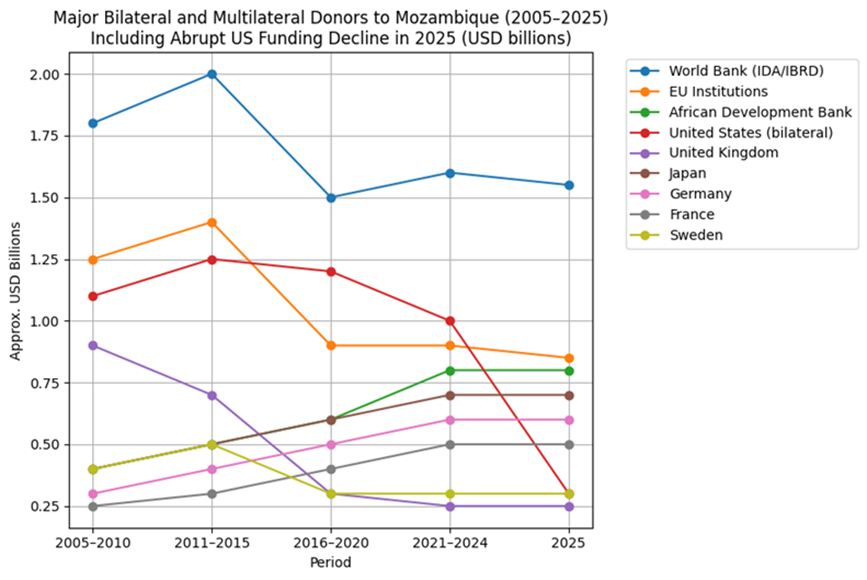
Sources: https://www.oecd.org/en/topics/oda-trends-and-statistics (Figure AI generated).
Table 5: Donors grouped by main focus areas
|
Main focus area |
Key donors |
|
Health (HIV/AIDS, immunisation) |
United States, Global Fund, Gavi, UNICEF |
|
Governance & public finance |
World Bank, EU, United Kingdom, Sweden, Portugal |
|
Education & social sectors |
EU, Sweden, Portugal, UN agencies |
|
Infrastructure & energy |
World Bank, AfDB, Japan, China, France, Germany |
|
Agriculture & rural development |
AfDB, United States, Netherlands, Sweden |
|
Humanitarian & food security |
United States, WFP, UN system, EU |
|
Climate & resilience |
AfDB, Germany, Sweden, France, World Bank |
|
Macroeconomic support |
IMF, World Bank, EU |
Source: Compiled by CoPilot from World Bank, AfDB, EU, UN, IMF and bilateral donor sources.
Between 2005 and 2013, Mozambique experienced strong growth in on-budget aid, including general and sector budget support, with aid representing up to 86.8 percent of government spending in 2010 (Sida Strategy Report for 2011). Major bilateral donors and multilateral organisations supported reconstruction, poverty reduction and the expansion of basic services. The period coincided with Mozambique’s reputation as a high-performing reformer and “donor darling”.
The hidden debt crisis in 2016 led the IMF and major donors to suspend budget support and some lending. Humanitarian finance, climate resilience support, targeted social protection and blended finance for infrastructure and extractives became more prominent. This marked a shift away from coordinated on-budget support towards project-based and externally managed financing.
From 2017 to 2025, the donor landscape became more fragmented. Multilateral institutions gradually resumed project-based lending, while general budget support largely remained suspended. Bilateral donors maintained selective engagement, particularly in health and humanitarian assistance, in response to conflict in Cabo Delgado and recurrent climate shocks. Humanitarian actors expanded their role as displacement, cyclones and violence created prolonged crises. Although still high, aid declined to 59.8 percent of government spending by 2024 (Sida Extended Strategy Report 2025).
At the same time, non-DAC actors, notably China, and private finance became increasingly important in infrastructure and energy investments. This reflected Mozambique’s shift towards more diversified and commercially oriented partnerships (Flentø and Simão 2023; see also Tjønneland 2026). The period ended with the sudden withdrawal of US support, which had severe consequences for poor people’s access to health services.
Table 6 presents the main shifts in ODA paradigms at global and Mozambique levels.
Table 6: Summary of ODA Paradigms and Context
|
2006–2010 |
|
|
2011–2015 |
|
|
2016–2020 |
|
|
2021–2025 |
|
National and international NGOs occupy an important position in Mozambique’s development landscape as service providers and intermediaries between citizens, communities, the state and development partners (Costantini et al. 2021). There are an estimated 250 active international NGOs and thousands of Mozambican NGOs, CBOs, associations and community groups. Beyond programme implementation, civil society contributes to policy dialogue, accountability, human rights and citizen participation, particularly where state capacity is limited.
At the same time, civil society operates in an increasingly challenging environment. The sector faces shrinking civic space, dependence on external funding, project-based approaches and unequal access to resources. Larger organisations, often based in Maputo, tend to have greater influence and funding, while grassroots organisations remain vital for community mobilisation and representation. Some of the main national NGOs are listed below, and Sweden has engaged with all of them at some stage.
Table 7: Main Mozambican National NGOs
|
Name |
Main focuses |
|
CIP |
Centro de Integridade Pública works with issues of governance, anti-corruption, public finance, extractives, elections, and accountability. |
|
LDH |
Major human rights organization focused on civil liberties, abuses by security forces, prisons, and civic freedoms. |
|
MASC |
Intermediary funding mechanisms and civil society platform supporting governance and accountability initiatives. |
|
CESC |
Strengthens civil society capacity and promotes social accountability and monitoring of public services. |
|
N’weti |
Promotes healthier communities through health communication, behaviour change, and sexual and reproductive health programs. |
|
FDC |
Works to reduce poverty and strengthen communities through development and social justice initiatives. |
|
MULEIDE |
Women’s rights and legal assistance organization focused on gender-based violence and women’s empowerment. |
|
Fórum Mulher |
Umbrella feminist coalition advocating for gender equality and women’s political participation. |
Source: Costantini et al. 2021. See List of Abbreviations for full names.
Poverty in Mozambique
The overarching goal of Swedish development cooperation is to contribute to “improved living conditions for people living in poverty and under oppression” (Government of Sweden 2013). The characteristics of poverty in Mozambique should therefore be reflected in the portfolio of Sweden-funded interventions. This chapter outlines how poverty in Mozambique has developed over time.
Mozambique underwent a major shift in consumption-based poverty[17] following the end of the civil war in 1992 and has since seen substantial changes in poverty levels and geography (Arndt et al. 2006; Jones and Tvedten 2019; Egger et al. 2023), as illustrated in the long-term trends in consumption-based poverty (Figure 2).[18] Economic growth and post-war reconstruction improved living conditions, including access to education, services, housing, electricity and assets. Until around 2015, consumption poverty declined markedly, with fewer households experiencing overlapping deprivations.
Figure 2: Consumption poverty rates 1996/97 – 2019/20 (%)
Source: Salvucci and Tarp (2023). Note: consumption poverty rate, calculated as the percentage of poor people over the total population for different areas and for all available household budget surveys.
These positive trends concealed growing spatial inequalities. Poverty declined more rapidly in urban than rural areas and was increasingly concentrated in the north and centre, while Maputo City and Province experienced much stronger improvements. The unequal distribution of poverty reduction is illustrated in Figure 3 on multidimensional poverty.
Figure 3: Multidimensional poverty incidence
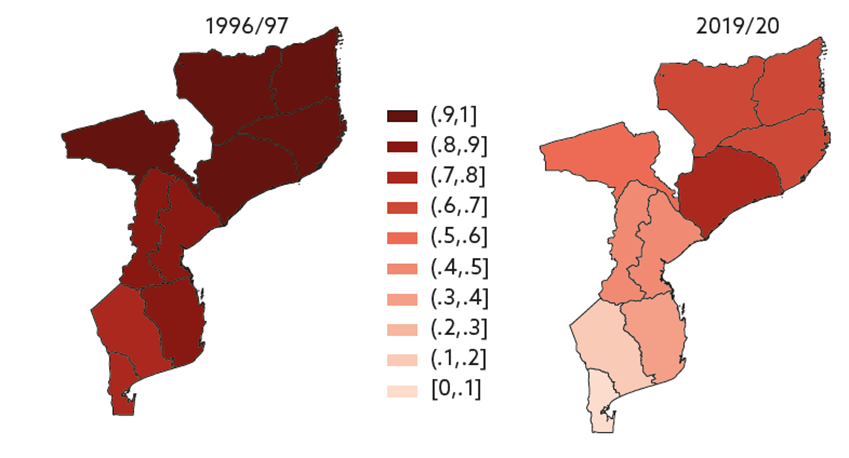
Source: Muchabel and Massingue (2024). The maps show the share of the population living in multi-dimensional poverty. In the north, more than 90% (9 out of 10 individuals) were living in multi-dimensional poverty in 1996/97, decreasing to 50–60% in 2019/20. In the southern-most province multi-dimensional poverty was less than 10% in 2019/20.
From the mid-2010s, progress reversed. Overlapping macroeconomic, climatic and security shocks weakened household resilience, with asset losses contributing to deteriorating living standards (Salvucci and Tarp 2023). Population growth compounded these challenges. Even where poverty incidence stabilised, the absolute number of poor people continued to increase, particularly in rural areas of the central regions.
The most recent overview of multidimensional poverty, presented in Table 8, confirms persistent structural inequalities. Rural areas account for a disproportionate share of multidimensionally poor and severely poor populations, while urban areas show substantially lower deprivation. High vulnerability levels indicate that large population groups remain at risk of falling deeper into poverty when exposed to shocks.
Table 8: Multidimensional poverty in Mozambique 2025
|
Area |
Multidimensional Poverty Index |
Poverty Headcount Ration |
Average Intensity of Deprivation |
Vulnerable |
Severe Poverty |
Population Share |
|
National |
0.334 |
60.7 % |
55.1 % |
16.9 % |
38.8 % |
100.0 % |
|
Urban |
0.129 |
27.1 % |
47.7 % |
22.7 % |
11.8 % |
34.0 % |
|
Rural |
0.440 |
77.9 % |
56.4 % |
13.8 % |
52.7 % |
66.0 % |
Source: Alkire et al. (2025a, b) based on the Demographic and Health Survey year 2022–2023.[19]
The main target groups for the Sustainable Development Goals 2030, to which Sweden is a signatory, are the 39 percent severely poor and marginalised population living in severe poverty (Table 8), including women and girls, children, elderly people, persons with disabilities, and refugees and displaced persons. They often lack both assets and supportive social networks and remain trapped in extreme vulnerability. The relevance of Swedish development cooperation will also be assessed against the extent to which strategies and portfolios target this population group.
One of the most detailed sources on poverty from the perspective of the poor is the Reality Checks Mozambique studies, commissioned by the Swedish Embassy and conducted in three communities in Niassa between 2011 and 2015 (Tvedten, Tuominen et al. 2011, 2014, 2016). The studies show that poverty is not only about material deprivation but also about social inclusion and exclusion. Communities distinguish between the destitute, the poor and the better off based on both assets and social networks. The most destitute often lack both, making them especially vulnerable and limiting opportunities for upward mobility.
About 70 percent of Mozambican households depend on agriculture and remain constrained by low productivity, weak infrastructure, limited services and climate shocks (Carrilho et al. 2023). Health and education services are valued but often difficult for the poorest to access because of distance, poor quality or indirect costs. Households rely on farming, casual labour, petty trade and family networks, but even these mechanisms may not be accessible for the poorest.
The findings also highlight the importance of addressing exclusion directly. The most destitute may benefit less from organisation-based or livelihood-focused interventions because they lack the resources and social connections needed to participate. Evidence suggests that when support reaches these groups, it improves both well-being and social ties (Tvedten, Tuominen et al. 2016). This points to the continued relevance of targeted social protection and cash transfers for reaching those most at risk of being left behind (Fiszbein and Schady 2009; Devereux et al. 2023).
Below, changes in the geography and severity of poverty are broken down into five-year periods broadly reflecting Sweden’s strategy timelines during 2005–2025, while recognising that poverty trends reflect longer-term processes.
Table 9: Summary of poverty context
|
2006–2010 |
|
|
2011–2015 |
|
|
2016–2020 |
|
|
2021–2025 |
|
Key findings and reflections on context
Mozambique’s development trajectory between 2005 and 2025 was shaped by political, economic, environmental, and security dynamics. Strong growth and poverty reduction, particularly in the early years, were constrained by governance weaknesses, regional inequalities, and dependence on external support. Over time, political centralisation, climate shocks, renewed conflict, and the hidden debt crisis weakened state legitimacy, institutional effectiveness, and inclusive development.
National policy priorities evolved from post-war reconstruction and poverty reduction towards growth, macroeconomic stabilisation, resilience, and the management of anticipated LNG revenues. Meanwhile, the international development landscape shifted from ownership, harmonisation, and budget support towards a more fragmented system characterised by climate finance, humanitarian assistance, private-sector engagement, diversified financing, and more direct forms of support. The 2016 hidden debt crisis accelerated donor withdrawal from budget support and the shift to project-based aid.
Although living conditions and multidimensional poverty improved until the mid-2010s, poverty reduction has since stalled or reversed. Climate shocks, conflict, economic crisis, population growth, and rising vulnerability have disproportionately affected rural, central, and northern areas, reinforcing inequalities. Mozambique remains among the world’s poorest countries, with poverty increasingly shaped by exposure to multiple shocks. This chapter provides a basis for assessing Swedish development cooperation across successive strategy periods.
Reflections
Mozambique’s development trajectory between 2005 and 2025 highlights both the possibilities and limits of external assistance. The early years showed that aid, economic growth, and donor coordination could contribute to poverty reduction. However, the hidden debt crisis, climate shocks, conflict, and increasing political centralisation revealed that many of the underlying causes of poverty remained unresolved. The experience suggests that external assistance can support development but cannot replace the domestic institutions and political commitment needed to sustain it.
At the same time, rising poverty in the later part of the period should not be seen as evidence that aid was ineffective. Development efforts increasingly operated in a context marked by economic crisis, conflict, and repeated environmental shocks. It is reasonable to conclude that external support helped protect livelihoods, maintain services, and reduce vulnerability. Without such support, poverty and hardship would likely have been even greater.
The Mozambican experience suggests that the effectiveness of external assistance depends on both the intervention and the political context. Support to basic services, social protection, climate adaptation, community development, and vulnerable groups often produced tangible results. Systemic support through government institutions can also be effective when political commitment and state capacity are strong, but progress in governance reform, anti-corruption, accountability, and reducing regional inequalities is more limited where governance and capacity weakened.
More broadly, the chapter points to the importance of viewing poverty reduction in terms of resilience as well as growth. In contexts exposed to repeated shocks, external assistance may be most valuable when it helps protect development gains, reduce vulnerability, and support gradual improvements in living conditions. This does not reduce the importance of long-term institutional change but suggests that expectations about what external assistance can achieve should remain realistic.
Sweden’s cooperation objectives
This chapter presents the overarching and country-specific objectives of Sweden’s Development Cooperation for the period of evaluation. It begins by introducing the overall objective of Sweden’s Development Cooperation, then presents and analyses the four country strategies for Mozambique that have been in effect during the evaluation period.
Overarching objectives
In the early 1960s the Swedish Government stated that the goal of foreign aid was to increase the standard of living for people living in poverty, explained as eradicating starvation and mass poverty, eliminating epidemic diseases, reducing child mortality, and increasing opportunities for decent living conditions.[20] (Government of Sweden 1962). In 2003, the Policy for Global Development (Politik för Global Utveckling) made international development a responsibility for Swedish society and government at large (Fellesson and Román, 2016). In 2013, the Government of Sweden reformulated this objective, stating that “the overarching objective of Swedish Development Cooperation is to contribute to improved living conditions for people living in poverty and under oppression” (Government of Sweden 2013).
The Policy for Global Development states that Swedish development cooperation shall be guided by the rights perspective and the perspective of the poor. It has subsequently evolved towards a stronger focus on multidimensional poverty (Government of Sweden 2016, 2017) and incorporated international commitments signed by Sweden (Government of Sweden 2024a), expanding the framework to include the conflict perspective, the gender equality perspective and the environment and climate perspective.
The Policy for Global Development remained in force until recently. The Swedish government elected in 2022 introduced the Reform Agenda, “Development assistance for a new era – freedom, empowerment and sustainable growth” (Government of Sweden, 2023), emphasising economic actors and commercial exchange while introducing themes such as migration into Swedish development policy (Government of Sweden, 2023). This was followed by the discontinuation of the Policy for Global Development, and the poverty perspectives introduced in 2013, in the budget proposition for 2025 (Government of Sweden 2024b).
What has remained unchanged is poverty reduction as the overarching objective of Swedish development cooperation. This therefore constitutes the overall goal against which relevance is assessed in this evaluation.
In addition to national policies, Sweden is a signatory to a range of international agreements in the area of ODA (Government of Sweden 2024a and Annex 4a). Together, these provide the framework for contemporary development cooperation, emphasising national ownership, alignment with country priorities, stronger partnerships and accountability, sustainable financing, climate action, and a commitment to ensuring that vulnerable and marginalised populations are not left behind.
Sweden’s aid strategies for Mozambique
Swedish development cooperation with Mozambique is governed by geographical and thematic strategies decided by the Swedish government. During the evaluation period, four country strategies, two regional strategies and twenty-one thematic strategies were in force. Country strategies accounted for 88 percent of aid between 2005 and 2025, thematic strategies 11 percent, and regional strategies one percent. The evaluation therefore focuses on objectives set out in the country strategies. (Annexes 5a and 5b).
Country strategies are based on the overarching objectives of Swedish development cooperation, with input from Sida and the Embassy. Figure 4 illustrates the strategy cycle from adoption to operationalisation, reporting and preparation of the next strategy.[21] Sida provides background analyses, proposes objectives and focus areas. Preparatory work includes a strategy report or similar document,[22] multidimensional poverty analyses for the two most recent strategies, and consultations with local partners.[23] The MFA undertakes the final drafting, after which the Government adopts the strategy.
Figure 4: The development cooperation strategy process
Sida then develops an operationalisation plan detailing programmes, partners and target groups, and produces annual reports during implementation.
The evaluation period covers four country strategies for Mozambique, presented in Table 10. The strategy periods approximately match the five-year periods used to organise the presentation of context in Chapter 2. While the first three strategies were all extended by one to two years, the last strategy will be cut short by four months due to the decision to phase out bilateral cooperation with Mozambique. The strategy values presented in the table illustrate the original decision made (MFA Sweden 2002, 2008, 20015, 2022).
Table 10: Country strategies for Swedish development cooperation with Mozambique
|
Period |
Strategy |
Value |
|
2002–2008 |
Country strategy for development cooperation Mozambique 1 January 2002–31 December 2006. (MFA Sweden 2002) Extended until June 2008. |
Annual value SEK 420 million (2002–2006), not including budgetary support. |
|
2008–2014 |
Strategy for development cooperation with Mozambique September 2008 – December 2012. (MFA Sweden 2008) |
Annual value SEK 750 million, including research cooperation and credits. |
|
2015–2022 |
Results strategy for Sweden’s international development cooperation with Mozambique 2015–2020. (MFA Sweden 2015) |
Total value SEK 4.1 billion. |
|
2022–2026 |
Strategy for Sweden’s development cooperation with Mozambique 2022–2026. (MFA Sweden 2022) |
Total value SEK 4 billion. |
The first strategy (2002–2008) focused strongly on state-building and basic service delivery, emphasising public administration reform, decentralisation, sector support, budget support, and alignment with national poverty strategies. The second strategy (2008–2014) retained budget support while placing greater emphasis on democracy, human rights, accountability, inequality, rural poverty, and marginalised regions. It also concentrated the portfolio and phased out support to areas such as higher education, roads and transport, and parts of democratic governance.
The third strategy (2015–2022) marked a shift away from budget support and introduced environment and climate change as a distinct objective, with stronger integration of gender equality and human rights. It also adopted a results-based framework, formulating objectives as results areas rather than sectors. Unlike previous strategies, the final strategy (2022–2026) did not specify a clear set of objectives. Instead, it restated the overarching objective of poverty reduction and outlined key preconditions for achieving it, while adding conflict prevention and crisis management as a new focus area.
The strategy goals and objectives for the four country strategies are summarised in Table 11 and presented in more detail in Annex 5b.
Table 11: Objectives of Sweden’s bilateral strategies for MozambiqueOverall objectives
|
2002–2007 |
2008–2014 |
2015–2022 |
2022–2026 |
|
Contribute to the reduction of poverty in Mozambique. |
Starting from the rights perspective and the perspective of poor people in development, reduce absolute poverty by promoting a democratic social development and rapid, sustainable and broad economic growth. |
Socially, economically and environmentally sustainable use of natural resources. Improve opportunities for people living in poverty to contribute to and benefit from economic and democratic development. |
Create conditions to improve the lives of people living in poverty and oppression. Based on the principles of aid and development effectiveness, the 2030 Agenda, the Addis Ababa Action Agenda and the Paris Agreement. |
Democracy and human rights
|
2002–2007 |
2008–2014 |
2015–2022 |
2022–2026 |
|
Promotion of democratic development and conflict prevention through support to players in the public sector and civil society. |
Improved efficiency, financial control and reduced corruption in public sector. Increased participation in democratic processes. Increased respect for human rights of most the vulnerable. |
Strengthened democracy and gender equality, and greater respect for human rights. |
Human rights, democracy, the rule of law and gender equality. |
Economic development
|
2002–2007 |
2008–2014 |
2015–2022 |
2022–2026 |
|
Contribute to the reduction of poverty in Mozambique by the promotion of economic growth that benefits the majority of the people. Increased production, sustainable development and reduced isolation in Niassa province. |
Reduction of poverty through budget support . Increased household incomes and food supply through effective and sustainable use of natural resources (targeting women). Greater supply of sustainable energy Improved economic climate and opportunities in Niassa. |
Better opportunities and tools to enable poor people to improve their living conditions. |
Improved opportunities for productive employment and decent work. Strengthened opportunities for productive and resilient agriculture, improved livelihood opportunities and food security. Strengthened systems for increased social protection. |
Environment and climate
|
2002–2007 |
2008–2014 |
2015–2022 |
2022–2026 |
|
Better environment, limited climate impact and greater resilience to environmental impacts, climate change and natural disasters. |
Environment, climate and sustainable use of natural resources. |
Other: Social and human development/ Peaceful and inclusive societies
|
2002–2007 |
2008–2014 |
2015–2022 |
2022–2026 |
|
Greater opportunities for development for the poor by increased access to quality education and HIV/AIDS support. Priority to children’s rights and opportunities. |
Strengthened national research capacity. |
Strengthened conditions to prevent and manage crises and conflicts by peaceful means. |
Source: MFA Sweden (2002, 2008, 2015, 2022).
Key Findings on Sweden’s cooperation objectives
Swedish development cooperation in Mozambique has consistently focused on poverty reduction, but the approach has evolved. Earlier strategies emphasised basic services, state-building, governance, rural development and budget support, while later strategies increasingly addressed poverty as a multidimensional issue involving rights, gender equality, economic exclusion and climate vulnerability.
A second key finding is the shift from broad state support toward more targeted, results-based cooperation. Budget support declined, while greater attention was given to productive employment, agriculture, entrepreneurship, food security, social protection, democracy, human rights and accountability.
Finally, environment and climate change have become increasingly important. From being addressed indirectly, they became a dedicated priority from 2015, with growing emphasis on climate resilience, biodiversity, renewable energy and sustainable resource management. The latest strategy also added conflict prevention and crisis management. Overall, cooperation has become more multidimensional and rights-based over time.
Reflections on the Swedish objectives
The Mozambique case suggests that the main strength of long-term country strategies is their ability to provide continuity in uncertain environments. A stable strategic framework can accommodate changing priorities while maintaining an overall direction. At the same time, such strategies risk remaining tied to assumptions that become less relevant as contexts evolve. The challenge is therefore to combine continuity with periodic reassessment of how development objectives are pursued.
A second reflection concerns the expansion of objectives over time. The shift from a relatively focused agenda towards a broader set of goals reflects a more sophisticated understanding of poverty and exclusion. However, broader agendas also create risks. As strategies become more comprehensive, prioritisation becomes more difficult and trade-offs less explicit, potentially reducing strategic clarity.
The case also highlights a persistent tension between country ownership and donor priorities. Development strategies are expected to respond to partner-country needs while reflecting evolving political priorities in donor countries. Broad frameworks can help reconcile these competing demands, but the balance may shift over time, raising questions about whose priorities ultimately shape cooperation.
More broadly, the experience underlines that long-term cooperation in fragile contexts requires both stability and adaptability. The value of country strategies may therefore lie less in defining fixed priorities than in providing a framework for adjusting approaches while maintaining commitment to longer-term development objectives.
Relevance of Swedish cooperation 2005–2025
This chapter responds to Evaluation question 1: Has the Swedish development cooperation portfolio in Mozambique over time stayed relevant to its overarching objectives and to the domestic context given major shifts?To cover relevance to both Swedish objectives and the Mozambican context, the chapter analyses the portfolio and case studies from three different perspectives: thematic composition (section 4.1); partnerships and aid modalities (section 4.2); and relevance for poverty reduction (section 4.3), before assessing long-termism, flexibility and strategy operationalisation in section 4.4. In this and the coming chapters, findings are presented in italic font, followed by supporting evidence and analysis. Each sub-sector ends with a summing up and reflections section.
Thematic composition of the portfolio
As presented in Chapter 3, the four country strategies for Mozambique have consistently highlighted three thematic areas. Below, the portfolio and case studies are analysed to assess if they are relevant in terms of reflecting the priorities of the Swedish strategies as well as the Mozambican reality. Additional information about the cases is provided in Annexes 5c and 5d.[24]
Overall composition of the portfolio
Finding (F): The overall composition of the portfolios is relatively well aligned with the thematic areas highlighted in the strategies and the key events in the local context.
The total budget of the Swedish portfolio for 2005–2025 exceeded USD 2 billion, peaking around 2014 before declining steadily after 2015, as shown in Figure 5. Total spending was close to USD 1.9 billion, with annual expenditure generally between 90 and 110 percent of budget. The main exception was 2014–2018, when planned budget support was not disbursed following the hidden debt crisis. The post-2015 decline reflects tighter budgets, changing priorities, and shifts in aid modalities. Overall, the figure illustrates continued long-term engagement despite reduced funding, supporting the notion of “flexible long-termism”.
Figure 5: Annual budget allocations and spending (USD, 2005–2025)
Figure 6 shows changes in funding across sector groups over time. The sharp decline in “Commodity Aid and General Programme Assistance” after 2016 reflects the end of budget support following the hidden debt crisis, with the peak in 2017 reflecting general budget support that was planned but not paid out. At the same time, funding for Social Infrastructure and Services remained relatively stable, while Economic Infrastructure fluctuated with major energy investments. Humanitarian aid remained limited but increased during the COVID-19 period. Overall, the post-2016 figures reflect reallocations and a reduction in overall Swedish ODA budgets, illustrating adaptation to changing financial and contextual conditions.
Figure 6: Total budget per year and sector group
The sector groups comprise multiple categories and individual sectors. Figure 7 shows trends in the largest individual sectors. Government and civil society consistently received substantial funding, although allocations declined in the latest strategy period. Budget support dominated the former category initially but shifted primarily towards civil society after the hidden debt crisis. Transport and storage received significant funding in the first two strategy periods before being phased out after 2014. Agriculture, forestry and fishing included major investments in integrated rural development in Niassa through the AGIR and ALCANCE programmes (see Case 1 below), and energy received a large share of funding throughout and became dominant in the last two strategy periods, including support hydropower rehabilitation and rural electrification. This appears to have been driven by both Mozambican priorities and the increasing prominence of energy within Swedish development cooperation (see below).
Figure 7: Swedish aid to main sectors
Total budget > USD 100 million, not including General Budget Support.
Democracy and human rights
F: The portfolios have included small but relevant support to democracy and human rights.
Democracy and human rights are highlighted throughout the four strategy periods (although human rights not explicitly included in the first one). Six of the sectors in the sector category ‘Government and civil society’ were identified as relating to democracy or human rights. The peak in funding to Democratic participation and civil society around 2015 can be linked to the shift from General budget support and probably also to the negative developments in the human rights situation in Mozambique (Chapter 2). Notably, very small amounts – barely visible in the diagram below – were dedicated for women’s and girls’ rights, and the total budget for democracy and human rights decreased substantially in the last strategy period. Note however, that many of the programmes apply integrated approaches which may benefit human rights and democracy without these being the main programme objective – such cases are not visible in the portfolio data.
Figure 8: Democracy and human rights sectors, budget/year
The Case Study of the AGIR and ALCANCE programmes illustrate the relevance of one of Sweden’s largest programmes in support of democracy and a strengthened civil society (for all case study documents, see Annex 3b:5b).
Case 1: From state systems to civil society and governance – AGIR I & II and ALCANCE
AGIR provided long-term core support to Mozambican civil society through intermediary organisations, aligning with Sweden’s emphasis on governance and accountability amid declining trust in state institutions and shrinking political space. Relevance was reflected in close alignment with priorities and needs of civil society actors. Funding organisational strategies rather than short-term projects enabled sustained engagement. Evaluations (e.g. Kruse et al. 2018) show that AGIR doubled its network to over 20 partner organisations, strengthened coordination and supported a shift to results-oriented approaches. This contributed to tangible political influence, including mobilisation against restrictive NGO legislation. ALCANCE (2023–2027) builds on this by combining organisational strengthening with livelihoods, land rights and women’s empowerment.
Evaluations and interviews nevertheless point to structural constraints. The intermediary model improved coordination and coherence but increased complexity in reporting, alignment and resource distribution. Core funding strengthened capacity and flexibility while increasing pressure to demonstrate results. Sustainability remained uneven, with smaller organisations particularly vulnerable once external funding declined.
AGIR responded closely to Mozambican civil society priorities, strengthening ownership and responsiveness. But it also raised questions about how wider objectives, including poverty reduction and system-level change, were pursued across a diverse portfolio.
Overall, the shift towards civil society support was highly relevant in addressing governance deficits and shrinking civic space. It strengthened voice, accountability and collective action, however, the reduced engagement with state institutions limited opportunities to influence public service delivery and institutional reform.
F: Programmes supporting sexual and reproductive health are especially relevant but is only a small part of the budget.
The two latest strategies include specific objectives relating to sexual and reproductive health and rights (SRHR) as part of the democracy and human rights area. In the portfolio data this is included in the health and population sector categories. The health sector (here a selection from the health and population sector categories) has included reproductive health care, family planning and control including HIV/AIDS. This support has been especially prominent in the last two strategy periods, mirroring the focus of these strategies.
Figure 9: Health by sector and year (sectors > 1 MUSD)
The main partner in the last few years is Ipas with the programme “Access to Safe Abortions” (see case study below). A second phase of the contribution had been planned but will now be discontinued following the exit decision. Interviewees noted that Sweden has played a particularly important role in advancing SRHR issues.
Case 2: Access to Safe Abortions
Sweden’s support to Ipas to increase access to safe abortions from 2016 onwards demonstrates particularly high relevance in a context of crisis, institutional fragility, and social inequality. Following the liberalisation of Mozambique’s abortion law, the key challenge shifted from policy to implementation, particularly within weak health systems and in the face of persistent stigma. Interview evidence confirms that the programme directly addressed this gap by supporting national guidelines, training providers, and integrating abortion services into professional curricula. The alignment between legal reform, institutional capacity building, and service delivery made the intervention particularly well suited to a context where policy change alone was insufficient.
The programme’s relevance was further reinforced by its focus on provinces such as Nampula and Zambezia, where maternal mortality and poverty remain high. Interviewees emphasised that the intervention extended beyond clinical services to address systemic barriers through engagement with ministries, professional bodies, and community actors, strengthening the broader “abortion ecosystem”, including social norms and awareness. This was particularly important in a context where abortion remained politically sensitive despite its legal status. Sweden played a leading role in initiating and sustaining this support, initially as the sole donor, filling a gap left by other actors, notably USAID. The programme’s relevance therefore also stemmed from its willingness to engage in an area that others avoided.
Interview material also highlights important vulnerabilities. Working through the public health system strengthened institutional ownership and sustainability but exposed the programme to systemic constraints, including limited funding and uneven service delivery. While some health centres have reached a degree of sustainability, others remain dependent on continued technical and financial support, particularly for training, supervision, and supply chains. This points to uneven durability of results and reflects wider weaknesses in the health system.
Overall, the Ipas programme was a contextually appropriate response that helped bridge the gap between legal reform and service delivery in a fragile and unequal setting where other donors were reluctant to engage. At the same time, its long-term impact remains constrained by systemic weaknesses and continued funding dependency, highlighting the limits of even well-designed interventions in addressing deeply embedded institutional challenges.
Economic development
F: The portfolios include support targeting economic development via different sectors and approaches. The portfolio generally reflects Sweden’s strategy objectives and is relevant to the Mozambican context.
Economic development – in one form or another – is included in all four strategies but the focus within this thematic area is changing over time. Although only the earlier strategy periods included road constructions and access to energy, inclusive economic development has remained a constant throughout. The first diagram below includes all sector categories that can be linked to economic development objectives described in the strategies, followed by analyses of a selection of them.
Figure 10: Economic development (major sectors categories)
The Energy and Transport and Storage sectors, both infrastructure-heavy and implemented with government partners, receive large budget shares, although support to transport ended after 2015. Other Social Infrastructure includes social protection, welfare services, social security, employment creation, and statistical capacity building. Funding increased gradually, peaking during the COVID-19 pandemic, while Industry, Mining and Construction received smaller but consistent support.
The remaining major sectors, Agriculture, Forestry and Fishing and Other Multisector, illustrate the agriculture and rural development portfolio. Support to rural, natural resource-based economic development continued throughout the period and was channelled through more than 50 organisations. Sida and partner interviewees highlighted small-scale agriculture and artisanal fisheries as particularly relevant to poverty reduction, as they remain the main sources of income and consumption for most Mozambicans (Chapter 2).
Figure 11: Agriculture and rural development (Budget, USD)
Finally, there has been an increasing expectation, from both Swedish (the Reform Agenda) and Mozambican governments (Chapter 2), for support to and via the private sector. The Women in Business programmes implemented by TechnoServe illustrates one of the few programmes implemented by a private sector partner:
Case 3: Women in Business – WIN I & II
The Women in Business (WIN) programme sought to maintain relevance to poverty reduction and gender equality in a context of economic contraction, weak job creation and declining state capacity. Implemented from 2017, it responded to women’s structural exclusion through a market-systems approach involving private firms, financial actors and service providers.
Interview evidence supports this logic. WIN worked with companies to adapt products, services and business models to reach women entrepreneurs, including tailored financial products. A later shift extended the programme to poorer rural women in the Beira and Nacala corridors, including conflict-affected areas, demonstrating responsiveness to changing vulnerability patterns.
However, expanding into rural areas proved more difficult and resource-intensive than anticipated. Digitalisation of savings groups and agricultural partnerships required longer timeframes and greater investment, highlighting a key trade-off: market-based approaches can promote sustainable inclusion but are less effective in reaching the poorest women, particularly in remote areas. The programme’s relevance was also shaped by budget reductions and uncertainty linked to changing Swedish priorities, creating tension between ambitions for systemic change and limited resources.
Overall, WIN represents a relevant shift towards private sector-mediated development where state-led pathways were constrained. However, its contribution to poverty reduction remained indirect, medium-term and uneven, with the poorest groups hardest to reach.
The energy sector
F: The energy sector plays a larger role in the portfolio than in the strategies.
Energy is not a separate thematic area but receives substantial funding and appears in all four strategies, initially as part of economic development and later under environment and climate. Despite its limited prominence in the strategies, it absorbs a large share of the portfolio, leading some interviewees to question its strategic weighting. Interviewees also noted that this reflected broader Sida priorities and headquarters guidance on energy access, infrastructure, and renewable energy, and involvement in the Power Africa initiative[25].
Approximately half of the energy budget supported centralised grids, a priority throughout the period. Hydropower rehabilitation dominated the second strategy period, while the latest period saw increased support to renewable energy, such as Brilho Renewable Energy Market Development, which supports renewable energy market growth in Mozambique, focusing on off grid solar, improved cooking technologies, and clean energy services to strengthen private sector capacity to expand energy access. Energy research, energy education and solar energy received comparatively minor funding (not included in figure below). Electricidade de Moçambique (EDM) remained a key partner throughout, with non-government actors entering mainly in the last two strategy periods.
Figure 12: Energy by sector and year (Budget, USD)
Case study 4 below on the rehabilitation of two hydropower plants, and the shift to two off-grid programmes in the energy sector, illustrates how Sweden has adapted its portfolio to changing priorities of the Swedish and Mozambican government. As noted by several Sida and partner interviewees, the case also highlights the differing implications of systemic and direct energy support for poverty reduction.
Case 4: Rehabilitation of Two Hydropower Plants
This long-term programme supported the rehabilitation of the Mavuzi and Chicamba hydropower plants in central Mozambique to strengthen reliable energy generation. The intervention aligned closely with Mozambique’s objective of expanding domestic energy supply and with Sweden’s focus on renewable energy and grid stability. Energy shortages were widely viewed as a constraint on growth, making the rehabilitation of existing hydropower assets a relevant and pragmatic investment.
Interview evidence supports this assessment while clarifying why the intervention was considered appropriate. Rehabilitation increased generation capacity from around 50–60 to approximately 90 MW, making the plants important sources of supply for the Beira corridor. The project emerged from collaboration between Electricidade de Moçambique (EDM) and the Swedish Embassy. Long-term Swedish engagement also contributed to technical training and institutional capacity within EDM, reinforcing broader system benefits. Hence, the intervention was not only aligned with national priorities but also embedded in existing institutional relationships and capabilities.
At the same time, interview material highlights important limitations. While increased generation capacity is a necessary condition for development, its effects on poverty are indirect and uneven. Electrification has improved access to services such as education and health, but most rural households remain unconnected to the grid. The poverty impacts of large-scale energy investments depend on complementary systems related to distribution, affordability, and last-mile access that fall outside the project itself.
Partly in response to these limitations and reflecting the stronger climate and environment focus of the last two strategy periods, Sweden expanded its energy portfolio. The Brilho programme supports renewable energy development through off-grid solar, improved cooking technologies, and clean energy services. Sweden also supports the Mozambique Energy for All Multi-Donor Trust Fund, implemented through the World Bank, which combines grid expansion with off-grid electrification to support the goal of universal electricity access by 2030.
Overall, the interventions were highly relevant from a national development and infrastructure perspective and were well aligned with both Mozambican priorities and Swedish policy objectives. However, their contribution to poverty reduction remained indirect and contingent on broader system development that only partly materialised.
Environment and climate change
F: The portfolio of interventions in the environment and climate area does not fully match the description of these areas in the strategies.
Although environment and climate change is included in all four strategy periods and a prioritised area in the two latest strategies, this is not mirrored in the budget allocations. The total budget for this sector was only USD 32 million for 2005–2025. Over the years the budget has shifted from support to Environmental research via University Eduardo Mondlane during the first two strategy periods, to contributions targeting biodiversity in the two latest strategy periods.
Figure 13: Environment and climate change, by sector and year.
None of the case studies is categorised as support to environment and climate change, but several programmes contain relevant components. For example, LoCAL[26], Biofund, Hydropower Rehabilitation, and ALCANCE have components aimed at sustainable use of natural resources, and AGIR contributes indirectly through environmental justice and natural resource governance: LoCAL supports climate adaptation at the district level through performance-based grants linked to locally identified priorities. Following strong results, Sida extended and expanded the programme, which also strengthens local planning, budgeting, and accountability for climate-resilient development. Biofund’s Restoration of Strategic Ecosystems programme is a Swedish-funded initiative aimed at strengthening biodiversity conservation through sustainable financing mechanisms. The programme focuses on supporting environmental trust funds (“bio funds”) that provide long-term, stable funding for protected areas and restoration to ensure that critical ecosystems – such as forests, wetlands, and coastal areas – are preserved and managed effectively over time.
Some programmes span multiple thematic areas. Case study 5 examines Sweden’s long-term partnership with UNICEF through the Nexus Support for Northern Mozambique programme. Between 2005 and 2025, Swedish support covered child protection, education, health, social protection, and humanitarian response, while addressing vulnerabilities related to conflict, climate shocks, and poverty. Interviewees highlighted UNICEF’s local knowledge, field presence, and government partnerships as important for its relevance
Case 5: UNICEF – Nexus Support in Northern Mozambique
Sweden’s support to UNICEF during 2021–2025 exemplifies relevance under conditions of prolonged fragility rather than acute crisis. Northern Mozambique faced overlapping pressures – conflict and displacement, climate shocks, COVID-19, and worsening cost-of-living conditions – where neither traditional development programming nor purely humanitarian responses were sufficient. In this context, UNICEF’s multisectoral, nexus-oriented approach was broadly appropriate. Its ability to operate across sectors and at scale, while working with both state and non-state actors, provided a flexible platform in a setting where government capacity was uneven and highly constrained.
Interview evidence reinforces this assessment and highlights how relevance was operationalised in practice. Programmes were typically co-created rather than imposed, particularly in areas such as climate, peacebuilding, and gender. This partnership allowed for adaptation within a relatively stable strategic framework, with adjustments made to geographic focus and intervention design rather than wholesale shifts in objectives. For example, programming in the north evolved from immediate conflict response towards reintegration, social cohesion, and support to returning displaced populations, illustrating responsiveness to changing realities on the ground.
While UNICEF’s scale and delivery capacity made it an effective channel under fragile conditions, this also reflected a pragmatic shift away from deeper institutional engagement. The emphasis was increasingly on maintaining service delivery, protecting vulnerable populations, and coordinating across actors, rather than strengthening national systems. As one respondent noted, predictable, multi-year and multi-partner funding – where Sweden was seen as particularly strong – enabled more coherent responses, but these gains are vulnerable when funding becomes uncertain or is withdrawn.
Overall, the case illustrates relevance shaped by constraint and pragmatism. UNICEF provided an appropriate vehicle for maintaining essential services and addressing multidimensional vulnerability in a fragile setting where the government was no longer an appropriate partner. However, this also points to a narrower pathway for long-term development, with limited contribution to rebuilding national systems and reduced resilience once external support is withdrawn.
Reflections on relevance of the composition of the portfolio
The Swedish portfolio in Mozambique amounted to just over USD 2 billion during 2005–2025. It remained focused on the strategic priorities of economic development, democracy and human rights, and climate and environment, with energy as a consistent area of support throughout the period. Although the size of the portfolio changed over time, its overall composition remained broadly aligned with both Swedish objectives and developments in the Mozambican context, indicating a high degree of relevance.
The portfolio evolved in response to changing circumstances. Annual funding peaked around 2014 before declining after 2015, reflecting tighter budgets, changing priorities and the consequences of the hidden debt crisis. General budget support came to an end, while funding for social infrastructure and services remained comparatively stable, demonstrating a combination of continuity and adaptation.
Overall, the portfolio illustrates long-termism through sustained engagement across two decades, while also showing flexibility in adapting funding levels, aid modalities and sectoral emphasis as conditions changed. Despite a gradual reduction in financial volume, the portfolio maintained a broadly consistent strategic direction.
Reflections on portfolio composition:
Reflection (R): Greater emphasis on social protection and vulnerability might have complemented the focus on governance and economic development.
Swedish cooperation invested substantially in governance, rights, economic development and infrastructure. A plausible alternative would have been to place greater emphasis on social protection systems and vulnerability reduction earlier, particularly after the hidden debt crisis and the increasing frequency of climate shocks. This might have produced a more direct link to poor and vulnerable populations, particularly during periods of crisis. The trade-off would likely have been less investment in longer-term institutional and economic transformation.
R: Climate resilience might have been elevated earlier and more strongly from a sector issue to a portfolio-wide organising principle.
Although climate and environmental concerns became increasingly prominent, climate resilience only gradually emerged as a central strategic concern. Given the growing evidence of climate vulnerability from around 2010 onwards, Sweden might reasonably have mainstreamed climate resilience more systematically across sectors earlier in the period. This could have improved responsiveness to one of Mozambique’s most persistent sources of vulnerability. The trade-off would have been reduced resources for other strategic priorities.
R: Humanitarian-development-peace approaches could potentially have been adopted earlier in conflict-affected areas.
The Cabo Delgado crisis eventually prompted more integrated approaches linking humanitarian assistance, resilience, development and peace efforts. A plausible alternative would have been to adopt such approaches earlier as conflict risks became more visible. Earlier engagement might have strengthened relevance in conflict-affected regions and improved coherence among different aid instruments. However, the political and operational uncertainties surrounding the conflict would have made early engagement difficult.
Partnerships and aid modalities
This section analyses the relevance of the Swedish portfolio from the perspective of partnerships and agreements. It begins with an overview of the characteristics of agreements and partnerships, then looks closer at the relevance of support to government institutions, civil society and the private sector.
The overall composition of partnerships
F: The Swedish portfolio has combined long-term relationships with selected partners with shorter-term partnerships, and long-running agreements with short-term contracts. This supports the notion of flexible long-termism.
The portfolio contains more than 1,000 agreements, of which 400 last over five years. The average agreement duration is just under five years, matching a typical strategy period. It varies over time with the start and end of strategy periods, with a peak around 2010 which can be linked to support to energy and road construction. Shorter agreements are mainly linked to consultancies, events, and similar activities, while some one- to two-year agreements form part of longer-term partnerships through successive funding arrangements. Overall, the portfolio balances flexibility with sustained engagement. Variation in agreement length reflects responsiveness to changing contexts and priorities, while the overall pattern supports long-termism within structured planning periods.
Figure 14: Average length of agreements by year
Note: Average length of agreements started each year.
The database downloaded from IATI includes planned contributions to 162 recipient organisations between 2005 and 2028. Figure 15 shows the persistence of partnerships, measured by the number of years an organisation has held agreements with Sweden. Most partnerships last five years or less, in line with typical strategy cycles, while a substantial number continue for ten years or more, indicating long-term engagement.
The figure highlights the persistence of key actors in Swedish development cooperation and reinforces the idea of flexible long-termism through selective continuity, although some Swedish stakeholders argue that it may reflect a preference for established partnerships at the expense of renewal. Overall, however, it demonstrates stability alongside adaptability.
Figure 15: Partnership persistence measured in number of years
Note: The figure only counts agreement years with a budget of USD 1000 or more.
F: There has been a shift over time in who are the main partners, showing adaptation to the changing institutional context.
The Mozambican Government is by far the largest partner in terms of total budget. Earlier funding was dominated by government channels and national NGOs, but there was a clear shift towards international NGOs and multilateral organisations following the reduction of direct government support after the hidden debt crisis (Figure 16; Figure 17 excludes government recipients).
Figure 16: Funding by receiver organisation type, including government.[27]
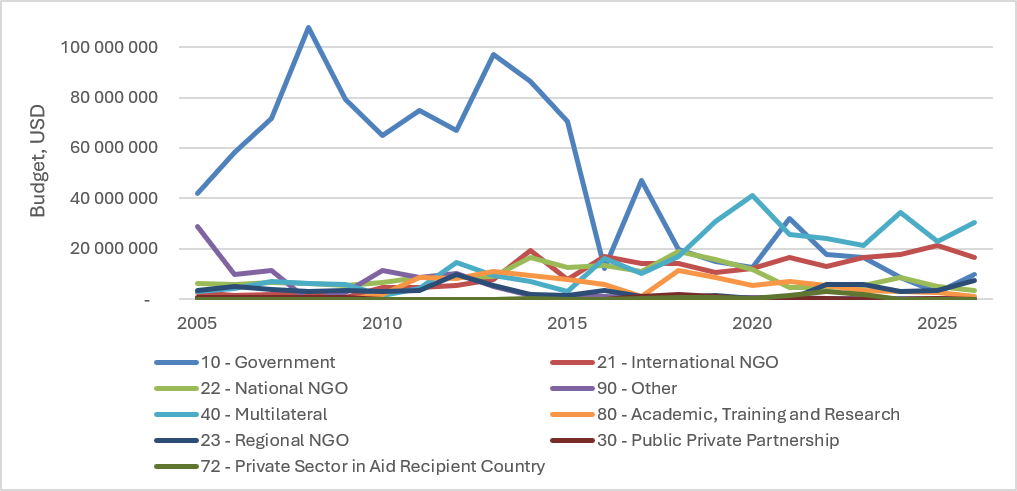
Figure 17: Funding by receiver organisation type, excluding government.
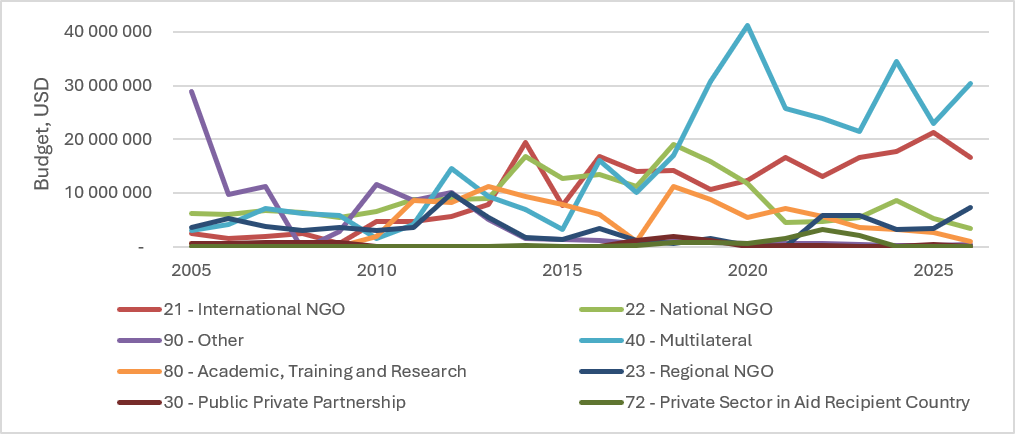
Private sector involvement remained limited throughout, while academic institutions consistently received a small share of funding (but is one of the few partners expected to continue receiving support post-exit). The growing role of multilateral organisations suggests a move towards risk management and broader coordination. The figure illustrates a clear shift in partnership strategies and supports the broader narrative of changing aid modalities and delivery channels.
Support to state institutions
Swedish support to government systems was highly relevant during state-building (2005–2010) but became less appropriate as governance risks increased. After the 2016 hidden debt crisis, Sweden shifted support to civil society, multilateral actors and selected sectors, maintaining relevance while reducing risk.
From 2005 to 2010, Mozambique’s state institutions expanded their authority amid high donor confidence, strong economic growth and significant reductions in multidimensional poverty (Chapter 2). Sweden aligned with this context by using partner country systems, supporting decentralisation and public administration reform, and maintaining substantial general budget support. This approach suited the policy environment and reflected the Paris/Accra principles as well as Mozambique’s PQG and poverty reduction strategies (Chapter 2).
As the political and governance environment became more complex between 2011 and 2015 – marked by increased centralisation, political tension, renewed RENAMO confrontation and the emergence of the hidden debts – Sweden’s approach grew more cautious. The portfolio shows recognition of governance weaknesses but did not fully anticipate the scale of the institutional crisis revealed in 2016.
The post-2016 period brought the most significant shift. After the exposure of undisclosed sovereign guarantees, Sweden reduced direct support to government systems and increased reliance on civil society and multilateral organisations. General and sector budget support were phased out, and support to the Ministry of Finance/Tribunal Administrativo was largely discontinued, as described in Case 6 below. Only support to the energy sector remained – EDM, rehabilitation of power lines, and off-grid support through BRILHO and Energy for All[28] – in strong partnership with other donors.[29]
Interview evidence supports this adaptation. Respondents note that early Swedish support was well aligned with government priorities and donor principles, reflecting confidence in state-led development. Several interviewees indicate that governance challenges became more visible during 2011–2015, leading to more cautious engagement with state institutions.
After 2016, interviewees argue there was a clear shift away from direct government support towards civil society and multilateral actors, and more indirect support to government objectives While this aligned with the governance context, some respondents note it reduced opportunities for direct institutional engagement.
Case 6: Budget centred state support and public financial management – Tribunal Administrativo
During 2005–2015, Swedish support to public administration and public financial management – including long-term assistance to the Tribunal Administrativo (TA) – was highly appropriate to Mozambique’s post-conflict and aid-dependent context. The dominant view, shared by government and donors, was that poverty reduction would be achieved through stronger state systems, improved budget credibility, and coordinated donor support. Sweden’s approach – budget support and sustained institutional capacity building – closely reflected this logic and was reinforced by the global Paris and Accra principles on using country systems.
Interview evidence confirms both the strength and the practical relevance of this approach. Swedish support played a central role in building the operational capacity of the TA, which fundamentally changed the institution from a passive reviewer of accounts into an active accountability mechanism. Long-term advisory support and training helped fill critical capacity gaps and enabled Mozambican staff to gradually take on more responsibility, contributing also to institutional learning and ownership. The combination of technical assistance, donor coordination through common funding, and close dialogue with the Embassy further strengthened relevance and coherence in this period.
At the same time, the interview material nuances the narrative of success. Some elements of the support, such as attempts to introduce complex systems or IT solutions, proved less well adapted to local conditions and had limited lasting impact. More fundamentally, the relevance of the intervention depended on sustained political commitment to transparency and reform. While the TA did gain visibility and played a role in major accountability processes, including the hidden debt crisis, its relevance was closely tied to the broader political environment and to continued donor engagement.
This dependency became particularly evident after 2015–2016, when Sweden’s withdrawal from the programme was perceived to weaken donor coordination and reduce the relevance of political dialogue. The case therefore illustrates both the strengths and limits of context-driven appropriateness: the intervention was well aligned with the assumptions and conditions of the 2005–2015 period, but its longer-term relevance proved fragile as political incentives shifted and external support declined.
Support to civil society
F: Civil society support became increasingly relevant after 2015 as civic space narrowed. Long-term, flexible funding strengthened organisations, sustained advocacy and enabled responses to emerging challenges, though outreach to marginalised groups remained limited.
Swedish civil society organisations – with Africa Groups of Sweden, Diakonia and Swedish Cooperative Center (later renamed We Effect) being the most important – were engaged in development cooperation with Mozambique in the early phase of the period under evaluation, but on a relatively limited scale (see Annex 4c). This period also included efforts to understand ‘development’ from the perspective of community-based organisations and the ‘perspectives of the poor,’ with a focus on the Niassa province where We Effect was engaged (see Section 2.4). At the same time, political space for supporting Mozambican civil society was relatively open compared to later years.
As civic space narrowed and political contestation intensified from 2015, Swedish partnerships with CSOs, watchdog organisations, gender rights groups and governance advocacy, became a central approach to promoting democratic accountability, inclusion and rights (Chapter 2). Long-term core funding as in AGIR I and II (Case 1) enabled these organisations to build institutional capacity, expand networks and sustain activity during periods of pressure. Sweden’s emphasis on rights-based programming aligned with local concerns about corruption, exclusion and limited voice (Tvedten and Picardo 2018).
Interview evidence suggests that the relevance of Swedish NGO support lay not only in thematic alignment but also in the modality, its partnership approach and its contribution to organisational capacity development. Core, flexible and long-term funding was widely valued, especially by organisations working on democracy, gender equality and civic participation. Civil society actors highlight a different dimension of relevance, focusing on empowerment, participation, and accountability.At the same time, civil society and research actors note that such approaches may be less accessible to the most marginalised groups, particularly those lacking organisational ties or social networks, which can limit how directly these interventions engage with the poorest. There were also critical voices arguing that Mozambican civil society became overwhelmed by the support and that too much remained with a limited number of national NGOs in Maputo.
Respondents noted that long-term, flexible funding enabled organisations to strengthen capacity and continue operating under political pressure, helped build democratic culture after the civil war and advance and sustain advocacy agendas. It also balanced limitations imposed by other donors’ exit or demands, as in the case of Ipas and the United States/USAID. Sweden’s ability to respond quickly to emerging civic issues, including financing NGO mobilisation against restrictive NGO legislation, further demonstrated the relevance of its support during periods of shrinking civic space.
Support to private sector
F: Swedish support to private sector development was moderately relevant, contributing to economic inclusion, rural livelihoods, SMEs and climate resilience. Its impact was constrained by limited scale and weak alignment with Mozambique’s increasingly resource-based economy.
Parallel to the shift in Swedish cooperation with the state and civil society, Mozambique’s private sector received increasing attention from the government and grew in importance, particularly after the discovery of offshore gas reserves in the early 2010s and greater ODA focus on infrastructure financing, blended finance, and climate-related investment (Chapter 2).Sweden’s adaptation in this area was more limited. While there was gradual expansion of inclusive economic development interventions – especially in agriculture value chains, rural livelihoods, small and medium sized enterprises (SMEs) development, and climate-related economic resilience – Sweden’s private sector portfolio remained modest relative to Mozambique’s evolving extractives-led economic model.
Interview evidence supports this picture of limited and selective engagement with the private sector. Several respondents note that Swedish support largely focused on smaller-scale interventions rather than major investments. While initiatives such as digitalisation, mobile finance, and market access were seen as relevant for improving opportunities for smallholders and entrepreneurs, they were not large enough to influence economic development more broadly.
One of the relatively few private sector projects applying innovative methods and targeting women is the Women in Business programme (Case 3). It illustrates a relevant adaptive shift toward private sector-led development in response to constrained state-led growth pathways, but also the limitations as its contribution to poverty reduction is indirect, medium-term, and uneven, and the difficulty of reaching the most vulnerable groups.
Some interviewees point out that Sweden’s portfolio has remained more aligned with social and institutional objectives than with Mozambican government priorities on agribusiness and private sector growth. This reinforces the observation that, although economic inclusion was addressed in targeted ways, the private sector was not a central focus of Swedish development cooperation during the period.
Reflections on relevance of partnership and aid modalities
The Swedish portfolio combined long-term engagement with flexibility in its choice of agreements and partners, supporting a model of “flexible long-termism”. While most partnerships and agreements aligned with five-year strategy cycles, a substantial share lasted ten years or more, demonstrating sustained commitment alongside the ability to adapt to changing circumstances and priorities.
Over time, Sweden’s partnership profile shifted in response to changes in the institutional context. The Mozambican Government was initially the dominant partner, but following the hidden debt crisis, funding moved increasingly towards international NGOs and multilateral organisations. This reflects changing aid modalities, with greater emphasis on risk management, coordination, and diversified delivery channels.
Similarly, Swedish support to government institutions was initially of high relevance, reflecting the state-building agenda, strong donor confidence, and the use of national systems. As governance risks increased and the hidden debt crisis exposed institutional weaknesses, Sweden showed flexibility by reducing direct government support and shifting towards civil society, multilateral organisations, and selected sectors while maintaining engagement with key development objectives.
Support to civil society became increasingly relevant as civic space narrowed, with long-termism reflected in sustained, flexible funding that strengthened organisational capacity, advocacy, participation, and accountability. Private sector support was also relevant, particularly for economic inclusion, rural livelihoods, SMEs, and climate resilience, but remained modest in scale and less aligned with Mozambique’s increasingly extractives-driven economy. Overall, Sweden adapted its partnerships and modalities to changing conditions, although challenges remained in reaching the most marginalised groups and in influencing broader economic transformation.
Reflections on partnerships and aid modalities:
R: Selected forms of government engagement might have been retained after the hidden debt crisis.
Sweden largely followed the broader donor shift away from government systems after the hidden debt crisis in 2016. An alternative pathway would have been to maintain more selective engagements with reform-oriented state government institutions, including at sub-national levels, than they did while reducing broader governance and financial risks. This might have preserved influence on institutional reform and strengthened coherence with national systems. However, it would also have involved higher governance and reputational risks in a context of declining donor confidence.
R: The portfolio might have diversified partnerships more actively while retaining long-term relationships.
Long-standing partnerships created trust, learning and adaptability, but they may also have reduced incentives to explore new actors and approaches. A more deliberate strategy of combining established partners with emerging local organisations, subnational institutions and research actors could plausibly have widened the portfolio’s reach and perspectives. Greater innovation and local ownership might have been achieved, albeit with higher transaction costs and greater uncertainty regarding partner capacity.
Poverty reduction
This section aims at assessing if the Swedish strategies and portfolio have been relevant as a tool for achieving the overall objective of Swedish development cooperation: improved conditions for people living in poverty and under oppression. To do this, we compare the specific objectives of strategies, thematic areas of the portfolio and partnership modalities, with the changing characteristics and geographical distribution of poverty.
F: The relevance of Swedish development cooperation to poverty reduction was high – both in the early period of overall poverty reduction and in the later periods of increasing poverty indicators. All four country strategies were explicitly focused on poverty reduction and linked governance, economic development and resilience to improved living conditions for people living in poverty. However, the persistent challenge of reaching the very poorest and most socially excluded largely remained.
Between 2005 and 2025, Swedish development cooperation with Mozambique pursued poverty reduction through a dual strategy: strengthening public institutions and supporting poor and vulnerable populations. This reflected the view that sustainable poverty reduction requires both functioning state systems and direct support to those most in need. Over time, however, the balance between these pillars revealed both gains and limitations.
A central feature of Swedish support was strengthening state institutions and public systems. Through institutional reforms, budget support, sector-wide approaches, and later more focused systems support, Sweden sought to improve service delivery and state responsiveness (Case 6, Tribunal Administrativo). These efforts expanded access to services and aligned aid with national priorities but were constrained by weak state capacity, political incentives, and elite capture.
Alongside systems support, Sweden consistently financed interventions targeting poor households, particularly in livelihoods, health, and education (Case 5, UNICEF). Interviews suggest these interventions delivered tangible benefits, especially by reducing vulnerability to shocks. However, impacts were often localised and difficult to sustain. Without effective institutions, gains could be reversed by service failures, conflict, economic crises, or climate shocks.
Swedish and partner respondents highlighted social protection as an important poverty-reduction approach, supported through UNICEF and the World Bank. However, some interviewees (see also Berkel et al. 2025; Jones and Tvedten 2019) argued that social protection and cash transfers could have played a larger role. More extensive use of predictable transfers might have complemented both institutional support and livelihood programmes by providing a stronger safety net for those least able to cope with recurrent shocks.
Sweden increasingly relied on subnational and area-based approaches where national engagement was constrained by political repression, conflict, fiscal crisis, and climate stress. This reflected recognition that poverty is unevenly distributed and requires locally adapted responses. Sweden also combined systems support with geographically focused interventions, acknowledging that neither institutional reform nor stand-alone projects were sufficient on their own.
A further evolution was the growing emphasis on accountability, civic space, and rights. Support to civil society, media, and accountability mechanisms sought to address poverty drivers linked to power imbalances, weak oversight, and restricted citizen voice (Case 1, AGIR/ALCANCE). This reflected a more politically informed understanding of poverty reduction and complemented both institutional strengthening and targeted support but carried greater risks in a more restrictive political environment.
While Sida and partner interviewees generally viewed programmes as relevant for poverty reduction, they emphasised different dimensions. Sida respondents highlighted support to poorer regions and vulnerable groups, particularly women and youth, through agriculture, local economic development, and employment. Government partners stressed the importance of support to economic development, energy, and infrastructure in addressing structural barriers to access to services, economic opportunities, health, and education. Civil society actors focused on empowerment, participation, and accountability.
We Effect’s long-term presence in Niassa (including Case 1) illustrates this approach. Support to strengthen farmer organisations addressed weak bargaining power and limited access to markets and technology; support to diversified livelihoods reflected the need for income diversification; and the focus on empowerment aligned with the importance of social relations for both poverty dynamics and mobility (Section 2.4).
Taken together, Swedish support reflected an increasingly nuanced understanding of poverty reduction. Rather than relying on a single pathway, it combined institutional strengthening, targeted household support, social protection, area-based interventions, and efforts to strengthen accountability. This suggests a growing recognising that sustainable poverty reduction depends on both reaching vulnerable groups and addressing underlying political and institutional constraints.
The box below clarifies the relevance of the case studies approaches to poverty reduction:
Approach to Poverty Reduction in the Six Case Studies
Across the six cases, contributions to poverty reduction are pursued through different pathways and with varying degrees of directness (see Annex 4b for pros and cons of different aid channels). As noted in Section 1.1, it is beyond the scope of this evaluation to assess the extent to which the featured interventions have been effective or generated sustainable poverty reduction impacts. Rather, the purpose here is to examine the relevance of these different intervention approaches to poverty reduction, including the assumptions through which they are expected to benefit poor and vulnerable populations and the extent to which poverty reduction is an explicit or indirect objective.
Case 6: Governance interventions, such as support to the Tribunal Administrativo, are based on the assumption that stronger state systems contribute to poverty reduction through improved accountability and more effective resource use. Whether their relevance is high or not depends on institutional performance.
Case 4: Infrastructure investments, such as hydropower, respond to development needs but are only indirectly linked to poverty reduction, since their benefits depend on access and distribution.
Case 1: A similar dynamic is evident in support to civil society through AGIR. By strengthening voice and accountability, these interventions create pathways to poverty reduction, although their relevance depends on whether governance improvements are expected to translate into benefits for poor and vulnerable groups.Case 3: Market-based interventions, such as WIN, represent another pathway by targeting economic exclusion. Their relevance to poverty reduction stems from the assumption that expanded economic opportunities and employment can contribute to improved livelihoods, although benefits may not reach the poorest automatically.
Case 2 and 5: In contrast, service-oriented interventions and social protection measures such as UNICEF and Ipas demonstrate more immediate relevance, as they directly address health, protection, and access to services, even though the latter also supports advocacy, learning and capacity building.
In sum, the different approaches show that relevance to poverty reduction depends both on the pathway chosen and its ability to reach poor and vulnerable groups. Structural interventions address underlying causes of poverty but often reach the poor indirectly. Service-delivery and social protection interventions demonstrate more immediate relevance through direct support to vulnerable populations but do not address the structural drivers of poverty. And market-based approaches expand opportunities but face greater challenges in ensuring that intended benefits reach the poorest and most marginalised.
Reflections on relevance to poverty reduction
Swedish development cooperation was generally relevant to poverty reduction throughout the evaluation period. The strategies combined support to public institutions with targeted interventions for poor and vulnerable groups, reflecting a strong element of long-termism in addressing the structural causes of poverty. Support evolved over time to include governance, livelihoods, resilience, accountability, rights, and social protection, demonstrating an increasing recognition that poverty is multidimensional and requires multiple pathways of engagement.
The portfolio also showed considerable flexibility in adapting to changing political, economic, and environmental conditions through subnational approaches, civil society partnerships, and geographically targeted interventions. While different actors emphasised different pathways to poverty reduction, there was broad agreement on the overall relevance of the portfolio. However, reaching the very poorest and most marginalised remained a persistent challenge, and interview- and other evidence suggests that greater use of social protection and predictable cash transfers could have complemented broader institutional and livelihood interventions by providing a stronger safety net for vulnerable households.
Reflections on Poverty Reduction:
R: Poverty reduction might have been translated into more explicit operational priorities.
Throughout the period, poverty reduction remained the overarching objective but increasingly became an implicit outcome of interventions in governance, climate, rights and economic development rather than a direct organising principle for portfolio choices. A plausible alternative would have been to translate poverty reduction more systematically into operational criteria for partner selection, geographical focus and sector prioritisation. This might have strengthened the poverty orientation of the portfolio and facilitated adaptation to changing poverty patterns. The trade-off would have been less flexibility to support broader governance, institutional and global public goods agendas.
R: An earlier shift towards northern Mozambique might have increased alignment with evolving poverty dynamics.
Evidence on poverty trends increasingly showed that poverty was becoming more concentrated in northern and central Mozambique long before the final strategy introduced a stronger overall northern focus. A more explicit geographical concentration from the mid-2010s onwards beyond Niassa could plausibly have increased the alignment between Swedish support and the location of the poorest populations. Greater relevance to changing poverty geographies and vulnerability patterns may have come at the expense of national influence and engagement with central institutions.
R: A stronger focus on urban poverty and economic vulnerability might have anticipated emerging development challenges.
Many Swedish interventions were designed around persistent assumptions about rural poverty, agriculture and regional inequality. While these remained important, poverty increasingly acquired urban dimensions linked to informality, unemployment and vulnerability to economic shocks. A more balanced rural-urban approach could have reflected these trends earlier. This may have increased relevance to emerging poverty dynamics but could have diluted resources available for the poorest rural regions, where poverty remained most severe.
Combining long-term commitment and flexible implementation
This final section assesses the relevance of Swedish development cooperation with Mozambique over the period 2005–2025. It does so through two complementary perspectives: first, by examining how Swedish strategies have been operationalised and implemented in response to the Mozambican context; and second, by assessing the extent to which Sweden has remained relevant by combining long-term engagement with the flexibility needed to adapt to changing political, economic and governance conditions.
The strategy operationalisation process
F: Both formulation and operationalisation of the strategies have been based on analyses of the local context. The strategies are generally perceived as being well adapted to the context, but less so in the most recent period.
As noted in Chapter 3, Sida plays a central role in strategy preparation by providing analysis and proposing objectives and focus areas, while the MFA undertakes final drafting. Strategy development draws on contextual analysis, stakeholder consultations, and reviews of previous strategies, helping align Swedish support with local needs and priorities.
A review of strategy operationalisation plans[30] confirms consistent Embassy involvement. The Embassy submitted proposals for country strategies in 2008 and 2014, while multidimensional poverty analyses (MDPAs) informed the two most recent strategy periods (Ternström, Tvedten et al. 2025). These analyses covered poverty, state capacity, donor engagement, and beneficiary needs.
The operationalisation plans illustrate how strategic objectives were translated into programmes through contextual analysis, partner selection, and implementation choices. Earlier plans emphasised donor coordination and the Paris Agenda, whereas later plans focused more on the Swedish portfolio and its partners.
Interviewees described the latest strategy as broad but largely aligned with Mozambique’s development challenges. The MDPA informed priorities in poorer northern regions, particularly Niassa, as well as programme design and partnerships. Stakeholder consultations also shaped initiatives supporting climate-smart agriculture, ex-combatants in Sofala, and displaced populations in Cabo Delgado.
Respondents nevertheless noted growing influence from Sida headquarters and the MFA, including priorities related to trade, energy, migration, and private-sector engagement that were not always perceived as locally driven. Overall, operationalisation remained the main mechanism for translating strategic objectives into relevant interventions.
F: Poverty reduction has a central role in the operationalisation process.
Poverty reduction appears in all operationalisation plans, although with varying emphasis. While the latest strategy places less explicit emphasis on poverty reduction, the corresponding operationalisation plan maintains a strong poverty focus. Respondents emphasised that operationalisation has sustained this focus through geographic priorities, target groups and programme design. Although views differ on how poverty reduction is best achieved, there was broad agreement that it remains the fundamental purpose of Swedish development cooperation.
F: The portfolio of interventions has been adapted to changes in the local context during programme implementation. In some cases, the adaptation was rushed.
Interviewees provided examples of programmes being adapted during implementation or introduced in response to changing circumstances. Some reflected learning and evolving needs, while others were driven by headquarters directives or external shocks such as the conflict in Cabo Delgado.
The hidden debt crisis illustrates both strengths and limitations of this approach. Withdrawal from budget support created pressure to identify new partners and programmes rapidly. According to interviewees, staff capacity and experience did not always match the pace of change, resulting in adaptation processes that were sometimes rushed.
F: Relationships with implementing organisations have played a key role in strategy operationalisation as well as implementation. Programme development was often done jointly and after partners were selected.
Document review and interviews show that partner selection is a central part of operationalisation, and existing relationships often influence both partner choice and programme design. Long-term partnerships, repeated collaboration and second programme phases indicate substantial continuity (Figure 15). Once a strategy is approved, the Embassy generally develops a portfolio outline and works with selected partners to refine programme design.
The introduction of biodiversity as a new programme area illustrates this approach. Interviewees highlighted its efficiency but also risks related to limited competition and reliance on a relatively small group of established organisations.
Strong partner relationships were repeatedly described as supporting relevance and flexibility. Informal dialogue and trust between the Embassy and partners facilitated programme adjustments when circumstances changed. One respondent highlighted how such relationships helped address corruption allegations during 2011–2012, illustrating the value of long-standing relationships in managing sensitive challenges.
F: The bilateral strategies are broad, leaving much room adaptation to the local context, but also places considerable power in the hands of Embassy staff.
Several interviewees noted that the broad nature of Swedish country strategies leaves considerable room for interpretation during operationalisation. This flexibility enables adaptation of interventions, partnerships and geographic targeting to local conditions, and many argued that key strategic decisions are made during operationalisation rather than in the strategy documents.
Interviews with Sida staff and partners indicate that Embassy staff have often played a significant role in shaping the portfolio. Delegated authority from Sida headquarters has enabled responsiveness to local opportunities and challenges. However, it also creates dependence on the judgement, networks and experience of individual staff members, while partnership development relies heavily on informal relationships. Although this flexibility generally strengthens contextual adaptation, it may also create risks related to consistency and transparency.
Long-term relevance and adaptation
F: Across the period 2005–2025, adaptation of Swedish strategies and portfolios to the Mozambican context has been dynamic but uneven.
Interviewees broadly agreed that Swedish development cooperation remained relevant to Mozambique’s changing context through its focus on poverty, governance, climate, conflict and gender equality, and its willingness to remain engaged during uncertainty. However, relevance became harder to maintain as the operating environment deteriorated.
The meaning of relevance also changed over time. Earlier cooperation was closely aligned with poverty reduction and government priorities, whereas later strategies were more influenced by Swedish priorities and global agendas. Relevance was strongest during periods of policy convergence and crisis-driven realignment (2005–2010 and 2016–2020) and weaker when growing risks were not matched by changes in aid modalities.
Sweden also occasionally diverged from Mozambican government priorities to address governance deficits, protect civic space and reach vulnerable groups through non-state channels.
F: The relevance of Swedish aid was high in the aid-optimistic, post-conflict context in 2005–2010, reflecting strong alignment with Mozambique’s development priorities and prevailing aid approaches.
Mozambique was widely regarded as a post-conflict success story characterised by economic growth, declining poverty and high donor confidence despite persistent rural poverty.
Swedish support focused on poverty reduction, state-building and service delivery, aligning closely with national development strategies and aid-effectiveness principles. This was reflected in budget support, sector-wide approaches, and investments in infrastructure, rural development and decentralisation (Figure 7). Under these conditions, reliance on national systems and long-term engagement was broadly appropriate.
F: Contextual relevance declined during the period 2011–2015, as the political-economy context evolved rapidly, but corresponding adjustments in the aid portfolio were delayed.
The period combined optimism linked to major gas discoveries and expectations of rapid economic growth with growing political centralisation, renewed conflict, slowing poverty reduction and hidden debt accumulation.
Swedish strategies increasingly emphasised democracy, human rights, accountability and inequality, in line with emerging concerns about these developments and international trends. However, portfolio adaptation lagged behind events. Budget support and reliance on government systems remained important despite rising governance and fiduciary risks.
This period illustrates how alignment with recipient government policy and practise and ODA paradigms can be undermined when political economy risks are underestimated or obscured, and when strategic signals are not matched by timely changes in aid modalities. Support to capacity development of the Tribunal Administrative (Case 6) illustrates this challenge.
F: During 2016–2020, the relevance of Swedish support was strengthened through a post-crisis realignment that shifted priorities towards democracy, human rights, accountability, inequality and civil society engagement, while moving away from earlier ambitions of systemic state-building through national systems.
The hidden debt crisis, together with economic instability, rising poverty, climate shocks and the Cabo Delgado insurgency, made Mozambique’s operating environment far more fragile. Sweden ended budget support and redirected resources to civil society and multilateral organisations, prioritising governance, accountability, resilience and gender equality, while continuing programmes such as AGIR (Case 1).
Interviewees generally considered this shift appropriate given declining state capacity and higher fiduciary risks. Sweden’s support for the hidden debt audit, despite straining relations with the government, was widely seen as evidence of its commitment to accountability.
Some, however, called for a better balance between state and non-state engagement. The UNICEF case (Case 5) illustrates this tension: its flexible approach sustained services and social cohesion but highlighted trade-offs between service delivery and institution-building. Overall, the period shows how flexibility helped Sweden maintain long-term objectives through changing partnerships and delivery mechanisms.
F: The relevance of Swedish aid remained broadly high between 2021–2025, as its focus on fragility, democratic space, climate and inclusion reflected Mozambique’s evolving challenges. However, relevance weakened after 2022 with the new Swedish policy priorities and the planned phase-out.
Mozambique continued to face conflict, climate shocks and widespread poverty. Swedish objectives remained broadly aligned through support for resilience, inclusion, democratic space and climate adaptation and civil society and multilateral organisations continued to play a central role in implementation. The portfolio remained relevant through its focus on multidimensional poverty and fragility, particularly in poorer northern regions and among populations affected by conflict, displacement and climate vulnerability.
After 2022, however, relevance weakened as other Swedish priorities increasingly shaped portfolio choices. The Reform Agenda and planned phase-out reduced scope for adaptation to Mozambican needs and created uncertainty for long-standing partnerships. At the same time, Swedish support became more important as funding from other donors declined, particularly for civil society, human rights and sexual and reproductive health and rights as illustrated in Ipas Safe Abortions programme (Case 2).
Reflections on long-term commitment and flexibility
Overall, Swedish development cooperation remained largely relevant to Mozambique during 2005–2025. This relevance stemmed less from strategy documents than from their implementation. Context analysis, local knowledge, stakeholder dialogue and strong partnerships enabled Sida and the embassy to translate broad objectives into interventions that addressed evolving needs and priorities. Poverty reduction remained a guiding principle throughout, although it became less explicit in the most recent period.
Sweden’s relevance depended on combining long-term engagement with flexibility. Established partnerships, contextual knowledge and a sustained presence supported adaptation while maintaining objectives related to poverty, governance, resilience and inclusion, particularly during periods of crisis and change.
This balance was not always achieved. Before the hidden debt crisis, portfolio adjustments lagged behind political developments, reducing the relevance of some support. Elsewhere, rapid adaptation strained staff capacity and programme processes. Broad strategies enabled responsiveness but created risks for consistency and transparency.
Despite these limitations, Sweden largely remained relevant across changing circumstances. Relevance was strongest when long-term commitment was paired with flexibility, although post-2022 policy shifts and the planned phase-out have weakened this balance and raised concerns about sustainability.
Reflections on long-termism and flexibility:
R: Could relevance have been strengthened further?
A somewhat stronger focus on changing poverty dynamics, climate vulnerability, selective state engagement, geographical concentration and adaptive strategy design might plausibly have strengthened the link between Sweden’s overarching objectives, Mozambique’s evolving realities and the ultimate goal of poverty reduction. Most alternatives would have involved trade-offs between national influence and local targeting, institutional reform and direct poverty reduction, or continuity and adaptation – the same tensions that lay at the heart of Sweden’s effort to reconcile long-termism and flexibility throughout the period.
R: The strategies could have incorporated more explicit triggers for adaptation.
Sweden was generally flexible in practice, but adaptation often depended on individuals, informal processes and contextual judgement. An alternative approach would have been to include clearer strategic triggers linked to governance deterioration, poverty reversals, climate shocks or conflict escalation. This could have facilitated earlier and more predictable adaptation while reducing dependence on individual interpretation. More explicit triggers, however, might have constrained flexibility in responding to unforeseen developments.
Key findings and reflections on relevance
The Swedish portfolio remained broadly relevant and aligned with Sweden’s development objectives throughout the evaluation period, both in addressing key priorities and contributing to poverty reduction. Its relevance stemmed from sustained attention to poverty, governance, gender equality, and human rights, combined with responsiveness to Mozambique’s changing development challenges. Document reviews and interviews indicate that contextual analysis played an important role in both strategy development and portfolio operationalisation.
The portfolio generally reflected shifts in both Swedish priorities and the Mozambican context. Before 2016, relevance was expressed mainly through support to state institutions and budget support. Following the hidden debt crisis, support increasingly focused on civil society, multilateral organisations, and more targeted interventions addressing the needs of poor and vulnerable groups affected by conflict, displacement, climate shocks, and economic hardship, particularly in northern Mozambique.
However, relevance was not always maintained. Adaptation lagged behind deteriorating governance conditions between 2011 and 2015 and the hidden debt crisis, while the subsequent move away from state systems reduced opportunities to influence policy and institutional reform. Portfolio choices were also increasingly shaped by Swedish policy priorities and HQ directives, at times weakening alignment with partner-government priorities. Nonetheless, Swedish development cooperation remained largely relevant across two decades of profound political, economic, and environmental change, although post-2022 policy shifts and the planned phase-out raised concerns about sustainability and future relevance.
Overall reflections on relevance:
The evaluation suggests that relevance is necessary for effective development cooperation, but not sufficient. Interventions can respond well to changing needs and priorities without addressing the deeper factors that sustain poverty. Mozambique illustrates this challenge. While support often adapted successfully to new realities, adaptation alone could not overcome weak institutions, political centralisation, conflict, or climate vulnerability. The key question is therefore not whether interventions were relevant, but whether they were relevant to the most important drivers of poverty.
With hindsight, it is reasonable to conclude that Sweden generally adapted appropriately to changing circumstances. However, the adaptation involved trade-offs. Increased attention to vulnerable groups and crisis-affected areas strengthened the poverty focus of the portfolio but reduced opportunities to influence broader institutional and policy reforms. The challenge was less about maintaining relevance than about choosing which forms of relevance mattered most.
The Mozambican experience also raises the possibility that development cooperation can become “too relevant” to immediate challenges. Constant adaptation may encourage a focus on symptoms rather than causes, favouring interventions that respond to urgent needs while giving less attention to longer-term transformation. Greater investment in social protection, climate resilience, and poorer regions was justified, but a stronger focus on selected state institutions and accountability mechanisms might have addressed underlying sources of vulnerability.
The Mozambican experience thus suggests that relevance is a fundamental condition for development cooperation to contribute to poverty reduction and development outcomes. While relevance alone cannot overcome structural constraints such as weak governance, conflict, or climate vulnerability, its absence would almost certainly reduce the impact of development cooperation. The challenge is therefore not whether to prioritise relevance, but how to define it. In fragile and rapidly changing environments, relevance should be understood as a continuous effort to ensure that interventions remain connected to the factors that matter most for reducing poverty and improving lives. Seen in this way, relevance is not merely one evaluation criterion among others, but a foundation for achieving broader development results.
Coherence of Swedish cooperation 2005–2025
This chapter responds to Evaluation question 2: Has the Swedish aid portfolio been and remained coherent with the planning and interventions of domestic actors and other donors?
While relevance concerns whether Swedish development cooperation is adapted to needs, priorities and context, coherence concerns how well Swedish interventions fit with and complements the actions of government institutions and other donors (external coherence), and other parts of the Swedish portfolio and norms guiding Sweden’s development cooperation (internal coherence). Sweden’s ability to maintain relevance over time has largely depended on its coherence – both internally (Section 5.1) and externally with Mozambican government institutions and other donors (Section 5.2).
Internal coherence
Sweden has adopted a set of ‘perspectives’ (Section 3.1), partly in response to international norms and standards arising from the conventions and agreements to which Sweden is a signatory (Annex 4a). These intend to guide how Swedish development cooperation is implemented and have been in place for much of the period under evaluation (Government of Sweden, 2013 and 2016).
F: Assessment of coherence with Sida’s five perspectives is constrained by limitations in the information available through Openaid. Nevertheless, the case studies indicate that the five perspectives were mainstreamed to varying degrees across the programmes and reflected in the portfolio through support to poverty reduction, human rights, gender equality, environmental sustainability, and populations affected by conflict and fragility.
The five perspectives[31] remained in place until 2023, when they were replaced by priorities in the Reform Agenda. Although introduced late in the evaluation period, this change affected data availability as search criteria now include the Reform Agenda priority areas instead of the policy markers that used to indicate the extent to which a programme considered the five perspectives. Hence, Openaid data could not be used to assess the extent to which the perspectives were mainstreamed across the portfolio.
Poor People’s Perspective is evident in several contributions, including long-term support to Niassa province through AGIR and ALCANCE. It is also reflected in the strategies’ overarching focus on poverty reduction and support to poor and vulnerable groups. However, contribution data do not allow systematic assessment of target groups or beneficiaries. The Reality Check programme (Section 2.4) was a notable effort to understand poverty from the perspective of the poor and, according to interviewees, informed later programming and planning of the Swedish portfolio (Jones and Tvedten 2019).
The Rights Perspective is reflected in support to democratic participation and civil society, and to human rights (Figure 8). Additional support was provided to media and elections and– albeit more limited – women’s rights organisations, including Forum Mulher. The perspective is mainstreamed in the broad civil society and inclusive economic development programmes such as AGIR and the UNICEF Nexus programme.
The Conflict Perspective is reflected in programme design through geographic targeting and beneficiary selection, including in UNICEF programmes.
The Gender Equality Perspective is reflected in programmes aimed at strengthening women’s rights and gender equality, such as Ipas’s Safe Abortions programme and Techno Serve’s Women in Business initiative, as well as through the targeting of women and mainstreaming the perspective across programmes.
The Environmental and Climate Perspective is reflected both in dedicated environment and climate programmes (although with a small budget share) and in broader initiatives such as AGIR, ALCANCE and the UNICEF Nexus programme. Environment also appears in all four strategies, although not as a primary objective in the first two.
These examples indicate that the five perspectives were integrated to varying degrees across the case studies. Table 12 presents the team’s assessment of their incorporation into the case-study programmes.[32]
Table 12: Integration of the five perspectives in case study programmes
|
Case study Program |
Poor People’s Perspective |
Rights Perspective |
Conflict |
Case study Program |
Poor People’s Perspective |
|
Case 1: AGIR I & II – Civil Society Strengthening |
X |
X |
X |
X |
|
|
Case 2: Ipas – Access to Safe Abortions |
X |
X |
X |
||
|
Case 3: WIN I & II – Women in Business |
X |
X |
X |
||
|
Case 4: Rehabilitation of Two Hydropower Plants |
X |
X |
|||
|
Case 5: UNICEF: Nexus Support for Northern Mozambique |
X |
X |
X |
X |
X |
|
Case 6: Public Administration – Tribunal Administrativo |
X |
X |
F: The Swedish portfolio was generally internally coherent, with contributions designed and implemented in ways that reinforced each other through long-term partnerships, co-creation with partners, and active portfolio management by the Embassy. Efforts to increase results-based management sometimes created tensions between Sida’s reporting requirements and partners’ own strategic priorities.
As described in Section 4.4, the Sida unit in Mozambique plays a strong coordinating role in shaping the portfolio. Several interviewees noted that both the Sida unit and the Embassy operate with considerable autonomy compared with counterparts elsewhere.
The operationalisation process also indicates that coherence with other actors and programmes is considered during portfolio development. Interviewees reported that partners are involved in programme design and that programmes are adjusted to fit with partners’ broader activities. One partner interviewee noted that the:
“co-creation approach in programme design foster partnership rather than simple contractual relations [which is] enhancing coherence.”
Joint programme development, with partners selected on the basis of both organisational capacity and strategic alignment with Sida’s priorities and objectives, increases opportunities for synergy across interventions. Coordination across thematic areas is less visible, although Embassy staff reported growing collaboration across thematic teams during the latest strategy period, with the Nexus programme contributing to this development.
One example of inadequate internal coherence is from the energy sector: Transmission lines in Mozambique are operated by EDM, and a 2022 reform opened the sector to private participation. A Swedish-backed private transmission project emerged while embassy staff were preparing a similar project with EDM, causing the latter to be dropped. Respondents cited this as a lack of coherence between Swedish financing channels. The case also exposed the limits of the Energy Sector Working Group, which coordinated donor financing at the sector level but did not ensure coordination among projects and actors within individual donor portfolios.
The AGIR/ALCANCE programme in Niassa illustrates coordination among partners and efforts to generate synergies by using their comparative strengths. While this approach strengthened local CSOs and utilised partner expertise effectively, interviewees also noted high administrative burdens and difficulties for local CSOs after programme completion. This was confirmed by other evaluations and reports (see Annex 3b, section 5). The second phase of AGIR introduced stronger results-based reporting requirements from Sida headquarters. Interviewees described increasing tension between programme results frameworks and the strategic priorities of partner organisations, reducing coherence with partner objectives.
Reflections on internal coherence
Sweden’s development cooperation with Mozambique demonstrated a relatively high degree of internal coherence, although limited data constrain definitive conclusions. Across the four strategy periods, the portfolio reflected continued commitment to the five perspectives, supported by long-term partnerships and sustained engagement in key sectors. This strengthened relevance by enabling Sweden to maintain a consistent strategic direction while responding to changing needs. Long-standing partnerships and multi-year programmes also reflected strong long-termism, supporting continuity despite major political, economic and institutional change.
At the same time, the portfolio demonstrated considerable flexibility, particularly after the 2016 hidden debt crisis, when support shifted from budget support towards civil society organisations, multilateral agencies and more targeted interventions. This helped maintain coherence in a changing political, institutional and donor environment by allowing Sweden to adapt its partnerships, funding channels and implementation modalities. However, tensions remained between continuity and adaptation. While broad strategies facilitated contextual adjustment, changing priorities from Sida headquarters, the Ministry for Foreign Affairs and later the Reform Agenda at times weakened coherence with operational priorities.
Reflections on internal coherence:
R: Sweden could have done more to address tensions between its different objectives, approaches and partnerships.
Different parts of the portfolio were not always mutually reinforcing, with programmes in governance, civil society, private-sector development, and local development sometimes operating in parallel without a clear strategy for managing complementarities or contradictions. A stronger focus on portfolio-wide coherence might have generated greater synergies across development objectives and strengthened overall impact. However, this would likely have increased management complexity and reduced flexibility for individual partners and programmes.
R: Sweden could have relied less on informal relationships and individual staff capacity to maintain coherence.
Swedish cooperation benefited from long-term relationships, delegated authority, and an experienced Embassy team. However, coherence often depended on individual staff members and informal coordination rather than institutionalised systems. Stronger mechanisms for portfolio management, learning, and coordination might have improved continuity and reduced reliance on personal networks. However, this could also have resulted in a more formalised approach, potentially reducing the flexibility and responsiveness that many partners valued.
External coherence
As defined by OECD DAC (2021), external coherence refers to the extent to which a donor’s interventions are compatible with, complementary to, and mutually reinforcing of those of other actors, including partner-country governments. In Mozambique, this involves assessing how Swedish development cooperation interacted with government and other actors to reduce duplication, minimise contradictions, and increase synergies and the likelihood that partner institutions can absorb and integrate interventions into existing systems. Before presenting the analysis, the table below provides an overview of the formal coordination and collaboration arrangements associated with the case studies. It highlights the diversity of mechanisms and Sweden’s central role in many of them. Section 5.2.1 examines coherence with government institutions, Section 5.2.2 coherence with other donors, and Section 5.2.3 Sweden’s roles in donor coordination mechanisms.
Table 13: Formal coordination of case study contributions
|
Case |
Forms of coordination |
Collaboration mechanisms |
Sweden’s role |
Roles of other actors |
|
1. We Effect and other CSOs: AGIR and ALCANCE |
Semi-formal + informal coordination among partners |
Networks, platforms, joint advocacy |
Facilitator, broker |
CSOs and intermediaries collaborate |
|
2. Ipas: Safe Abortions |
Multi-level, multi-stakeholder coordination |
Joint planning, joint fieldwork |
Collaborative partner |
Govt, CSOs, UN co-implement |
|
3. TechnoServe WIN I & II |
Informal, partnership-based |
Programme partnerships |
Strategic influencing partner |
Implementers collab |
|
4. EDM: Hydropower rehabilitation |
Formal sector working groups |
Joint financing, pooled funds |
Convenor, thematic leader |
Govt leads; donors co-finance |
|
5. UNICEF: Nexus programme |
DP groups, troika, UN frameworks |
Co-creation, multi-agency programmes |
Active co-coordinator, thematic leader |
UN system + donors jointly engage govt |
|
6. Gov’t of Mozambique: Support to Tribunal Administrativo |
Formal donor groups, common funds |
Joint dialogue, pooled financing |
Coordinator, convener, leader |
Donors + govt institutions |
Source: Derived from Swedish and partner interviews (AI-generated). No formal/official overview has been available
Coherence with Mozambican government institutions
F: Sweden’s coherence with Mozambican government institutions evolved from broad system-level alignment to more selective and thematic engagement as governance conditions deteriorated. Following the hidden debt crisis, Sweden continued to support government priorities through direct cooperation with selected public institutions and indirect engagement via multilateral partners, maintaining coherence at a reduced level while also reducing its influence on broader institutional reform.
According to Cruz et al. (2023b), public institutions in Mozambique are crucial because they shape how resources are used and whether growth leads to poverty reduction and better services. They underpin the rule of law, public service delivery, and political stability, all of which are necessary for inclusive and sustainable development. At the same time, Mozambique’s government institutions face major challenges, including weak state capacity, corruption, and limited independence of the judiciary and other oversight bodies.
Sweden’s coherence with Mozambican government institutions evolved through four distinct phases. It moved from strong alignment and donor harmonisation (2005–2010), through growing divergence despite continued formal cooperation (2011–2015), to selective engagement after the hidden debt crisis (2016–2020), and finally towards thematic alignment combined with the Reform Agenda, reductions in funding and eventually the bilateral aid exit (2021–2025).
F: Between 2005 and 2010, Sweden’s external coherence relied on the assumption that incremental institutional strengthening through national systems would support sustainable poverty reduction.
Coherence was achieved through close integration with other development efforts operating via government systems and policy frameworks. Interviewees emphasised open and substantial policy dialogue– also on sensitive issues such as democracy, participation and governance – and Sweden’s leadership in governance, energy, decentralisation and budget support.
Reliance on budget support, sector-wide approaches and pooled funding reflected strong alignment with Mozambican systems and Paris Declaration principles (see Annex 4a). Respondents underline that pooling resources around a common instrument contributed to coherence by aligning incentives and reducing duplication. It supported donor harmonisation, reducing fragmentation and transaction costs for government counterparts. In OECD-DAC terms, Swedish interventions were largely mutually reinforcing with government action.
Donor coordination: Budget Support Governance.[33] During the budget-support era, Sweden participated in joint government-donor mechanisms monitoring governance and public-sector performance, engaging with Mozambican authorities alongside other development partners, helping align external support with government reform agendas and creating a common framework for policy dialogue and accountability. This strengthened coherence by linking Swedish support to broader governance reform processes rather than stand-alone projects.
Case studies underline this coherence. Support to the Ministry of Planning and Finance and the Tribunal Administrativo (Case 6) strengthened audit, budgeting and oversight systems while remaining embedded within state institutions. Long-term engagement in Niassa (Case 1) similarly combined infrastructure, decentralisation and service delivery that complemented local government mandates and capacity.
F: Coherence between Swedish support and Mozambican government interventions became increasingly strained between 2011 and 2015.
As Mozambican priorities shifted towards growth acceleration, infrastructure expansion and anticipated extractive revenues, alongside increasing political centralisation and weakening accountability, Swedish interventions placed greater emphasis on democracy, human rights, inequality and accountability. While government interviewees credited Sweden for maintaining transparency and accountability principles, Sida staff and partners noted that increasingly strained relationships reduced the scope for collaboration.
Sweden continued to rely on budget support and government-centred implementation, maintaining formal compatibility with Mozambican policy frameworks. However, coherence weakened because donor assumptions about institutional behaviour increasingly diverged from political and administrative realities. Different programme modalities also generated tensions. In Niassa the ALCANCE programmes (Case 1) managed by We Effect focused on district- and community-level development, while the MALONDA programme promoted private-sector investment. The expansion of MALONDA forestry plantations created difficulties for local farmers targeted by We Effect activities (Tvedten, Tuominen et al, 2014; Adler 2018).[34]
F: After 2016, coherence shifted from integration to complementarity with government systems.
The disclosure of the hidden debt crisis marked a decisive rupture in donor-government relations and fundamentally changed the conditions for coherence in Mozambique. As confidence in state institutions collapsed, the IMF and most donors, including Sweden, suspended budget support, removing a key mechanism for coordination and alignment through government systems.
Sweden adjusted its partnerships and modalities to maintain coherence under these conditions. Rather than relying on central government systems, support shifted towards complementarity with other actors, often outside central state structures while continuing to support the government’s poverty reduction objectives. This included engagement with provincial and district authorities, notably in Niassa and through AGIR partners (Case 1), as well as selective capacity development support to public institutions. Coherence was therefore pursued less through system integration and more through strategic complementarity in a fragmented environment.
The shift reflected emerging priorities related to fragility, climate resilience and localised approaches to development. According to interviewees, coherence increasingly depended on selecting appropriate partners and coordination mechanisms rather than integrating support through national systems. While this reduced Sweden’s influence on broader institutional reform, it enabled support to remain relevant and complementary in a context of declining state capacity and growing governance risks.
Donor coordination: Agricultural and Rural Development Group (AGRED). Sweden participated in AGRED, which provided a forum for dialogue between government and development partners on policies, interventions and priorities in agriculture and rural development, supporting transparency and alignment between donor-funded activities and government objectives.
At the same time, Sweden maintained selective cooperation with public institutions where institutional capacity remained sufficiently robust. One example is the Tax Authority[35], where Sida supported tax administration through pooled funding and later technical assistance. Although cooperation was interrupted in 2017 due to integrity concerns, a new technical-assistance agreement was signed in 2022. This illustrates how support was adapted to different institutional capacities and risk levels.
F: In the final period 2021 to 2025, Sweden remained aligned with national priorities by supporting resilience, social protection and climate adaptation where government capacity was limited.
Coherence was shaped less by acute shocks than by prolonged fragility. As noted in Chapter 2, Mozambican government priorities increasingly emphasised resilience, social protection and recovery, broadly overlapping with Swedish priorities relating to fragility, climate risk and shrinking civic space. This created a basis for cooperation and coherence. However, deteriorating governance conditions and Sweden’s decision to phase out bilateral cooperation limited opportunities to translate this convergence into deeper coordination and complementarity. One interviewee noted that:
“There is continuing coordination in specific groups… but [there] lacks a vision of what the partners do in the country.”
Cooperation with organisations such as Ipas, LoCAL and UNICEF exemplifies this late-stage coherence. Ipas (Case 2) supports implementation of the government’s legalisation of abortion and LoCAL supports district-level climate adaptation through performance-based resilience grants aligned with local priorities and strengthened local planning, budgeting and accountability. UNICEF’s Nexus programme (Case 5), supports government efforts to strengthen social protection, operating outside government systems while remaining aligned with national objectives.
These interventions complement national objectives while operating through decentralised or non-state channels better suited to local capacity and risk profiles than government agencies. In OECD-DAC terms, Swedish support avoided duplication by focusing on areas where government capacity was limited.
F: Sweden has at times intentionally supported interventions that go against Mozambican government priorities.
Some interventions challenged overall coherence by placing Swedish support in direct tension with government priorities and, at times, with the approaches of other donors. As a result, Sweden was sometimes perceived as an “enfant terrible” within government and parts of the donor community.
Examples include support to the Centre for Public Integrity (CIP), LAMBDA (the Mozambican Association for the Defence of Sexual Minorities), and Ipas (Case 2), which supports the right to abortion (see Section 2.3, and Annex 4c). Interviews suggest that support to LAMBDA generated friction not only with government but also with some civil society actors and segments of the broader public.
More recently, changing Swedish development priorities, including the Reform Agenda, and the impending aid exit have shifted engagement from coherence towards disengagement, prioritising risk management and withdrawal from both long-term and shorter-term state partnerships (see Chapter 6).
Coherence with other donors and development partners
F: Sweden’s coherence with other donors has generally been strong but changed from broad donor harmonisation and joint financing to more selective and thematic collaboration. Following the hidden debt crisis, Sweden adapted to changing donor practices and continued to play a coordinating role in selected areas, although overall donor coherence and collective influence declined.[36]
Sweden’s coherence with other donors evolved from strong donor harmonisation and coordinated aid (2005–2010), through growing strategic divergence despite continued coordination (2011–2015), to fragmentation and selective cooperation after the hidden debt crisis (2016–2020), and finally towards thematic and situational partnerships in a more fragmented donor landscape (2021–2025) (see Fischer et al. 2008; Tvedten and Orre 2016; Flentø and Simão 2023; UNDP 2024a).
Between roughly 2005 and 2010, Swedish development cooperation displayed a high degree of coherence with other major donors. Shaped by the Paris Declaration and Accra Agenda, donors aligned around sector-wide approaches, Programme Aid Partner (PAP) frameworks, and large volumes of budget support.
Within this context, Sweden’s portfolio was embedded in coordinated donor arrangements primarily alongside the World Bank, IMF, EU, UK, the Netherlands and Nordic partners. Extensive use of budget support and pooled funding reinforced collective influence in policy dialogue, public financial management and service delivery. Donor fragmentation was limited, donors coordinated well with each other, and there was little competition over which organisations would implement which projects.
Donor coordination: Energy Sector Working Group. In the energy sector, Sweden participated in a donor-government coordination mechanism involving the Ministry of Mineral Resources (MIREME), EDM and external financiers. Interviews describe that the group reviewed investments, discussed priorities and coordinated financing decisions, helping avoid duplication and improve complementarity among donor-funded investments.
After the contested elections of 2009, a crisis between general budget support donors (the so-called G19) and the government ensued. From around 2011, donor coherence began to weaken, and by 2014 a substantial number of the general budget support donors had abandoned the Programme Aid Partner (PAP) frameworks. While formal coordination mechanisms remained, donor strategies increasingly diverged. Some donors prioritised growth and infrastructure linked to expected gas revenues, while others, including Sweden, shifted towards democracy, rights and accountability. These differences gradually weakened the shared donor agenda.
The hidden debt crisis in 2016 marked a systemic rupture. Budget support was suspended by the IMF and most major donors, joint financing frameworks collapsed, and aid became more fragmented and riskaverse. Sweden adapted to this new environment through greater financial caution, stronger humanitarian engagement, and increased reliance on NGOs, local partners and multilateral channels, but coherence was substantially weaker than under the pre-2016 model.
“Coordination was significant during the Budget Support era… After that coordination has not been very prominent, especially as funding has been reduced.” (Embassy staff)
Donor coordination: Leadership of the Hidden Debt Audit Group. Following the hidden debt crisis, Sweden played a central role in coordinating donor responses and supporting the independent audit process. After an initial rotation among donors, Sweden led the group from approximately 2008/09 to 2013 and remained influential thereafter. The group coordinated support to auditing and accountability institutions and promoted collective dialogue with government counterparts. Interviewees highlighted Sweden’s leadership in selecting auditors and promoting transparency when some partners were reluctant to publish the findings. This strengthened coherence among reform-oriented donors and reinforced collective accountability efforts.
By the 2020s, coherence with other donors was largely thematic and situational rather than systemic. Interviews indicate that Sweden aligned closely with humanitarian actors, UN agencies and selected multilaterals such as the World Bank in crisis-affected regions. Several like-minded donors had exited or reduced their presence, and donor coordination became weaker, more fragmented and less focused on long-term institutional development. Nevertheless, partners highlighted continued collaboration platforms through which Sweden and the UN engaged government with a coordinated voice. Sweden was also credited with supporting “double-mandated” organisations that bridged humanitarian, development and peace objectives.
Donor coordination: Troika Coordination with UNICEF and Development Partners. Sweden was described by UNICEF as one of the most active participants in Mozambique’s troika-based coordination system. These arrangements brought together embassies, UN agencies, international financial institutions and government counterparts through thematic groups with shared positions and rotating leadership, enabling joint engagement with government and reducing fragmented donor messaging.
“Sida HQ pushed for ‘nexus decisions’… Push to support ‘double-hatted organisations’ combining food, resilience, social protection and humanitarian.” (Embassy Staff)
F: Sweden maintained strong coherence and long-term relevance through collaboration with like-minded donors, but the growing influence of non-DAC and commercially oriented actors increasingly limited its broader system-level influence.
Throughout the evaluation period, Sweden’s strongest coherence was with like-minded donors, including Nordic countries, the Netherlands, Ireland, the UK and UN organisations with strong governance and rights mandates. These actors shared commitments to poverty reduction, transparency, gender equality and human rights. During the budget-support era, coherence among like-minded donors was institutionalised through joint working groups, shared performance frameworks and coordinated policy dialogue, allowing Sweden to act collectively on sensitive governance issues, sharing risks and political exposure.
After 2016, interviewees describe that coherence within this group remained strong but the scope for joint action narrowed. Most donors shifted towards civil society support, humanitarian assistance and multilateral channels. While this preserved compatibility and avoided contradictory interventions, it also contributed to reduced engagement with Mozambican state institutions and lower system-level influence.
Donor coordination: Social Protection and Child Marriage Prevention. Through development partner groups, Sweden assumed leadership roles in areas such as social protection and child marriage prevention. UNICEF respondents noted that Sweden combined financial support with sustained policy engagement and advocacy, often alongside Canada, Ireland, the UK and UN agencies, helping maintain a coordinated donor voice.
By contrast, Sweden’s coherence with donors prioritising commercial, geopolitical or infrastructure objectives was more limited. According to interviewees, Sweden generally avoided close alignment with approaches that conflicted with its rights-based and governance-oriented priorities. While consistent with Swedish objectives, this placed Sweden and other like-minded donors in a more marginal position relative to some of the main drivers of Mozambique’s economic development, particularly after the hidden debt crisis.
Donor incoherence: Conflicting policies related to abortions. The Ipas case illustrates “intentional” external incoherence, with Sida pursuing policies that conflicted with US policies barring USAID-funded organisations from offering abortion services. Sweden’s support to Ipas worked through the public health system, but because of USAID’s substantial role in health sector logistics, USAID-funded actors could not transport abortion medicines. As a result, the programme had to establish parallel systems to distribute medicines and other project materials. As one respondent noted:
“Transportation funded through USAID could not transport abortion pills” (Embassy staff).
The growing role of non-DAC actors, most notably China, has further reshaped Mozambique’s development finance landscape, especially in infrastructure, energy and extractive industries. Interviews indicated that these actors largely operate outside DAC coordination structures and emphasise bilateral arrangements, commercial finance and state-to-state agreements. Despite this, Sweden continued to cooperate with both like-minded and less like-minded donors, including the World Bank, particularly in the energy sector.
As non-DAC finance increasingly shapes Mozambique’s trajectory, Sweden’s influence – particularly on governance, accountability, and debt – has become more indirect as its interventions risk running parallel to dominant investment flows. This reflects a structural tension between Sweden’s rights-based approach and infrastructure-led models promoted by non-DAC actors. One interviewee observed that the Mozambican government appeared increasingly less concerned with the approaches promoted by traditional donors.
Sweden’s changing role as donor coordination and convenor
F: Sweden evolved from a leading donor coordinator to a more selective partner, preserving flexibility and thematic coherence but reducing its ability to shape collective donor action and broader development strategies.
As reported in the reviews of coherence with government and other donors above, Sweden has played a range of coordination and convening roles within Mozambique’s development partner community: [37]
Table 14: Sweden’s role as donor coordinator
During the early and mid-2000s, Sweden was widely regarded as a trusted and influential partner. Its role extended beyond participation in coordination mechanisms to include chairing donor groups, leading technical discussions, facilitating dialogue, and helping develop common positions on governance and public financial management. Sweden acted as both a coordinator and a broker between development partners and government institutions.
This role was particularly prominent during the budget-support era, when Sweden assumed central leadership functions within joint donor structures. By chairing groups and leading thematic workstreams, it helped shape collective donor positions and broader development dialogue. Sweden’s reputation as a predictable, principled and long-term partner enabled it to exercise influence beyond the scale of its financial contribution.
Following the suspension of budget support, Sweden gradually shifted away from broad coordination leadership roles. Instead, it focused on selected sectors, partnerships and thematic areas where it had comparative advantages. Convening and facilitation roles continued but became more targeted and issue-specific, as illustrated by several case studies in Chapter 4.
However, interview data suggest that these coordination mechanisms became less influential. Several Embassy and partner interviewees described coordination as uneven, siloed and dependent on individual personalities rather than institutional systems.
“There are ‘working groups’ among donors in all main sectors, but in reality they function very differently… There are few examples of ‘real alignment’ where donors meet to divide a programme for added value.” (Embassy staff)
By the 2020s, Sweden’s coordination role was characterised less by leadership of major donor platforms and more by selective convening, coalition-building and thematic leadership, particularly in areas such as climate, energy, humanitarian response and selected multilateral partnerships. While maintained flexibility allowed Sweden to focus where it could add value, it reduced opportunities to shape collective donor agendas and broader development strategies.
Reflections on external coherence
Sweden generally maintained strong coherence with Mozambican government institutions and other development partners, although the nature of that coherence changed over time. In the early years, Swedish support was closely aligned with government systems, donor coordination mechanisms, and national development priorities, with Sweden often taking a leadership role in joint donor processes.
Following deteriorating governance conditions and the 2016 hidden debt crisis, Sweden moved towards a more selective approach. Support increasingly flowed through local authorities, civil society organisations, multilateral agencies, and selected public institutions, helping maintain coherence while reducing opportunities for wider policy influence.
Sweden also remained closely aligned with like-minded donors. While donor harmonisation and joint financing characterised the period before 2016, cooperation later became more thematic, focusing on areas such as governance, social protection, humanitarian response, and climate resilience.
Overall, Sweden combined long-termism with flexibility. Long-term engagement provided continuity, while adaptive partnerships and implementation models helped sustain coherence in an increasingly fragmented environment. However, donor fragmentation, the growing role of non-DAC actors, and Sweden’s planned aid exit gradually reduced its broader system-level influence.
Reflections on external coherence:
R: Sweden could have reassessed its reliance on government-centred aid modalities earlier as governance risks increased.
Swedish cooperation remained closely aligned with government systems and budget support even as governance concerns became more apparent before the hidden debt crisis. An earlier reassessment might have enabled a smoother shift towards alternative partnerships and aid modalities. This could have reduced the disruption caused by the end of budget support, but at the cost of weaker alignment with government systems and potentially less influence in donor coordination processes.
R: Sweden could have maintained a more balanced engagement between state institutions and civil society after 2016.
After the hidden debt crisis, Sweden shifted strongly towards civil society, multilateral organisations, and a limited number of public institutions. An alternative approach would have been to maintain broader engagement with selected government institutions while managing risks carefully. This might have preserved opportunities to support reforms, strengthen public systems, and sustain policy dialogue. However, it would also have entailed continued governance and fiduciary risks.
R: Sweden could have broadened its approach to external coherence beyond the community of like-minded donors.
Sweden maintained strong coordination with traditional donor partners, but Mozambique’s development landscape increasingly included influential actors operating outside these structures. More systematic engagement with such actors could have improved Sweden’s understanding of emerging development dynamics and expanded opportunities for influence. However, it would also have required engagement with partners whose priorities and approaches were not always consistent with Swedish development principles.
Key findings and reflections on coherence
This section has assessed the coherence of Swedish development cooperation with Mozambican institutions, other donors, and Sweden’s own guiding principles. Overall, the evaluation finds that the portfolio was characterised by a relatively high degree of coherence throughout the period.
Internal coherence was – with some exceptions – supported by strong coordination within the Embassy and by long-standing engagement with a relatively consistent set of partners and objectives. Coherence with Mozambican government institutions and other donors was particularly strong during the budget-support era, when Swedish interventions were closely aligned with government systems, donor frameworks, and through joint policy dialogue. Sweden also played important coordinating roles within several donor groups.
The hidden debt crisis marked a turning point. As trust in government systems declined and donor coordination weakened, maintaining coherence became more challenging. Sweden responded by working increasingly through civil society organisations, multilateral agencies, and selected public institutions. This helped preserve coherence with broader development objectives and government priorities in specific sectors, but reduced opportunities for direct influence on national policies and institutional reforms.
Sweden maintained coherence throughout the evaluation period by adapting partnerships and aid modalities to changing circumstances. After the hidden debt crisis, support shifted away from government systems to alternative channels. While this reduced opportunities to influence national reforms, coherence was maintained through strategically aligned partners and continued engagement in priority sectors. As the aid landscape fragmented, Sweden moved from a coordinating role towards a more focused partnership approach, with coherence evolving into a more pragmatic model.
Overall reflections on coherence:
The evaluation suggests that coherence was an important contributor to the effectiveness of development cooperation in Mozambique. Alignment with government systems, donor frameworks, and shared priorities helped reduce duplication, strengthen complementarities, and increase the influence of external support. In a highly aid-dependent context, coherence enabled individual interventions to contribute to broader development efforts. At the same time, coherence could not compensate for underlying political and governance inefficiencies.
The Mozambican experience also highlights the trade-offs associated with coherence. While greater independence may sometimes encourage innovation, fragmentation can reduce collective influence and lead to duplication. In Mozambique, donor coordination generally strengthened the contribution of individual partners by linking interventions to broader development objectives and policy processes. Overall, the benefits of coherence appeared to outweigh the potential gains from greater autonomy.
The shift after the hidden debt crisis illustrates both the strengths and limits of coherence. The move towards civil society organisations, multilateral agencies, and targeted programmes was a pragmatic way of maintaining coordination and complementarity under more difficult conditions. However, it also reduced opportunities to influence broader institutional and policy reforms through government systems.
In overall terms, the evaluation suggests that coherence should be seen as a fundamental condition for effective, efficient and sustainable development cooperation. Interventions that are coherent with national systems, partner priorities, and the efforts of other actors are more likely to avoid duplication, achieve scale, and generate sustainable results. The central challenge is therefore not whether to pursue coherence, but how to maintain it as contexts change. In this sense, coherence is not merely a means to better development outcomes but one of the foundations upon which such outcomes depend.
The exit from bilateral support to Mozambique
On December 5th, 2025, the Swedish Government announced that bilateral development cooperation with Mozambique and four other countries would be ended (Embassy of Sweden Mozambique, 2025). The Embassy received the information just hours before the public announcement, giving them very little time to prepare for reactions. The exit was to be completed by 31st August – also leaving the Embassy with limited time to prepare for the shut-down.[38] The urgency was compounded by the lack of a real exit strategy.
This evaluation was carried out in parallel to the exit process, with the main data collection period ending in April 2026. Except for the Phase-out Plan for Mozambique 2026–2027 (Sida 2026), the team has not had access to any written documentation about Sida’s exit from Mozambique. The following analysis is therefore based on a combination of relevant document reviews (Annex 3b.1), other exit evaluations and experiences, interviews carried out during the evaluation and the team’s general knowledge of/experience with exit processes in development cooperation. After providing background information on best practice on exiting from development cooperation, we describe and assess the exit strategy (Section 6.2), exit process (Section 6.3), and the impact of the exit (Section 6.4).
Exit background and exit guidance
F: OECD DAC guidance and international experience show that effective exits from development cooperation require early planning, clear communication, partner ownership, sustainability measures, and sufficient transition time to safeguard results and minimise disruption.
OECD DAC recognises that development cooperation is by nature time bound and that exits or phase outs are a normal and expected part of development partnerships. Rather than prescribing detailed exit regulations, the organisation provides principles and good practice guidance to support orderly, responsible, and transparent exits consistent with aid effectiveness commitments (Cattaeno and Piemonte 2021).
Exit processes are expected to be planned in advance, communicated clearly, and implemented over a defined timeframe. They emphasise sustainability, ownership, coherence, and risk management as central considerations when withdrawing bilateral support. Particular attention should be given to safeguarding achieved results, managing financial and reputational risks, and minimising disruption for partners and intended beneficiaries (Lücking et al. 2021; Lücking and Eppler 2022).
Finally, the importance of aligning exits with partner country priorities and coordinating with other donors to avoid fragmentation or gaps in support is emphasised. Documentation, learning, and transfer of responsibility are also integral elements of a well managed exit. While exit decisions remain the prerogative of individual donors, the DAC framework provides a shared international reference for assessing the quality and credibility of exit processes.
A fairly recent example is Denmark’s exit from Mozambique in 2017. The decision was taken in 2015 with formal exit in 2017 and final closure in 2019, when all agreements had reached their end. An evaluation made prior to the closure and to inform the process (MFA Denmark 2017) found that from a process perspective, the exit strategy was well planned and communicated, with a detailed phase-out plan, clear responsibilities, and consultations with government counterparts. The Danish Embassy also actively engaged with Mozambican authorities to prioritise which programmes could continue during the phase out period. However, while procedurally sound, the evaluation questioned the strategy’s justification and the lost opportunity for a more forward looking transition in a country in the process of structural change. A similar path is followed by Finland, that decided to end its development cooperation with Mozambique in January 2024 but will use an estimated 3–4 years to phase out its responsibilities and programmes (see also Engen and Prizzon 2019).
F: Previous Swedish aid exits have often been politically driven and weakly planned, with limited attention to sustainability, partner consultation, and structured exit management.
The team has been able to identify very few relevant evaluations of earlier Swedish exits.[39] One studies exit strategies in development cooperation where Sweden is one of several cases (Heldgaar 2008, see also Tjønneland et al. 2008; von Hagen and Schultz 2009). It found Swedish exit processes were often under-planned and politically driven, with decisions taken unilaterally and limited attention to sustainability or structured dialogue with partners. Although phase-outs were often gradual, exit strategies, monitoring, and donor coordination were generally weak, reflecting a broader tendency to prioritise aid entry over exit management (d’Orey and Prizzon 2019). There are also evaluations of Swedish exits from larger joint programmes in Mozambique. The exit from Budget support, which included Sweden, was gradual and uneven, with donors withdrawing, suspending, or scaling down support (European Commission 2014).
F: The Mozambique phase-out reflects broader changes in Swedish development policy, including aid budget cuts, a reduced emphasis on long-term bilateral partnerships, and a stronger focus on development cooperation as a means to advancing Swedish interests.
Recent Swedish aid policy has been marked by significant budgetary reductions and a strategic reorientation of development assistance. The Government’s letter of appropriation to Sida for 2026 confirms the historically most extensive cuts to the aid budget, with an overall reduction of approximately SEK 3 billion compared to 2025 (Amland 2025, CONCORD 2026, MFA Sweden 2025).
A central feature of this policy shift is the reallocation of resources towards Ukraine, alongside an increased share of aid administered directly by the Ministry for Foreign Affairs. Sida’s budget has declined steadily since 2022 when the new government abandoned the one percent of GNI target, with the sharpest drop taking place in 2026 by roughly 20 percent compared to the previous year. This reflects a broader move towards greater flexibility to prioritise other MFA allocations and a reduced emphasis on long term, geographically anchored engagement.
Country and regional development strategies have been particularly affected by these changes. Since 2021, funding for Sida’s geographical strategies has declined sharply across all regions, with reductions exceeding 50 percent in several cases. In 2026 alone, allocations to country and regional strategies fell substantially compared to 2025. Several strategies that formally expired have been extended only on a short term basis, signalling a more cautious and selective approach to long term bilateral commitments (Amland 2025).
While certain thematic areas – such as humanitarian assistance, civil society support, and support to human rights and democracy – are formally protected from these cuts as they are funded by separate strategies, reductions elsewhere mean that overall volumes of support have declined in practice. Taken together, these policy and budgetary developments form the immediate context for decisions to scale down and discontinue selected bilateral engagements like the one for Mozambique.
The exit strategy
F: The phase-out was launched without a formal exit strategy and on a highly compressed timeline, significantly constraining opportunities for strategic planning, stakeholder consultation, risk mitigation, and the establishment of a coherent transition process.
When the Swedish Government announced that bilateral development cooperation with Mozambique and four other countries would be ended, the Embassy received the information just hours before the public announcement, giving them very little time to prepare for reactions. The deadline for when the exit was to be completed left the Embassy with limited time to prepare for the shut-down as well.[40] The urgency was compounded by the fact that there was no real exit strategy – neither for Mozambique nor for bilateral cooperation in general.[41]
Swedish MFA/Sida does not have an overall exit strategy framework but designs specific phase-out plans for specific purposes as in the case of Mozambique (Sida 2026). In an interview published the day after the exit was announced, Sida’s Director General stated:“Sida will implement the Government’s policy and phase out five bilateral strategies. Sida’s mission to improve the living conditions of people living in poverty and oppression remains unchanged […] The transition is substantial and will be implemented with due care for staff, while taking full account of our partners’ diverse circumstances […] The embassies and Sida’s geographical departments are preparing phase-out plans to ensure a smooth and responsible transition […] Sida has extensive experience in implementing both phase-outs and major transitions in complex environments. This experience will be invaluable in carrying out the Government’s decisions”.[42]
Finding (F): The phase-out plan focuses primarily on administrative deadlines and closure requirements, placing greater emphasis on procedural compliance and rapid implementation than on sustainability, continuity, and the safeguarding of development results and partnerships.
The Phase-out Plan for Mozambique 2026–2027 (Sida 2026), published early February 2026, follows a template that defines the framework, priorities, and measures for the phase out. Its purpose is to ensure that the withdrawal is conducted in line with government decisions, Sida regulations, and sound administrative practice, while ‘safeguarding achieved results’ and maintaining constructive relations with partners and stakeholders.
The plan outlines the background and rationale for the exit, provides an overview of the existing portfolio and how it will be concluded, and addresses resource requirements, risk management, communication, follow up, and reporting. It also identifies potential avenues for continued Swedish engagement through thematic or regional strategies after the bilateral strategy has ended. However, as noted in interviews, the competition for such resources is high.
All interventions financed through the bilateral strategy are to be concluded by the 31 August 2026 deadline, with no disbursements permitted beyond that date. The phase out plan focuses on contract renegotiation, adjustment of disbursements, partner dialogue, documentation and archiving. The Embassy in Maputo is responsible for implementation until August 2026, after which remaining follow up and closure tasks will primarily be managed by Sida headquarters.
From an administrative perspective, there is a clear exit decision, a defined phase out timeline and a phase out plan prepared in line with the MFA/Sida template. Interviews suggest implementation has been disciplined and predictable. Funding commitments are planned to be concluded on fixed dates, new obligations are not being entered into, and bilateral cooperation is scheduled to end according to the centrally determined timeline. According to Embassy interviewees, challenges related to agreements with individual partners and their contributions remain but are mainly due to ad hoc nature of requests occurring outside formal reporting schedules.
However, there is a clear difference between Sida’s phase-out plan and OECD DAC guidance on exit strategies. From a development-effectiveness perspective, the phase-out plan functions primarily as a shut-down mechanism rather than a strategy. It focuses on terminating contracts, reallocating responsibilities internally in Sida, and ensuring budget compliance. It does not explain how results will be sustained after withdrawal, which actors are expected to take over key functions, or what conditions are needed for a responsible exit in different parts of the portfolio.
Exit in Women in Business (TechnoServe)
The WIN programmes (2013–2026), implemented by TechnoServe, aim to strengthen women’s economic empowerment through a market systems development approach, working with private and public partners to improve access to finance, services, and markets for low income women entrepreneurs. In the second phase, the model was expanded into rural areas, reflecting Sweden’s emphasis on inclusive growth and gender equality.
Exit process. The exit was abrupt and externally driven rather than planned. Programme management was informed through a Sida letter in December 2025, with little prior warning and simultaneous notification across partners. This came despite earlier expectations that the programme would continue until 2027, interrupting the recently extended second phase. The short timeline has forced an improvised response led by the implementing organisation. Efforts focus on handing over selected interventions to other TechnoServe programmes and exploring new donor interest (bilateral or multilateral). However, these remain partial and uncertain, reflecting the absence of a coordinated transition led by Sida/Embassy.
Implications for future work
Interviewees stress that the exit cuts interventions before results fully materialise. The programme’s Market Systems Development (MSD) approach depends on long cycles of partnership and experimentation; early termination particularly affects more complex rural and digital interventions that require longer timeframes. Some systemic gains – especially increased private sector awareness of gender inclusion – may persist. Yet sustainability is uneven: early-stage and rural interventions are unlikely to continue without initial funding, resulting in short-term rather than lasting transformation.
According to Embassy interviewees, a defining feature of the phase-out plan is its uniformity. The same deadlines and rules apply across sectors, partners, and instruments, regardless of programme maturity, fragility, dependency, or the effects of Sweden’s withdrawal. Sida staff acknowledge both the limited timeframe and the lack of flexibility in the formal instructions. As one noted:
“There is only one strategy: ‘You have to phase out by August 31’. [There is] No indication that flexibility has influenced the exit process.”
Both the embassy and its partners proposed a range of mitigation measures, including front-loading disbursements, transferring resources to regional or global programmes, and coordinating handovers with other donors. Interviewees consistently report that such options were not permitted. Sida headquarters is described as operating under strict MFA guidance, including the directive that “not a single krona should remain” in Mozambique.
As a result, programmes at very different stages – some close to completion, others halfway through implementation and yet others just starting – are treated identically. The evidence suggests that this approach prioritised speed and administrative clarity over differentiation and risk management. Apart from managing financial risks, there seem to have been little consideration of the aspects considered key by OECD DAC: safeguarding achieved results, managing financial and reputational risks, and minimising disruption for partners and intended beneficiaries.
This lack of flexibility has significant operational implications. Programmes are being closed mid-cycle, planned funding tranches could not be advanced, and multi-donor initiatives face misaligned timelines. While humanitarian funding continues, it is explicitly separated from development support. Several interviewees characterise the exit as administratively orderly yet developmentally damaging – one describing it as “catastrophic.” The phase-out plan has been effective in ensuring closure of the Swedish funding, but much less so in safeguarding continuity or preserving investments in institutions, systems, and human capacity.
The exit process
F: The exit process was largely top-down and externally driven, with key decisions taken in Sweden and communicated late, leaving partners with little opportunity to influence, prepare for, or adapt to the transition.
The exit process is widely described by interviewees as top-down and externally driven, shaped by political decisions in Sweden rather than country-level dialogue or performance considerations. Embassy staff highlight that both the decision and its timeline were communicated late, leaving minimal room for forward planning before implementation began.
Several interviewees compare this approach unfavourably with other donor exits in Mozambique – such as those of Denmark, Switzerland, and Finland – which generally allowed for multi-year transitions. In contrast, the compressed timeframe of Sweden’s exit – around six months to conclude a five-decade partnership – is seen as exceptionally challenging, particularly in Mozambique’s fragile and conflict-affected context. As one partner noted, capturing a broader sense of concern among stakeholders, the process was ‘irresponsável’ (‘irresponsible’).
A small minority of Mozambican partner interviewees offer a more positive interpretation framing donor exits as a necessary wake up call for national ownership and self reliance and arguing that prolonged aid dependency has delayed domestic resource mobilisation and accountability. Yet even these respondents tend to separate the principle of exit from the manner in which it has occurred, implicitly acknowledging that timing and process still matter.
F: Partner engagement during the exit focused primarily on implementation and closure arrangements rather than genuine consultation, limiting the use of local knowledge and reducing opportunities to manage transition risks collaboratively.
Partners were formally informed of the exit shortly (“within hours”) after the Embassy received the decision but with little opportunity to influence it and and limited time to adapt plans, secure alternative financing, or restructure activities in a meaningful way. Many were notified when programmes were under implementation, staff had been recruited, and beneficiaries identified and informed about future benefits. As one respondent put it: “The message was unexpected. The time given to the process was too short. Ideally the current strategy should end, and then closure could come.”
While bilateral communication between the embassy and individual partners did take place after the decision had been announced, this engagement focused mainly on managing contract closure and compliance, rather than on jointly shaping transition pathways. There is little evidence that partners were meaningfully consulted on whether or how exits should be sequenced, or that their contextual knowledge substantially influenced exit design.
F: The exceptionally compressed timeline for ending a five-decade partnership placed significant strain on programmes and institutions, increasing the risk of disrupted interventions, weakened organisations, and loss of development gains.
Civil society organisations and social sector partners appear particularly affected by the dynamics of the exit process. Many have long standing, trust based relationships with Sweden and Swedish development cooperation and rely on Swedish support as a cornerstone of their financial and strategic positioning. For these actors, the compressed timeframe and the absence of structured co planning for exit reduces their ability to diversify funding, redesign programmes, or retain staff. Even where partners demonstrated awareness of broader global aid trends, the specific timing and rigidity of the exit were experienced as disruptive.
Multilateral partners, especially UN agencies, were comparatively better protected contractually due to the nature of agreements but nonetheless face serious operational consequences. Swedish cooperation had often been channelled through multi year, multi donor arrangements, and the sudden withdrawal of one partner created imbalances between funding cycles, donor conditions, and planned delivery schedules. Attempts by partners to negotiate smoother transitions – such as advancing disbursements or aligning timelines across donors – were not successful, reinforcing perceptions of limited partner inclusion in managing exit risks.
UN agencies report that they were formally informed and invited to meetings at the Embassy, but only after decisions had already been made. This restricted their ability to adjust multi-year, multi-agency programmes: “All those programmes are multi-year, multi-agency… But now we end up forced to interrupt interventions.”
A consistent theme across interviews is the disruption of programmes that were either mid-cycle or recently initiated. Embassy staff emphasise the difficulty of compressing closure into a short timeframe:
“Exiting 50 years of cooperation in six months is very difficult. There is a risk that it is not done in a responsible way.”
UN agencies highlight the direct operational consequences of this compression, particularly for beneficiaries already engaged in programme activities: “We have families who have already started receiving support, and we might interrupt the free payments [to these families].” For civil society organisations, the immediate implications are even more stark, extending beyond programmes to organisational survival: “Many organisations will have to close their doors.”
Civil society organisations also describe a more acute impact, reflecting their higher dependence on Swedish funding: “Partners need to report on what they have done, reduce activities and possibly close. This has implications for many real lives.” Government counterparts, while acknowledging donor priorities, also point to the practical consequences: “It is understandable that donors prefer to focus on their domestic problems. But it is a loss for the country.”
Immediate and likely long-term effects of the exit.
F: The compressed and inflexible exit is causing immediate disruption to ongoing programmes, forcing partners to curtail activities, reduce staffing, and abandon planned interventions before results have been fully realised.
F: The long-term effects are likely to be substantial but uneven: major infrastructure investments and institutional development are expected to remain in place, while gains in civil society, governance, human rights, gender equality, and social protection are more vulnerable to gradual erosion in the absence of continued support.
According to Sida’s phase-out plan (Sida 2026), on January 1st 2026 there were 32 ongoing agreements with a total of MSEK 600 in agreed payments for 2026. In addition to the mid-year exit-date, the phase-out decision also decreases the budget for 2026 to MSEK 350. 27 of the agreements have end-dates after August 2026 and had to be renegotiated.
Table 15: Overview of 2026 portfolio
|
Type of partner/agreement |
Total |
Activity-period ending before 31 August 31st 2026 |
Activity-period continuing after 31 August 31st 2026 |
|
World Bank Fund |
3 |
3 |
|
|
United Nations Joint Programme |
4 |
4 |
|
|
UN bilateral |
6 |
1 |
5 |
|
EDM (government) |
2 |
2 |
|
|
International CSOs |
8 |
4 |
11 |
|
Local CSOs |
2 |
2 |
|
|
Total |
32 |
5 |
27 |
Source: Adapted from Sida 2026.
Analysis of IATI data, however, indicate there are 41 contributions funded via the country strategy that end after August 2026. Planned end dates range from one month to several years after Sweden’s exit. These contributions are managed by 25 partners, though interviews indicate that several of them operate through additional implementing partners, considerably increasing the total number. Contributions with end-date after exit are largely found in rural and economic development, democracy, human rights, peace building and sexual and reproductive health and rights (SRHR).
The exit will have both short- and long-term impact, but the implications will vary across sectors and partners. Large scale energy investments are likely to endure, while investments in people and institutions – civil society, governance, SRHR – are far more fragile.
Embassy staff distinguish between large-scale infrastructure investments and social sector programmes:
“The biggest investments are in energy. There it would really have been money wasted to stop. The other programmes are investments in people and organisations.”
Government counterparts similarly recognise this imbalance, noting that larger programmes – with stronger institutions and funding bases – are more likely to continue after Sweden’s withdrawal. In contrast, smaller NGO-led initiatives in social sectors face a far more uncertain outlook: “Large programmes continue more easily. Social programmes need continued support.”
Exit impact on Rehabilitation of Two Hydropower Plants (Mavuzi – Chicamba)
The rehabilitation of the Mavuzi and Chicamba hydropower plants (2010–2024) is a major Swedish funded investment to restore aging infrastructure, increase generation capacity, and strengthen Mozambique’s renewable energy system.
Exit process. This case differs in that the core infrastructure investment was already largely completed when the decision to exit was made. The exit was formally communicated through a letter followed by direct discussions with the Embassy, including explanation of the decision and its implications. Even so, the decision was described as unexpected and not preceded by gradual planning. The exit therefore does not disrupt the asset itself but halts ongoing cooperation and planned future investments. Projects in preparation must now be re financed, shifting the process from closure to interruption of a longer cooperation trajectory.
Implications for future work. According to interviews, the main effect will be delay and uncertainty for future investments. Projects close to implementation must return to resource mobilisation, extending timelines from roughly 2–3 years to 5–6 years or more. Interviewees also emphasise the loss of long term capacity building relationships that historically accompanied Swedish support. While infrastructure outcomes remain – plants continue to operate and deliver electricity – the broader institutional and pipeline effects are weakened. Future development in the sector thus becomes more dependent on other donors and national financing capacity.
The phase-out plan as well as interviews indicate that infrastructure heavy investments – especially in energy – will remain relatively insulated, given existing contracts, co financing arrangements, and long implementation cycles. Some are discontinued, while others are likely to continue – albeit with a waning Swedish influence.
By contrast, interviewees representing different stakeholders note that social sectors and rights based interventions face substantial risk. Social protection programmes may be interrupted or scaled down where Swedish funding underpinned multi year caseloads. Civil society partner organisations are expected to contract sharply, with some closing entirely, weakening accountability and civic engagement.
Across interviews, there is strong consensus that not only civil society partners, but also civil society as a whole will be hardest hit. This is especially true for those heavily reliant on Swedish core or programme funding, including under AGIR. Many are already facing sustainability challenges following the withdrawal of Swedish funding and are likely to scale down or cease operations, with knock on effects for democratic participation and rights advocacy.
Similarly, social sectors – SRHR, gender equality, and social protection – are consistently identified by interviewees as highly exposed. Sweden is widely described as a “driving” donor and respondents expect regression of achieved results rather than substitution by other donors, especially in SRHR. Several note that other donors cannot fill gaps, while restrictive global positions further constrain space (multilaterals). UN agencies and civil society partners emphasise the vulnerability of rights-based work.
“With Sweden being the principal partner, work related to access to abortions will largely disappear,” one respondent notes, while another adds: “Sweden has been very focal and driving in SRHR. This area will go backwards.”
UN agencies, notably UNICEF and WFP, emphasise the disruptive effects of losing predictable, multi year Swedish funding (multilaterals). Interruptions to transfers and programmes are seen as damaging both materially and ethically, undermining trust among beneficiaries and in institutions more broadly (multilaterals, Moz. government). Large multi-donor programmes losing the funds from one donor jeopardises the carefully planned phasing of donor funds.
Exit impact on UNICEF Multipartner Support
UNICEF is a key multilateral partner, implementing programmes in social protection, peacebuilding, gender, and basic services. Swedish support has largely been provided through multi-year, multi-donor programmes, often with other UN agencies. The partnership is described as highly aligned and based on co-creation.
Exit process. The exit is viewed as abrupt and operationally challenging. Multi-year programmes must end earlier than planned, disrupting activities and some beneficiary commitments. However, UNICEF is considered better able to manage the transition due to its embedded role in government systems, participation in donor coordination, and diversified funding base.
Implications for future work. In the short term, the main effects are expected to be reduced programme continuity and coverage. Some programmes may be scaled back if replacement funding is not secured. However, the institutional impact is more limited than for bilateral or NGO partners, as UNICEF can partly offset funding gaps through donor mobilisation, resource reallocation, and joint financing mechanisms. Its long-term relationship with government also helps sustain influence and engagement.
More broadly, the exit will likely contribute to a wider shift in the aid architecture. Reduced bilateral funding may weaken multi-partner programmes and policy influence. Nevertheless, multilateral actors such as UNICEF are likely to remain important stabilising intermediaries as bilateral engagement declines.
A particular challenge for an aid-dependent country like Mozambique, especially at a time when several other donors are also scaling down, is that many well-educated and highly qualified Mozambicans with valuable international experience will find it difficult to secure alternative employment that matches their skills and experience. This will have serious personal as well as broader developmental repercussions.
F: Five decades of Swedish cooperation have created significant development value, but the abrupt withdrawal risks weakening that legacy by reducing the financing, partnerships, and institutional support required to sustain and build on past achievements.
Many respondents reject the notion that Swedish support has been wasted. Over more than five decades of cooperation, Sweden has contributed to strengthening institutions, public systems, and civil society, while expanding opportunities for democratic participation and rights advocacy. Many organisations and networks that remain influential today have benefited from long-term Swedish support. While the abrupt exit risks weakening some of these gains, especially where organisations remain dependent on external funding, interviewees emphasised that important capacities, relationships, and institutional practices will endure. Mozambique is widely seen as having been transformed in part through Swedish development cooperation, particularly through sustained support to civil society and citizen engagement. The central concern is therefore not whether the investments created value, but how much of that value can be sustained after Sweden’s withdrawal.
Interviewees broadly agree that institutional capacity development through Swedish support alone is not sufficient to sustain outcomes in the absence of funding from important donors like Sweden. Embassy staff highlight this gap between systems and resources:
“We have built systems and policies, but now the question is: who has the budget to use what has been built?”
UN agencies reinforce the point, stressing that the issue is not theoretical sustainability but the inability to fulfil existing commitments:
“It’s not about sustainability in principle; it’s about commitments already made that cannot be fulfilled.”
Civil society organisations describe limited resilience to the withdrawal of support, particularly given their financial dependence:
“Most civil society is not sustainable without financial support. Some will survive; others will not.”
F: The absence of the long-termism and flexibility approach that had previously characterised Swedish cooperation further increased the negative effects of the withdrawal.
A striking finding of the evaluation is that the high degree of balancing long-termism and flexibility that characterised Swedish cooperation during implementation did not carry over into the exit phase. Before the exit decision, Swedish engagement in Mozambique was widely regarded as adaptable, responsive to context, and committed to long term partnership. Programmes often allowed for adjustments, extended time horizons, and alignment with broader donor coordination mechanisms.
However, this flexibility does not seem to have informed the design or management of the exit. Once the decision was taken, earlier practices of adaptation, coordination, and joint problem solving were largely suspended. Central instructions constrained the embassy’s ability to apply contextual judgement or negotiate pragmatic solutions, even where such solutions might have reduced harm or preserved results at limited additional cost.
Embassy staff reflect on the contrast with past practice:
“We have built incredibly strong networks and were very flexible before. But during the exit, there is no room for that.
”UN agencies explicitly link disruption to the loss of flexibility:
“We proposed advancing funds to manage the transition, but that was a no go.
”Civil society actors note that earlier deep engagement increased dependency risks:
“When Sweden is so big, others think they don’t need to go in. Then Sweden exits.
”Government counterparts place this in a longer historical perspective:
“We should have been preparing for this. It is not a surprise – but the timing still matters.”
This change is particularly evident in sectors where coordination had been strong. In social protection, gender equality, and other joint programmes, Swedish cooperation was previously valued for its predictability and willingness to work through shared frameworks. The rigid exit timetable disrupted these arrangements, not because coordination mechanisms were absent, but because the exit rules did not allow them to be used effectively.
The evaluation also finds that Sweden’s previous role as a leading or anchor donor in certain areas unintentionally amplified exit effects. In cases where Swedish engagement had been deep and sustained, other donors often assumed Sweden’s continued presence and did not develop parallel support. With Sweden’s abrupt exit, these areas were more exposed, and substitution by other actors proved difficult.
Across interviewee perspectives, earlier balance between long-termism and flexibility is seen as having enhanced effectiveness during implementation, but their absence during exit increased adjustment pressures. In short, earlier flexibility and coordination increased the value of Swedish cooperation, but the absence of similar flexibility during exit came as a surprise to most partners and increased the burden of withdrawal.
Findings and reflections on the exit
Sweden’s withdrawal from bilateral development cooperation with Mozambique was driven by a political decision, implemented within a highly compressed timeframe. While Sida and the Embassy followed formal procedures, the process focused largely on administrative and financial closure, leaving limited scope to address sustainability risks for partners, programmes, or beneficiaries.
The evaluation further finds that Sweden had a phase-out plan, but not a broader exit strategy. Although responsibilities and closure procedures were clearly defined, less attention was given to sustainability, partner ownership, differentiated transitions, and safeguarding results. Partner engagement was largely informative rather than participatory, with efforts focused more on closure than on securing follow-on support or transition arrangements.
The exit also marked a departure from the flexibility, responsiveness, and close partnerships that had characterised Swedish cooperation over many years. In some cases, these relationships increased partners’ dependence on Swedish support and their vulnerability to withdrawal. While the benefits of completed infrastructure investments are likely to endure, civil society, governance, social protection, gender equality, and SRHR initiatives face significant risks of weakened capacity and erosion of results.
Finally, the evaluation finds that the exit may affect perceptions of Sweden as a long-term development partner. Although Sweden remains widely recognised for its contribution to Mozambique’s development over more than five decades, the speed of the withdrawal risks weakening some of the trust, predictability, and partnership capital that have historically been important strengths of Swedish development cooperation.
Overall reflections on the Exit:
The Mozambique case highlights a broader issue in development cooperation: while considerable attention is given to the design and implementation of aid, much less emphasis is placed on how support ends. Yet sustainability, institutional ownership, and local capacity are ultimately tested when external funding is withdrawn. Exits should therefore be considered an integral part of development performance rather than merely an administrative process.
The experience illustrates the risks of approaching exits primarily as a management exercise. Withdrawal decisions can have significant implications for partner institutions, incentives, and development outcomes, creating a tension between donors’ ability to reallocate resources and the objective of sustaining local ownership. In consequence, the way support is phased out can be as important as the decision to withdraw itself.
More broadly, the case illustrates a recurring challenge for bilateral donors in fragile and aid-dependent contexts. Continued engagement may not always be politically or strategically justified, but rapid exits can weaken development gains where external support has become embedded in institutions or service delivery systems. The key question is therefore not whether donors should exit, but how transition risks can be managed and viable results preserved.
Finally, the Mozambique experience reflects broader shifts in international development cooperation. Many donor countries are placing greater emphasis on domestic priorities, security concerns, and geopolitical interests when allocating development resources. While this may be a rational response to changing political and fiscal realities, it also suggests a move away from a model of development partnership based on solidarity and a moral commitment to support countries facing persistent poverty and vulnerability. Sweden has historically been one of the strongest advocates of this approach. Whether this represents a temporary adjustment or a more lasting transformation of the international development landscape remains to be seen.
Conclusions and lessons learned
This chapter presents conclusions and lessons based on the evaluation findings. It follows the structure of the evaluation questions and concludes by considering what Sweden might have done differently.
The evaluation has examined whether Swedish development cooperation reflected its own objectives, including poverty reduction, while staying relevant, coherent and responsive to changing conditions and needs in the Mozambican context – that is, the extent to which Sweden reconciled long-termism and flexibility in its development cooperation with Mozambique during 2005–2025 amid major political, economic, security and environmental changes.
Following a post-conflict period of growth and poverty reduction, Mozambique remained highly aid-dependent while experiencing governance deterioration, democratic backsliding, climate shocks and conflict. Against this backdrop, Sweden largely maintained the relevance of its development cooperation and developed a reputation as a trusted and influential partner. The principal strength was its ability to combine long-term commitment with flexibility, adapting approaches and partnerships while maintaining consistent objectives.
The decision to exit significantly qualifies this otherwise positive record. Primarily driven by changes in Swedish priorities rather than developments in Mozambique, the decision was implemented through a compressed transition process. As a result, five decades of largely relevant and coherent engagement are accompanied by an exit that risks weakening sustainability, trust and some of the gains achieved through Sweden’s long-standing partnership.
Conclusions on relevance
Conclusion (C): The Swedish development cooperation portfolio in Mozambique largely remained relevant to both Swedish objectives and Mozambican needs despite major contextual changes.
Sweden maintained relevance by combining long-term objectives with adaptation to changing realities. Poverty reduction, governance, human rights and sustainable development remained central reference points, while the portfolio evolved from budget support and state-centred approaches towards civil society, resilience, climate adaptation and support to vulnerable groups. Relevance weakened somewhat in the final period, when Swedish policy shifts and the withdrawal increasingly shaped programming decisions.
C: Swedish development cooperation remained relevant to Sweden’s overarching objectives through significant shifts in strategic emphasis, modalities and partnerships.
Poverty reduction remained the overarching objective, while democracy, human rights, inclusive development and climate resilience represented evolving pathways towards that goal. Although the portfolio changed substantially, its underlying rationale remained aligned with Swedish development policy.
Changes in modalities and partnerships generally reflected efforts to pursue the same objectives under changing circumstances. As conditions evolved, Sweden shifted from budget support and institutional strengthening towards civil society engagement, resilience-building and rights-based approaches. Relevance therefore depended on continued alignment with core objectives rather than continuity in instruments.
C: The portfolio remained broadly relevant to Mozambique’s changing poverty profile and development context.
Sweden increasingly recognised the multidimensional and vulnerability-driven nature of poverty, particularly in northern Mozambique. Support adapted to the hidden debt crisis, climate disasters, conflict in Cabo Delgado and democratic pressures, demonstrating considerable responsiveness. Adaptation was occasionally delayed where changes emerged gradually rather than through acute crises.
The move away from budget support after 2016 increased relevance in a context of weakening governance and declining donor confidence. However, reduced engagement with government systems also limited Sweden’s influence over broader institutional reforms and structural drivers of poverty. Immediate relevance increased, while opportunities for systemic impact became more constrained. Long-term partnerships with public institutions, civil society organisations and multilateral actors helped balance continuity with adaptability.
C: Misalignment occurred mainly where Sweden prioritised normative objectives or where Swedish priorities diverged from Mozambican dynamics.
Although generally responsive to Mozambican needs, Sweden also continued to support human rights, gender equality, SRHR and marginalised groups even when these priorities were contested domestically. This strengthened alignment with Swedish values but not always with national priorities.
In the final period, portfolio choices became increasingly shaped by Swedish policy changes, including the Reform Agenda and the decision to end bilateral cooperation. Consequently, the portfolio became less responsive to developments in Mozambique and more influenced by domestic policy considerations in Sweden.
Conclusions on coherence
C: Swedish development cooperation demonstrated substantial internal coherence.
There was strong consistency between Swedish policy objectives, country strategies, partner selection and portfolio composition. Changes in modalities generally reinforced existing objectives rather than introducing new priorities. Long-term partnerships, institutional memory and continuity across strategy periods supported coherence despite changing approaches.
C: Coherence with Mozambican government institutions evolved from broad alignment and direct cooperation to indirect support via other partners.
During the budget-support period, Sweden coordinated closely with Mozambique’s government. Following the governance crisis, Sweden continued supporting Mozambican government priorities but instead partnered other organisations capable of advancing governance, rights and development objectives. While this reduced influence over wider policy processes, it strengthened coherence within priority sectors and partnerships.
C: Sweden maintained substantial coherence with other donors but in changing constellations.
In the earlier years, coherence was supported through joint financing, policy dialogue and donor harmonisation, and Sweden’s strong role in donor groups. As aid became more fragmented, coherence increasingly took thematic and operational forms. This development reflected broader changes in the aid architecture rather than a shift in Swedish practice. Sweden thus moved from systemic to more selective coherence in an increasingly fragmented aid environment.
C: Long-term partnerships were a key source of coherence.
Enduring relationships delegated decision-making and extensive dialogue created continuity across strategy periods and facilitated coherence. This strengthened learning and responsiveness, although reliance on established partners may occasionally have limited diversification. By the final period, there were “islands of coherence” in areas such as social protection, climate resilience, energy and civil society support, while Sweden’s ability to shape coherence across the wider development system had diminished.
Conclusions on decision to exit bilateral cooperation
C: Sweden’s exit lacked a comprehensive strategy, was implemented rapidly, and is likely to have significant consequences for partners and interventions.
The withdrawal represented a clear break from Sweden’s tradition of flexible long-term engagement. While administratively orderly, it was implemented within a limited timeframe and without a broader strategy focused on sustainability, transition and risk mitigation to limit harm.
C: The Swedish approach only partly reflected recognised good practice for responsible exits.
The exit included a formal phase-out process, clear responsibilities and orderly closure procedures. However, it aligned less closely with approaches emphasising early planning, consultation, partner ownership, transition support and sustainability. Compared with more gradual exits, including Denmark’s experience in Mozambique, transition planning received limited attention.
C: Sweden developed a phase-out plan but not a comprehensive exit strategy.
The phase-out plan provided clarity regarding responsibilities, timelines and closure procedures and appears to have been implemented largely as intended. Its focus, however, was administrative closure rather than management of the longer-term future of partnerships, functions and investments. Hence, there was no exit strategy.
C: The exit marked a break with the principles that had guided earlier cooperation.
Most major portfolio adjustments over the evaluation period responded to developments in Mozambique. By contrast, the decision to end bilateral cooperation was driven by Swedish political priorities. The compressed timeframe and limited consultation meant many partners felt they had little influence over either the decision or the transition process.
C: The effects of withdrawal are likely to vary considerably.
Government institutions, infrastructure investments and large multilateral organisations generally have stronger prospects for continuation through alternative funding or existing capacities. Local civil society organisations, rights-based programmes and initiatives dependent on long-term advocacy appear considerably more vulnerable. Sustainability will therefore depend substantially on whether other actors replace Swedish support. Given the present donor situation, this option is limited.
C: The management of the exit has become part of Sweden’s development legacy.
Over five decades Sweden developed a reputation as a predictable and trusted partner. The withdrawal created tension between accountability to changing Swedish priorities and accountability to long-standing partnerships. Although governments may redefine development priorities, how disengagement is managed shapes perceptions of reliability. The exit therefore becomes part of Sweden’s broader legacy in Mozambique.
Lessons learnt from 20 year of cooperation with Mozambique
Sweden was able to maintain a consistent focus on poverty reduction and inclusive development while adapting its portfolio, partnerships and instruments to profound changes in governance, conflict, climate vulnerability and poverty dynamics. Several lessons can be learnt from the experience:
- Long-term development cooperation is most resilient when continuity is anchored in objectives rather than aid modalities. Sweden fundamentally changed instruments while maintaining a stable focus on poverty reduction, governance and human development. (Particularly relevant in contexts affected by recurring political or institutional shocks.)
- Strong contextual knowledge delegated decision-making and flexible implementation support adaptation. Adaptation was most effective when flexibility operated within a stable strategic framework. (Relevant for donors operating in rapidly changing environments.)
- Long-term partnerships provide both stability and adaptability. Trust, institutional memory and dialogue facilitated adjustments during crises and transitions. (Especially relevant in fragile and politically volatile settings.)
- The appropriateness of aid modalities depends on governance conditions. Modalities that worked under conditions of trust and institutional strengthening became less suitable as governance concerns intensified. (Relevant where governance conditions deteriorate or institutions undergo major change.)
- Poverty reduction strategies must evolve as development challenges change. Growing importance of conflict, inequality, displacement and climate vulnerability required adaptation of poverty-focused interventions. (Relevant where poverty is increasingly shaped by risk and fragility.)
- Selective engagement can sometimes preserve relevance and coherence better than broad systems engagement. Following the governance crisis, selective partnerships helped maintain effectiveness despite reduced influence over broader reforms. (Relevant where institutional quality varies significantly across sectors and levels of government.)
Lessons learnt from the decision to exit
The withdrawal from Mozambique demonstrates that exit is not simply the end of development cooperation but an integral part of it. Sustainability depends not only on achievements during implementation but also on how institutions, partnerships and responsibilities are managed during disengagement.
- Exit processes are development interventions in their own right. Decisions on timing, communication and transition arrangements influence institutions and development outcomes long after funding ends. (Relevant for any donor withdrawal or portfolio restructuring.)
- Long-term partnerships shape expectations about continuity and commitment. These expectations influence how withdrawal is experienced and affect perceptions of donor reliability. (Particularly relevant where relationships are built on long-term trust.)
- Exit strategies should be tailored to different interventions and partners. Sectors and organisations vary considerably in their vulnerability to withdrawal and their capacity to adapt. Relevance (Relevant for portfolios with diverse intervention types and partner ecosystems.)
- Sustainability depends on institutions, ownership and resources beyond project results. Long-term influence relies on continuing political, organisational and financial support. (Relevant to most sustainability discussions in development cooperation.)
- Communication and transparency affect partners’ ability to adapt. Understanding the rationale, timing and implications of withdrawal helps partners mobilise alternatives and manage transitions. (Relevant for all donor transitions involving multiple stakeholders.)
- How cooperation ends affect both results and legacy. Transition arrangements influence sustainability, while management of expectations shapes perceptions of the partnership. Exit should therefore be considered an integral part of development cooperation. Relevance beyond Mozambique: Relevant wherever donor withdrawals affect both development outcomes and credibility.
References
Thematic Literature (flexible long-termism, relevance, coherence)
Beach, D and Pedersen, R (2013). Process- Tracing Methods: Foundations and Guidelines. University of Michigan Press. https://www.researchgate.net/publication/287260232_Process-Tracing_Methods_Foundations_and_Guidelines
Biggs, D., & Stroh, D. P. (2014). Systems Thinking for Social Change: Donor Exit Strategies and Sustainability. Chelsea Green Publishing. https://www.chelseagreen.com/product/systems-thinking-for-social-change/
Bond. (2018). Ending Aid Well: Guidelines on Responsible Donor Exit. Bond Network. https://www.bond.org.uk/resources/ending-aid-well-guidelines-on-responsible-exit
Cox, M., & Norrington-Davies, G. (2019). Exit Strategies and Sustainability in Development Programmes. Overseas Development Institute (ODI). https://odi.org/en/publications/exit-strategies-and-sustainability-in-development-programmes/
Brown (2015) Foreign Aid and Policy Coherence for Development. In: Handbook on the Economics of Foreign Aid. Elward Elgar Publishing. https://www.e-elgar.com/shop/gbp/handbook-on-the-economics-of-foreign-aid- 9781783474578.html?srsltid=AfmBOooycuMWxc5IX1AZrIC2r4GHGThP_g0K7oZGvxrcfHn1KKVsjFeX
Burns, Danny and S. Worsley (2023). Navigating Complexity in International Development: Facilitating sustainable change at scale. Practical Action Publishing https://practicalactionpublishing.com/book/1460/navigating-complexity-in-international-development.
Cliffe, Sarah et al. (2023). Aid strategies in ‘politically estranged’ settings. How donors can stay and deliver in fragile and conflict-affected states. Research paper, Chatham House International Security Programme. https://www.chathamhouse.org/sites/default/files/2023-04/2023-04-03-aid-strategies-politically-estranged-contexts-cliffe-et-al.pdf
Cox, M., & Norrington-Davies, G. (2019). Exit Strategies and Sustainability in Development Programmes. Overseas Development Institute (ODI). https://odi.org/en/publications/exit-strategies-and-sustainability-in-development-programmes/
d’Orey, M. A. J., & Prizzon, A. (2019). Exit from aid: An analysis of donor experiences. London: Overseas Development Institute (ODI). https://www.econstor.eu/handle/10419/206742
EBA (2026): The EBA Aid Review 2026. Aid Reconsidered https://eba.se/app/uploads/2026/04/EBA-A%CC%8Arsrapport-Bista%CC%8Andsanalys-2026-EN-TGA.pdf
Guffler, K. et al. (2020. Development Cooperation from a Partner Perspective. How can Germany and other donors perform better in the eyes of their partner countries? German Institute for Development Evaluation (DEval), Bonn. https://www.deval.org/fileadmin/Redaktion/PDF/05-Publikationen/Berichte/2021_Development_Cooperation_Partnerperspective/DEval_Report_2020_Development_Cooperation_from_a_Partner_Perspective_web.pdf
Heldgaar, Jesper (2008). Managing Aid Exit and Transformation Summary of a Joint Donor Evaluations. Sida Joint Evaluations 2008:1. sida46360en-managing-aid-exit-and-transformation-summary-of-a-joint-donor-evaluation.pdf
Hernandez et al. (2019) Towards evidence-informed adaptive management. A roadmap for development and humanitarian organisations. ODI Working Paper 565. https://media.odi.org/documents/12985.pdf
IDS (2022). Seeing the Combined Effect of Aid Programmes. Policy Briefing 196 May 2022. https://www.ids.ac.uk/publications/seeing-the-combined-effects-of-aid-programmes/
INTRAC. (2015). Aid Withdrawal and Exit Strategies: Lessons for Civil Society Sustainability. INTRAC Praxis Paper. https://www.intrac.org/resources/aid-withdrawal-exit-strategies-lessons-civil-society-sustainability/
Keijzer, N., Klingebiel, S., Örnemark, C. & Scholtes, F. (2018): Seeking balanced ownership in changing development cooperation relationships. EBA Evaluation 2018:08.
Lücking, Kim, M. Eppler and M. S. Heinelt (2021): Exit processes in Development Cooperation. Synthesis Study. DEval, Bonn.
Lücking, K., & Eppler, M. (2022). Looking for the Right Exit: Designing Exit Processes in Development Cooperation. DEval Policy Brief, 1/2022.
Mahoney, J. (2000). Path Dependence in Historical Sociology. Theory and Society, 29(4), 507–548. https://doi.org/10.1023/A:1007113830879
Mayne, J. (2012). “Contribution analysis: Coming of age?” In: Sage Evaluation, 18(3), 270–280.
Nadelman, et al. (2023). International aid actions for accountability: Identifying interaction effects between programmes. In: Dev Policy Rev. 2023;41. International aid actions for accountability: Identifying interaction effects between programmes
Norad Evaluation (2022). Long Term Approaches in a Changing World. Annual Report 2021/2022, Department of Evaluation.
OECD (n.d.). Policy Coherence for Sustainable Development (PCSD) Framework. https://www.oecd.org/en/topics/policy-coherence-for-sustainable-development.html
OECD DAC (2021a). Transition Finance Compendium Challenges and recommendations for the Development Assistance Committee. pdf
OECD (2021b). Applying Evaluation Criteria Thoughtfully, OECD Publishing, Paris, https://doi.org/10.1787/543e84ed-en
Pierson, P. (2000). Increasing Returns, Path Dependence, and the Study of Politics. American Political Science Review, 94(2), 251–267. https://doi.org/10.2307/2586011
Ramalingam, B. (2015). Aid on the Edge of Chaos: Rethinking International Cooperation in a Complex World. Oxford University Press. https://global.oup.com/academic/product/aid-on-the-edge-of-chaos-9780199578023
Reid-Henry, S. (2025). Time for a Reset: Development Cooperation at the Crossroads. PRIO.
Roux, D. J., Kingsford, R. T., & Cockburn, J. (2025). Strategic Adaptive Management for Transparency, Accountability and Learning: Insights from More Than a Quarter Century of Practice. Environmental Management. https://doi.org/10.1007/s00267-025-02272-5
Samoff, J., (2021): Relevant? Almost always. Relevance in Development Cooperation. EBA Working Paper. May 2021. https://eba.se/app/uploads/2021/06/WEBB-Samoff-Relevance-Criterion-Final.pdf
Slob, A., & Jerve, A. M. (2008). Managing Aid Exit and Transformation: Lessons from Donor Transitions. Swedish International Development Cooperation Agency (Sida). https://www.sida.se/en/publications/managing-aid-exit-and-transformation-lessons-from-donor-transitions
Tjønneland, Elling, P. Pilay et al. (2008). Managing Aid Exit and Transformation South Africa Country Case Study. Sida Joint Evaluation. 2008:3. https://cdn.sida.se/publications/files/sida46360en-managing-aid-exit-and-transformation-south-africa-country-case-study.pdf
van der Puije, Nina & F. Satzinger (17 Apr 2025): Decolonising international development evaluation: rethinking OECD DAC evaluation criteria from a decolonial perspective. In: Development in Practice, https://doi.org/10.1080/09614524.2025.2482780
von Hagen, Markéta and N-S Schultz (2019). Silently leaving Malawi: Sweden’s delegated exit. file:///C:/Users/inget/Downloads/IP_Malawi_version25_ENG_nov09.pdf
Wood, Mathew (2015) “Puzzling and powering in policy paradigm shifts: politicization, depoliticization and social learning”. In: Critical Policy Studies, 9:1, 2–21
Context Mozambique
Arndt, Channing, F. Tarp and S. Jones (2006). Aid and Development: The Mozambican Case. Ministry of Planning and Development Republic of Mozambique. https://researchprofiles.ku.dk/en/publications/aid-and-development-the-mozambican-case/
Artur, Luis & Hilhorst, Dorothea (2012). “Everyday realities of climate change adaptation in Mozambique.” Global Environmental Change. DOI: 10.1016/j.gloenvcha.2011.11.013
Bertelsen, Bjørn Enge. Violent Becomings: State Formation, Sociality, and Power in Mozambique. New York: Berghahn Books, 2016. ISBN 978-1-78533-236-4.
Bussotti, Luca (2021). “Peace and Democracy in Mozambique: An Endless Transition”. In: Africa Development, Volume XLVI, No. 2, 2021, pp. 1-16. https://www.jstor.org/stable/48628291
Castel-Branco, Nunes and E. Greco (2022). “Mozambique – neither miracle nor mirage”. In: Review of African Political Economy, 49:171, 1–10. https://www.researchgate.net/publication/357393851_Mozambique_–_neither_miracle_nor_mirage
Cortez, Edson, A. Orre et al. (2019). Costs and Consequences of the Hidden debt Scandal in Mozambique”. Centro de Integridade Pública/Chr. Michelsen Institute. https://www.cmi.no/publications/7841-costs-and-consequences-of-the-hidden-debt-scandal-of-mozambique
Costantini, Gianfrancesco; J.J. Macuane et al (2021). Mapping Study of Civil Society Organisations Mozambique, 2020-2021. https://www.academia.edu/75117233/Mapping_Study_of_Civil_Society_Organisations_Mozambique?uc-sb-sw=3304936
Cuco, Albino et al. (2021). “Cyclones, floods and vulnerability in Mozambique.” Climate and Development. DOI: 10.1080/17565529.2020.1860774
Cruz, António, A. Ines et al. (eds) (2021). Mozambique at a Fork in the Road. Cambridge University Press. https://www.iese.ac.mz/wp-content/uploads/2024/01/Mozambique_at_a_Fork_in_the_Road.pdf
Cruz, António, I A. Ferreira et al. (2021) Institutional Performance: Perceptions of Institutional Constraints – Quantitative and Qualitative Insights. In: Cruz, António, A. Ines et al. (eds) (2021). Mozambique at a Fork in the Road. Cambridge University Press. https://www.iese.ac.mz/wp-content/uploads/2024/01/Mozambique_at_a_Fork_in_the_Road.pdf
Egger, Eva-Maria, V. Salvucci and F. Tarp (2023). “Evolution of Multidimensional Poverty in Crisis‑Ridden Mozambique”. In: Social Indicators Research (2023) 166:485–519. https://link.springer.com/content/pdf/10.1007/s11205-022-02965-y.pdf
IESE (2010). Moçambique: Avaliação Independente do Desempenho dos PAP em 2009 e Tendências de Desempenho no Período 2004-2009. Maputo: IESE. https://www.iese.ac.mz/lib/publication/2010/PAP_2009_v1.pdf.
IESE (2008-201X). Mozambique Programme Aid Partners Performance Review 2007. https://www.iese.ac.mz/lib/publication/outras/PAPs_PAF_2007.pdf.
IESE (2010-2024, Biannual). Desafíos para Moçambique. Maputo: Instituto de Estudos Sociais e Económicos. https://www.iese.ac.mz/artigos-des2023-24/
Jones, Sam and I. Tvedten (2019). “What does it mean to be poor? Investigating the qualitative-quantitative divide in Mozambique”. In: World Development Volume 117, May 2019, Pages 153–166
Macuane, José (2025) (co-authored with Lars Buur and Padil Salimo). Anticipating the bonanza: The politics of natural resources, elite accumulation and conflict in Mozambique. SECO Working Paper 2025: 2. https://ruc.dk/sites/default/files/2025-09/SECO_working_paper_2025-2.pdf
Macuane, José (2020). Estrutura e agência das Instituições de Soberania e democratização em Moçambique, 1990-2020. In do Rosário, Domingos; Guambe, Egídio; de Salema, Ericino (2020). Democracia Multipartidária em Moçambique. Maputo, EISA, pp. 55-79. https://www.eisa.org/pdf/moz2020multiparty.pdf
Muchabel, Hilário and T. Massingue (2024). The Evolution of Poverty in Mozambique. In: Inclusive Growth in Mozambique (IGM) Programme. Updates. https://igmozambique.wider.unu.edu/opinion/evolution-poverty-mozambique
Monjane, Celso M. and A. Pitcher (2022). The Elusive Dream of Democracy, Security, and Well-Being in Mozambique. Current History (2022) 121 (835): 177–183. https://doi.org/10.1525/curh.2022.121.835.177
Morier-Genoud, Eric (2020). “The jihadi insurgency in Mozambique.” Journal of Eastern African Studies. DOI: 10.1080/17531055.2020.1789271
Mosca, João and T. Selemane (2025). Do País Sonhado ao País Vivido: Moçambique 1975-2025. Maputo: Observatório do Meio Rural (OMR). https://omrmz.org/livros/do-pais-sonhado-ao-pais-vivido-mocambique-1975-2025/
Newitt, Malyn. A Short History of Mozambique. London: Hurst; New York: Oxford University Press, 2017. ISBN 9781849048330.
Orre, Aslak & H. Ronning (2017). Mozambique: A Political Economy Analysis. Bergen: CMI. https://www.cmi.no/publications/file/6366-mozambique-a-political-economy-analysis.pdf.
OPHI (2025). Oxford Poverty & Human Development Initiative – MPI Data Portal https://ophi.org.uk/ [ophi.org.uk]
Pitcher, M. Anne (2002). Transforming Mozambique: The Politics of Privatization, 1975–2000. Cambridge University Press.
Salvuzzi, Vincenzo and F. Tarp (2023). Crises, prices, and poverty – An analysis based on the Mozambican household budget surveys 1996/97–2019/20. In: Food Policy 125 (2024). Crises, prices, and poverty – An analysis based on the Mozambican household budget surveys 1996/97–2019/20 – ScienceDirect
Sumich, J. (2018). The middle class in Mozambique: The state and the politics of transformation in Southern Africa. Cambridge University Press. https://www.sciencedirect.com/science/article/pii/S0264275122001408
Sumich, Jason and B. Bertelsen (2021). “Just out of Reach Imminence, Meaning, and Political Ontology in Mozambique”. In: Current Anthropology, Vol.62, No. 3, 2021. https://www.journals.uchicago.edu/doi/10.1086/714268
Tvedten, Inge and R. Picardo (2018). ‘Goats eat where they are tied up’: illicit and habitual corruption in Mozambique. In: Review of African Political Economy vol. 45 no. 158. https://www.cmi.no/publications/6784-goats-eat-where-they-are-tied-up
ODA Mozambique
Adler, Nils (2018). Mozambique plantation leaves no land or jobs for villagers. New Internationalist, 3 April 2018. https://newint.org/features/2018/03/01/mozambique-land-grabs-chikweti
African Development Bank (2024). Country Focus Report 2024, Mozambique. Driving Mozambique’s Transformation. The Reform of the Global Financial Architecture. African Development Bank. https://www.afdb.org/ar/documents/country-focus-report-2024-mozambique-driving-mozambiques-transformation-reform-global-financial-architecture
João Z. Carrilho, I. A. Ferreira et al. (2023). The Relative Neglect of Agriculture in Mozambique. In: Cruz, António, A. Ines et al. (eds) (2021). Mozambique at a Fork in the Road. Cambridge University Press. https://www.iese.ac.mz/wp-content/uploads/2024/01/Mozambique_at_a_Fork_in_the_Road.pdf
Clément, Jean and S. J. Peiris (eds) (2008). Post-stabilization economics in Sub-Saharan Africa: Lessons from Mozambique. Washington, IMF. https://www.elibrary.imf.org/display/book/9781589066779/9781589066779.xml
Constantini, Gianfrancesco, J.J. Macuane et al. (2022). Mapping Study of Civil Society Organisations Mozambique. Mozambique Mapping Study of civil Society 2021.pdf
DANIDA (n.d). A Guidance Note on Country Exit from Bilateral Development Cooperation. https://um.dk/media/tl3htjes/guidance_note_exit.pdf
Development Initiatives (2014). Evaluating progress on the Global Partnership for Effective Development Co-operation, post Busan: Mozambique Case Study. https://www.kaleidoscopio.co.mz/wp-content/uploads/2019/07/Euclides-Gon%C3%A7alves.-Evaluating-progress-on-the-Global-Partnership-for-Effective-Development-Co-operation-post-Busan-Mozambique-Case-Study.pdf
European Commission (2014). European Commission (2014). Independent Evaluation of Budget Support in Mozambique (2005–2012), Final Report, Volume I. Independent Evaluation of Budget Support in Mozambique (2014)
European Commission. (2022). Mozambique – EU Cooperation Profile. European Commission Development & Cooperation – EuropeAid. https://international-partnerships.ec.europa.eu/countries/mozambique_en
Fischer, Felix; E. Bosten and V. Lledó (2008). Government-Donor Partnerships: Mozambique as a Model of Donor Coordination. In Shanaka, J. Peiris and J. A. P. Clément (2007). Post-stabilization economics in Sub-Saharan Africa: Lessons from Mozambique. Washington, IMF.
Flentø, Jonny and L.S. Simão (2023). The Changing Dependence on Donor Countries. In: Cruz, António, A. Ines et al. (eds) (2021). Mozambique at a Fork in the Road. Cambridge University Press. https://www.iese.ac.mz/wp-content/uploads/2024/01/Mozambique_at_a_Fork_in_the_Road.pdf
International Monetary Fund. (2024). IMF Country Team Report: Mozambique. IMF. https://www.imf.org/en/Countries/MOZ
Killick, Tony; C. N. Castel-Branco and R. Gerster (2005). Perfect Partners? The Performance of Programme Aida Partners in Mozambique, 2004. Report Commissioned by the Programme Aid Partners. https://evalafrica.wordpress.com/wp-content/uploads/2009/12/perfect-partners-the-performance-of-programme-aid-partners-in-mozambique.pdf
MFA Denmark (2017): Evaluation of Danish Engagement in Mozambique 1992-2016. https://um.dk/en/danida/results/eval/eval_reports/evaluation-of-danish-engagement-in-mozambique-1992-2016-20180309t135240
OECD DAC (2025) Policy Brief. Cuts in official development assistance: OECD projections for 2025 and the near term. file:///C:/Users/inget/Downloads/8c530629-en%20(1).pdf
Republica de Moçambique (2015-2025). Mozambique’s National Development Strategy 2005-2025/ENDE
Republica de Moçambique (2025-2044). Mozambique’s National Development Strategy 2025-2044/ENDE. https://www.mef.gov.mz/index.php/publicacoes/estrategias/2184-estrategia-nacional-de-desenvolvimento-2025-2024/file
Republica de Moçambique (2005-2025, Quinquennial). Plano Quinquenal do Governo (PQG). https://www.mef.gov.mz/index.php/publicacoes/politicas/programa-quinquenal-do-governo-pqg
Republica de Moçambique (2005-2025, Annual). Economic and Social Plan and State Budget/PESOA.
Republica de Moçambique (2001-2010). Poverty Reduction Action Plans 2001-2005; 2006-2009; 2010-2014.
Sabaratnam, Meera (2013). “History repeating? Colonial, socialist and liberal state building in Mozambique”. In: D. Chandler and T.S. Sisk (eds): Routledge Handbook of International State building. file:///C:/Users/inget/Downloads/Sabaratnam%20-%20History%20repeating.pdf
Tjønneland, Elling (ed. 2026). Chinese Development Aid and Africa: What, How, and Why. Routledge. https://www.routledge.com/Chinese-Development-Aid-and-Africa-What-How-and-Why/Tjonneland/p/book/9781032778365
Tvedten, Inge, M. Tuominen and C. Rosario (2016). Reality Checks Mozambique. Final Report 2011-2015. Stockholm: Sida.
Tvedten, Inge and A. Orre (2016). “Country Evaluation Brief Mozambique”. Norad Evaluation Report 8/2016. Oslo: Norwegian Agency for Development Cooperation. https://www.cmi.no/publications/file/5981-country-evaluation-brief-mozambique.pdf
Political Ontology in Mozambique”. In: Current Anthropology, Vol.62, No. 3, 2021.
UNDP (2025). Human Development Report 2025. A matter of choice: People and possibilities in the age of AI. https://hdr.undp.org/system/files/documents/global-report-document/hdr2025reporten.pdf
UNDP. (2024a). Mozambique UN System Development Cooperation Framework 2023–2027. UNDP. https://www.undp.org/mozambique/publications
UNDP (2024b). The Cost-of-Living Crisis in Mozambique: Poverty Impacts and Possible Policy Responses undp-dfs-the-cost-of-living-crisis-in-mozambique.pdf
UNICEF (2025) Mozambique Annual Report 2024 https://www.unicef.org/mozambique/en/media/8166/file/UNICEF_Mozambique-Annual-Report-2024.pdf.pdf
World Bank. (2021). Mozambique Country Partnership Framework for the period FY2022–FY2026. The World Bank Group. https://documents.worldbank.org/en/publication/documents-reports/documentdetail/093516487093865182/mozambique-country-partnership-framework-for-the-period-fy22-fy26
World Bank (2025). Macro Poverty Outlook – Mozambique 2025 https://thedocs.worldbank.org/en/doc/bae48ff2fefc5a869546775b3f010735-0500062021/related/mpo-moz.pdf
Swedish Development Cooperation Mozambique
Amland, Bjørn H. (2025). “Election year: Even if the opposition wins, it could take years to restore Swedish aid level” in: Development Today, December 31, 2025. https://www.development-today.com/archive/2025/dt-10–2025/election-year-even-if-the-opposition-wins-it-could-take-years-to-restore-swedish-aid-level
Brolin, Therese (2017a). Ownership and Results in Swedish General Budget Support to Mozambique. Forum for Development Studies, 44(3), 377–399. https://doi.org/10.1080/08039410.2017.1388279
Brolin, Terese (2017b). Ownership or Donorship? Results and ownership in Swedish international development cooperation. PhD Thesis submitted at the University of Gothenburg, Department of Economy and Society. https://gupea.ub.gu.se/items/8cd0477c-0e83-4599-b8cd-d830f17fc720
Embassy of Sweden, Mozambique (2025). “Sweden is reshaping its cooperation with Mozambique, gradually phasing out bilateral development cooperation”. Sweden is reshaping its cooperation with Mozambique, gradually phasing out bilateral development cooperation – Sweden Abroad
Government of Sweden (2017). Riktlinjer för strategier inom svenskt utvecklingssamarbete och humanitärt bistånd. https://www.regeringen.se/contentassets/e9f20f643f4c459596b1f8f69bf13c38/riktlinjer-for-strategier-inom-svenskt-utvecklingssamarbete-och-humanitart-bistand.pdf
Government of Sweden (2023). Development Assistance for a New Era – Freedom, empowerment and sustainable growth. Sweden_ The Reform Agenda.pdf
MFA, Sweden (2024). ”Uppdrag om gjenomförande och oppföljning av landstrategier och andra strategier inom biståndet”. Stockholm: Regeringen/Utrikesdepartementet. https://www.regeringen.se/contentassets/e9f20f643f4c459596b1f8f69bf13c38/ud2024-17865—uppdrag-om-genomforande-och-uppfoljning-av-landstrategier-och-andra-strategier-inom-bistandet.pdf
MFA, Sweden (2025). Regleringsbrev för budgetåret 2026 avseende Styrelsen för internationellt utvecklingssamarbete (Sida. Regleringsbrev 2026 – Sida (PDF)
OECD-DAC (2025). Development Cooperation Profiles – Sweden. https://www.oecd.org/content/dam/oecd/en/publications/reports/2025/06/development-co-operation-profiles_02ffa45c/sweden_66663803/557d7c2d-en.pdf
SADEV (2012). Mutual accountability in practice The case of Mozambique. SADEV Report 2012:6. https://eba.se/app/uploads/2021/04/2012.6-Mutual-accountability-in-practice-The-case-of-Mozambique.pdf
Sellström, Tor (2002). Sweden and National Liberation in Southern Africa Volume II: Solidarity and Assistance 1970–1994. Nordic Africa Institute. https://www.diva-portal.org/smash/get/diva2:272713/FULLTEXT01.pdf
Sida (2025). Plan. Utfasningsplan Moçambique 2026-2027. Utfasningsplan Mocambique.pdf
Westerlund, Joel (2020). Perspectives on Development and Diplomacy A Case Study of Swedish Foreign Relations with Mozambique. University of Stockholm, Department of Political Science. https://www.diva-portal.org/smash/get/diva2:1439551/FULLTEXT01.pdf
Evaluations
Kruse, Stein-Erik, I. Tvedten and J. Macuane (2018): Mid-term Evaluation of Swedish government funded Civil Society Support through the AGIR II Programme in Mozambique 2014–2020. Sida Decentralised Evaluation 2018 (8). https://cdn.sida.se/publications/files/sida62137en-mid-term-evaluation-of-swedish-government-funded-civil-society-support-through-the-agir-ii-programme-in-mozambique-20142020.pdf
Lawson, Andrew et al. (2014). Independent Evaluation of Budget Support in Mozambique (2005–2012). https://www.oecd.org/content/dam/oecd/en/toolkits/derec/evaluation-reports/derec/ec/Mz-BS-Eval-Final-Report-Vol-1.pdf
Sida (2014). Evaluation of thematic results achieved and demonstrated within the Programa de Acções para uma Governação Inclusiva e Responsável – AGIR: Final Report. Sida Decentralised Evaluation, 2014:37. https://cdn.sida.se/publications/files/sida61766en-evaluation-of-thematic-results-achieved-and-demonstrated-within-the-programa-de-accoes-para-uma-governacao-inclusiva-e-responsavel—agir—final-report.pdf
Sida (2013) Mid-Term Review of the AGIR Programme
Uaila, R. (2021) Final Evaluation We Effect Nace Sub-Programme AGIR Programme Final Report We Effect
UNICEF (2021). Evaluation of the Mozambique-UNICEF Country Programme of Cooperation (2017 2020/1). EVALUATION OF THE MOZAMBIQUE-UNICEF COUNTRY PROGRAMME OF COOPERATION (2017-2020/1)
UNICEF (2023). A Child-Focused Approach to the Humanitarian-Development Nexus in Northen Mozambique.
Appendix
Appendix 1–5 available online at: www.eba.se/
Previous EBA reports
2026:01 Linking Migration and Development: European Experiences and Policy Lessons for Sweden, eds: Henrik Malm Lindberg and Iris Luthman
2025:08 China as a Global Development Actor: Transforming the International Aid Landscape, eds: Malin Oud and Oscar Almén
2025:07 Strengthening health systems – important but challenging for Swedish health aid, Jesper Sundewall, Björn Ekman, Adam Lagerstedt, Jens Wilkens, Joseph Kazibwe, Olga Kaartinen
2025:06 Employment and Earnings in Sub-Saharan Africa: Sida’s Contribution, Louise Fox, Derick Abudu
2025:05 Bridging aid and trade: Exploring synergies between Swedish climate-related development and export finance, Max Schmidt, Luisa Weber, Ziqun Jia, Igor Shishlov
2025:04 Evaluation of Sida’s Application of Multidimensional Poverty Analyses, Ingela Ternström, Inge Tvedten, with contributions from Fredrik Uggla
2025:03 Forced Self Reliance? Protracted Displacement and Economic Inclusion: Cases from East Africa, Måns Fellesson, Mats Hårsmar
2025:02 Land Tenure and Climate Resilience: Household Level Evidence from Kenya, Kathleen Klaus, Emma Elfversson
2025:01 What Are They Fighting For? An Issue-based Approach to the Analysis and Resolution of Civil War, Johan Brosché, Sebastian Raattamaa, Kate Lonergan
2024:10 Extreme Poverty and Marginalisation in Bangladesh: Drivers and Lessons for Development Cooperation, Owasim Akram, Mathilde Maîtrot, Joe Devine
2024:09 En antologi om trender och olika perspektiv på global hälsa, Jesper Sundewall och Malin Ahrne (red.)
2024:08 Reformagendans genomförande: en startrapport, Expertgruppen för biståndsanalys2024:07 Swedish Climate Mitigation Finance, Númi Östlund, Luisa Weber, Max Schmidt, Igor Shishlov, Annika Hilgert, Fiona Lambe, Flintull Annica Eriksson, Per Strömberg
2024:06 External Support to Constitution Building Processes, Cheryl Saunders, Andy Carl, Anna Dziedzic, Samantha Smith
2024:05 Evidence-Based Anti-Corruption? Evaluation of Sida’s Efforts to Reduce Corruption in Partner Countries, Marina Nistotskaya, Hayden Buker, Marcia Grimes, Anna Persson, Michelle D’Arcy, Bo Rothstein, Adea Gafuri
2024:04 Det svenska biståndets transparens, Pontus Hedlin, Cristoffer Lokatt
2024:03 Public Opinion on Carbon Pricing and Revenue Uses in East Africa, Niklas Harring, Anna Nordén, Daniel Slunge
2024:02 The Long and Winding Road: Evaluation of Swedish Long-Term Development Cooperation with Liberia, Christoph Emminghaus, Simon Wallisch, Kou Meapeh Gbaintor-Johnson, Julian Klauke, Anouchka Baldin, Tillman Hönig, John Pokoo, Johanna Schaefer-Kehnert
2024:01 Supporting Local Actors: Evaluation of Sweden’s Application of the Grand Bargain Localisation Agenda, Sophia Swithern, Charlotte Lattimer, Teddy Atim, Gang Karume, Dmytro Kondratenko, Kateryna Korenkova, Cheery Zahau2023:04 Det är resultatet som räknas: För en bättre resultatredovisning av biståndet, Númi Östlund, Helena Hede Skagerlind
2023:03 The Swedish Aid Response to the HIV Epidemic: An Overview, Pam Baatsen, Thyra de Jongh, Hannah Kabelka, Liana Petrosova, Josefine Olsson, Renée Robbers, Noor Tromp
2023:02 More Than a Label, Less Than a Revolution: Sweden’s Feminist Foreign Policy, Ann Towns, Elin Bjarnegård, Katarzyna Jezierska
2023:01 The Role of Aid in the Provision of Sexual and Reproductive Health Services, Jesper Sundewall, Björn Ekman, Jessy Schmit
2022:08 The Rise of Social Protection in the Global South: The Role of Foreign Aid, Miguel Niño-Zarazúa, Ana Horigoshi, Alma Santillán Hernández, Ernesto Tiburcio
2022:07 Member State Influence in the Negotiations on the Neighbourhood, Development and International Cooperation Instrument (NDICI), Magnus Lundgren, Jonas Tallberg, Camilla Pedersen
2022:06 Swedish Development Cooperation with Ethiopia: Sixty Years of Lessons Learned, Bereket Kebede, Leif Danielsson, Hailu Elias, Gunnar Köhlin
2022:05 Mapping Swedish Aid to Agriculture, Ivar Virgin, Alice Castensson, Filippa Ek, Ylva Ran
2022:04 A Team Player and Free Agent: Sweden’s Engagement with EU Country and Joint Programming, Erik Lundsgaarde
2022:03 Hur förändra världen? En antologi om förändringsteorier i biståndet, Kim Forss och Númi Östlund (red.)
2022:02 Swedish Aid in the Time of the Pandemic, Carsten Schwensen, Jonas Lövkrona, Louise Scheibel Smed
2022:01 Utvärdering av strategiska sekunderingar som del av svenskt påverkansarbete, Lisa Dellmuth, Paul T. Levin, Nicklas Svensson
2022: July Social protection for the forcibly displaced in low- and middle-income countries, Jason Gagnon, Mona Ahmed, Lisa Hjelm, Jens Hesemann (joint with the OECD Development Centre, published as OECD Development Policy Papers No. 43)
2021:08 Practicing Peacebuilding principles: A Study of Sweden’s Engagement in Fragile and Conflict-Affected States, Gary Milante, Jannie Lilja, Jups Kluyskens, Johanna Lindström
2021:07 In Pursuit of Sustainable Peace: An Evaluation of the Folke Bernadotte Academy 2008–2019, Nicklas Svensson, Julian Brett, Adam Moe Fejerskov, Charlotte Bonnet
2021:06 Informerad eller kunnig: Utvärdering av insatser för information och kommunikation om bistånd 2010–2020, Maria Grafström, Cecilia Strand
2021:05 Supporting Elections Effectively: Principles and Practice of Electoral Assistance, Therese Pearce Laanela, Sead Alihodžić, Antonio Spinelli, Peter Wolf
2021:04 Sexual and Reproductive Health and Rights: Measuring Values and Norms to Guide Swedish Development Cooperation, Anna Kågesten, Karin Båge, Jesper Sundewall, Helena Litorp, Bi Puranen, B., Olalekan Uthman, Anna Mia Ekström
2021:03 Credible Explanations of Development Outcomes: Improving Quality and Rigour with Bayesian Theory-Based Evaluation, Barbara Befani
2021:02 Målbild och mekanism: Vad säger utvärderingar om svenska biståndsinsatsers måluppfyllelse?, Markus Burman
2021:01 Data Science Methods in Development Evaluation: Exploring the Potential, Gustav Engström and Jonas Nóren
2020:07 Effects of Swedish and International Democracy Aid, Miguel Niño-Zarazúa, Rachel M. Gisselquist, Ana Horigoshi, Melissa Samarin and Kunal Sen
2020:06 Sextortion: Corruption and Gender-Based Violence, Åsa Eldén, Dolores Calvo, Elin Bjarnegård, Silje Lundgren and Sofia Jonsson
2020:05 In Proper Organization we Trust – Trust in Interorganizational Aid relations, Susanna Alexius and Janet Vähämäki
2020:04 Institution Building in Practice: An Evaluation of Swedish Central Authorities’ Reform Cooperation in the Western Balkans, Richard Allen, Giorgio Ferrari, Krenar Loshi, Númi Östlund and Dejana Razić Ilić
2020:03 Biståndets förvaltningskostnader För stora? Eller kanske för små?, Daniel Tarschys
2020:02 Evaluation of the Swedish Climate Change Initiative, 2009–2012, Jane Burt, John Colvin, Mehjabeen Abidi Habib, Miriam Kugele, Mutizwa Mukute, Jessica Wilson
2020:01 Mobilising Private Development Finance: Implications for Overall Aid Allocations, Polly Meeks, Matthew Gouett and Samantha Attridge
2019:09 Democracy in African Governance: Seeing and Doing it Differently, Göran Hydén with assistance from Maria Buch Kristensen
2019:08 Fishing Aid – Mapping and Synthesising Evidence in Support of SDG 14 Fisheries Targets, Gonçalo Carneiro, Raphaëlle Bisiaux, Mary Frances Davidson, Tumi Tómasson with Jonas Bjärnstedt
2019:07 Applying a Masculinities Lens to the Gendered Impacts of Social Safety Nets, Meagan Dooley, Abby Fried, Ruti Levtov, Kate Doyle, Jeni Klugman and Gary Barker
2019:06 Joint Nordic Organisational Assessment of the Nordic Development Fund (NDF), Stephen Spratt, Eilís Lawlor, Kris Prasada Rao and Mira Berger
2019:05 Impact of Civil Society Anti-Discrimination Initiatives: A Rapid Review, Rachel Marcus, Dhruva Mathur and Andrew Shepherd
2019:04 Building on a Foundation Stone: the Long-Term Impacts of a Local Infrastructure and Governance Program in Cambodia, Ariel BenYishay, Brad Parks, Rachel Trichler, Christian Baehr, Daniel Aboagye and Punwath Prum
2019:03 Supporting State Building for Democratisation? A Study of 20 years of Swedish Democracy Aid to Cambodia, Henny Andersen, Karl-Anders Larsson och Joakim Öjendal
2019:02 Fit for Fragility? An Exploration of Risk Stakeholders and Systems Inside Sida, Nilima Gulrajani and Linnea Mills
2019:01 Skandaler, opinioner och anseende: Biståndet i ett medialiserat samhälle, Maria Grafström och Karolina Windell
2019: August Migration and Development: the Role for Development Aid, Robert E.B. Lucas (joint with the Migration Studies Delegation, Delmi, published as Delmi Research overview 2019:5)
2018:10 Nation Building in a Fractured Country: An Evaluation of Swedish Cooperation in Economic Development with Bosnia and Herzegovina 1995–2018, Claes Lindahl, Julie Lindahl, Mikael Söderbäck and Tamara Ivankovic
2018:09 Underfunded Appeals: Understanding the Consequences, Improving the System, Sophia Swithern
2018:08 Seeking Balanced Ownership in Changing Development Cooperation Relationships, Nils Keizer, Stephan Klingebiel, Charlotte Örnemark, Fabian Scholtes
2018:07 Putting Priority into Practice: Sida’s Implementation of its Plan for Gender Integration, Elin Bjarnegård, Fredrik Uggla
2018:06 Swedish Aid in the Era of Shrinking Space – the Case of Turkey, Åsa Eldén, Paul T. Levin
2018:05 Who Makes the Decisions on Swedish Aid Funding? An Overview, Expertgruppen för Biståndsanalys
2018:04 Budget Support, Poverty and Corruption: A Review of the Evidence, Geske Dijkstra
2018:03 How predictable is Swedish aid? A study of exchange rate volatility, Númi Östlund
2018:02 Building Bridges Between International Humanitarian and Development Responses to Forced Migration, Alexander Kocks, Ruben Wedel, Hanne Roggemann, Helge Roxin (joint with the German Institute for Development Evaluation, DEval)
2018:01 DFIs and Development Impact: an evaluation of Swedfund, Stephen Spratt, Peter O’Flynn, Justin Flynn
2017:12 Livslängd och livskraft: Vad säger utvärderingar om svenska biståndsinsatsers hållbarhet? Expertgruppen för biståndsanalys
2017:11 Sweden’s Financing of UN Funds and Programmes: Analyzing the Past, Looking to the Future, Stephen Browne, Nina Connelly, Thomas G. Weiss
2017:10 Seven Steps to Evidence-Based Anticorruption: A Roadmap, Alina Mungiu-Pippidi
2017:09 Geospatial analysis of aid: A new approach to aid evaluation, Ann-Sofie Isaksson
2017:08 Research capacity in the new global development agenda, Måns Fellesson
2017:07 Research Aid Revisited – a historically grounded analysis of future prospects and policy options, David Nilsson, Sverker Sörlin2017:06 Confronting the Contradiction – An exploration into the dual purpose of accountability and learning in aid evaluation, Hilde Reinertsen, Kristian Bjørkdahl, Desmond McNeill
2017:05 Local peacebuilding – challenges and opportunities, Joakim Öjendal, Hanna Leonardsson, Martin Lundqvist
2017:04 Enprocentmålet – en kritisk essä, Lars Anell
2017:03 Animal health in development – it’s role for poverty reduction and human welfare, Jonathan Rushton, Arvid Uggla, Ulf Magnusson
2017:02 Do Anti-Discrimination Measures Reduce Poverty Among Marginalised Social Groups? Rachel Marcus, Anna Mdee, Ella Page
2017:01 Making Waves: Implications of the irregular migration and refugee situation on Official Development Assistance spending and practices in Europe, Anna Knoll, Andrew Sherriff
2016:11 Revitalising the policy for global development, Per Molander
2016:10 Swedish Development Cooperation with Tanzania – Has It Helped the Poor?, Mark McGillivray, David Carpenter, Oliver Morrissey, Julie Thaarup
2016:09 Exploring Donorship – Internal Factors in Swedish Aid to Uganda, Stein-Erik Kruse
2016:08, Sustaining a development policy: results and responsibility for the Swedish policy for global development, Måns Fellesson, Lisa Román
2016:07 Towards an Alternative Development Management Paradigm? Cathy Shutt
2016:06 Vem beslutar om svenska biståndsmedel? En översikt, Expertgruppen för biståndsanalys
2016:05 Pathways to change: Evaluating development interventions with Qualitative Comparative Analysis (QCA), Barbara Befani
2016:04 Swedish responsibility and the United Nations Sustainable Development Goals, Magdalena Bexell, Kristina Jönsson
2016:03 Capturing complexity and context: evaluating aid to education, Joel Samoff, Jane Leer, Michelle Reddy
2016:02 Education in developing countries what policies and programmes affect learning and time in school? Amy Damon, Paul Glewwe, Suzanne Wisniewski, Bixuan Sun
2016:01 Support to regional cooperation and integration in Africa – what works and why? Fredrik Söderbaum, Therese Brolin
2015:09 In search of double dividends from climate change interventions evidence from forest conservation and household energy transitions, G. Köhlin, S.K. Pattanayak, E. Sills, E. Mattsson, M. Ostwald, A. Salas, D. Ternald
2015:08 Business and human rights in development cooperation – has Sweden incorporated the UN guiding principles? Rasmus Klocker Larsen, Sandra Atler
2015:07 Making development work: the quality of government approach, Bo Rothstein and Marcus Tannenberg
2015:06 Now open for business: joint development initiatives between the private and public sectors in development cooperation, Sara Johansson de Silva, Ari Kokko and Hanna Norberg
2015:05 Has Sweden injected realism into public financial management reforms in partner countries? Matt Andrews
2015:04 Youth, entrepreneurship and development, Kjetil Bjorvatn
2015:03 Concentration difficulties? An analysis of Swedish aid proliferation, Rune Jansen Hagen
2015:02 Utvärdering av svenskt bistånd – en kartläggning, Expertgruppen för biståndsanalys2015:01 Rethinking Civil Society and Support for Democracy, Richard Youngs
2014:05 Svenskt statligt internationellt bistånd i Sverige: en översikt, Expertgruppen för biståndsanalys
2014:04 The African Development Bank: ready to face the challenges of a changing Africa? Christopher Humphrey
2014:03 International party assistance – what do we know about the effects? Lars Svåsand
2014:02 Sweden´s development assistance for health – policy options to support the global health 2035 goals, Gavin Yamey, Helen Saxenian, Robert Hecht, Jesper Sundewall and Dean Jamison2
014:01 Randomized controlled trials: strengths, weaknesses and policy relevance, Anders Olofsgård
- Assessing the effectiveness, efficiency, impact and sustainability of Swedish development cooperation with Mozambique over a 20 year period – encompassing close to 600 programmes and projects (EBA 2025) – is beyond the resources and time available for this evaluation. It is also difficult to do in a credible way: there would be challenges in assessing contribution and causality across such large portfolios of interventions operating within complex and evolving political, economic and institutional systems, as well as challenges in getting access to necessary documentation so far back in time (confirmed by the Embassy). ↑
-
The OECD Development Assistance Committee (OECD DAC) evaluation framework defines the six evaluation criteria presented in the textbox (OECD DAC 2019, 2021b; see also van der Puije and Satzinger 2025): Relevance: is the intervention doing the right things? Coherence: how well does the intervention fit? Effectiveness: is the intervention achieving its objectives? Efficiency: how well are resources being used? Impact: what difference does the intervention make? Sustainability: will the benefits last?
-
www.openaid.se and International Aid Transparency Initiative – iatistandard.org
-
These contextual themes coincide with the structural or ‘binding constraints’ defined in Multidimensional Poverty Analyses (MDPAs) which since 2019 forms the basis for Swedish development cooperation strategies (Ternström, Tvedten et al. 2025).
-
If not specifically stated, this chapter is based on references listed in Annex 3b under the headings ‘2. Context Mozambique’ and ‘3.ODA Mozambique’ – in addition to team members’ knowledge and expertise from decades of research and analytical work on Mozambique.
-
Mozambique: Public consultation for dialogue focused on rural areas
-
Average GDP growth across the period was 7.2%; poverty rates decreased from 60.3% to 58.3% between 2002/03 and 2008/09 (World Bank, 2018; 2026a).
-
Average GDP growth 7.4%; average poverty rates fell to 46.1% in 2014/15 (Egger et al. 2023; World Bank, 2018, 2026a; IMF, 2026a).
-
Average GDP growth 2.4%; average poverty rates increased, reaching 68.2% in 2019/20; public debt rose to 124% of the GDP (IMF 2018, 2026a; World Bank 2020, 2021a; Egger et al. 2023).
-
GDP grew by 2.4% in 2021, 4.4% in 2022, 5.5% in 2023, then growth declined to 2.1 in 2024 and 0.5% in 2025 (IMF 2022, 2026a, 2026b; World Bank 2026b); estimated national poverty rate 62.9% in 2022, and 81.8% of the international poverty line of US$3.00 per person per day (2021 PPP) in 2025 (World Bank 2026b, 2026c).
-
República de Moçambique (2004).
-
República de Moçambique (2014).
-
The overviews of PQG and PESOE are AI generated and checked by the Team for accuracy.
-
The PRSPs (“Poverty Reduction Strategy Paper”) were a major framework in international development policy introduced by the International Monetary Fund and the World Bank in 1999 for low-income countries seeking concessional loans or debt relief.
-
From Plano de Acção para a Redução da Pobreza Absoluta, in Portuguese.
-
For more references, see Annex 3b sections 1. Thematic Literature and 3.ODA Mozambique.
-
Consumption-based poverty indices measure poverty through household income or expenditure levels, typically against a monetary poverty line reflecting the resources needed to meet basic needs. Multidimensional poverty indices assess overlapping deprivations across several dimensions of well-being—such as health, education, housing, and access to services.
-
As noted, the figure does not contain data for the period 2020-2025 (for 2025, see below). A key limitation for assessing recent poverty trends is the scarcity of high-quality, nationally comparable poverty data for 2024/25. This gap complicates assessments of the post-pandemic period and the most recent shocks. The estimates are based on the latest DHS data, partially address this limitation by providing an updated and methodologically consistent snapshot of multidimensional poverty (Salvucci and Tarp 2023).
-
The MPI is a composite measure of poverty that captures both the share of people who are poor (H) and the number/intensity of deprivations (A) they experience across multiple dimensions (such as health, education, and living standards).
-
Author’s translation. The original text states that: ”Målet för biståndsgivningen är att höja de fattiga folkens levnadsnivå. Konkret innebär detta att avskaffa svälten och massfattigdomen, att eliminera de epidemiska sjukdomarna, att minska barnadödligheten och över huvud skapa möjligheter till drägliga levnadsvillkor.”
-
Adapted from information on Sida’s webpage: Sida is guided by strategies | Sida.
-
The routines and terminology vary somewhat over time, but the main process is similar.
-
Sida is guided by strategies | Sida, accessed 260602.
-
The descriptions of what is included in these thematic areas in the strategies, are not fully aligned with the sector groups categories defined by OECD DAC and used to categorise contribution data. In the analysis below, OECD DAC sectors are selected and combined to approximate the content of the thematic areas as described in the strategies, to assess if the portfolio of Swedish contributions matches strategy priorities and objectives.
-
Power Africa | Sida.
-
LoCAL supports climate adaptation at the district level through performance-based grants linked to locally identified priorities. Following strong results, Sida extended and expanded the programme, which also strengthens local planning, budgeting, and accountability for climate-resilient development.
-
The ‘other’ receiver organisation types, mainly in early data, seem to indicate missing information.
-
Mozambique Energy for All supports Mozambique’s national “Energy for All” strategy targeting universal electricity access by 2030. It combines grid expansion and off grid electrification models implemented through the World Bank.
-
Some smaller contributions to capacity development in selected parts of the administration also remained.
-
Listed in Annex 3b, section 5a, Strategy documents.
-
Poor People’s Perspective of Development: Aims to ensure that the realities, needs, and priorities of people living in poverty are at the centre of all development efforts. Rights Perspective: Focuses on human rights, seeking to empower rights-holders to claim their rights while strengthening duty-bearers to meet their obligations. Conflict Perspective: Integrates a conflict-sensitive approach into aid delivery to manage risks, prevent violence, and build sustainable peace in fragile regions. Gender Equality Perspective: Centers on women’s and girls’ empowerment, ensuring their full participation in economic, political, and social development. Environmental and Climate Perspective: Sida mainstreams climate resilience, biodiversity preservation, and the transition to green energy across its global initiatives.
-
The overview has been generated by AI on the basis of a comprehensive overview of the six case-study programmes and subsequently validated by the team.
-
The examples of coordination and coherence presented below are drawn from interviews with Swedish and partner stakeholders (no written documentation has been available).
-
See also: Inclusive Economic Growth through the Sustainable Use of Natural Resources in Niassa Province: Malonda Program – Verde Azul.
-
Sweden’s support to Mozambique’s tax administration evolved from pooled donor funding to targeted delegated cooperation. Following concerns over public financial integrity, support shifted from the Tax Common Fund to the TEDI programme, which provides technical assistance and strengthens domestic revenue mobilisation through a lower-risk implementation model.
-
For a broad overview over the evolving ODA landscape, see Chapter 2.3 and Annex 4c and 4d.
-
The team has not been able to get a complete ‘authoritative’ list of joint/coordinating bodies. The list is based on information from stakeholder interviews and may not be complete/accurate.
-
There have been speculations about why the exit plan for Mozambique and the other four countries with similar plans have been given such a short timeline – in stark contrast to what is common practise among bilateral donors and the exit strategies of other bilateral donors in Mozambique. One suggestion (Amland 2025) is that the deadline of 31 August will secure implementation before the Swedish general elections in September 2026 and a possible change of government.
-
Sweden has undertaken several types of bilateral exits: policy-driven geographical concentration exits in the late 2000s; graduation exits in countries such as India, Botswana and South Africa; delegated exits such as Malawi; and politically driven exits, including those from Bolivia, Zimbabwe, Tanzania, Liberia and Mozambique.
-
There have been speculations about why the exit plan for Mozambique and the other four countries with similar plans have been given such a short timeline – in stark contrast to what is common practise among bilateral donors and the exit strategies of other bilateral donors in Mozambique. One suggestion (Amland 2025) is that the deadline of 31 August will secure implementation before the Swedish general elections in September 2026 and a possible change of government.
-
Sida/Embassy interviews.
-
https://www.sida.se/en/about-sida/how-we-are-governed/swedish-government-decides-to-phase-out-bilateral-strategies-and-close-embassies
Acknowledgements
The authors (Inge Tvedten, main researcher, Ingela Ternstrom, team leader and José Macuane, local expert) would like to thank all interviewees who generously contributed their time and expertise despite their busy schedules during Sweden’s phase-out from bilateral cooperation with Mozambique. We appreciate your sincerity and interest in sharing valuable information during these times.
The team would also like to express gratitude for constructive and valuable feedback on earlier report versions from the Expert Group for Aid Studies and the Reference Group for the evaluation (Mats Hårsmar, Anna-Mia Ekström, Eunice Jethá, Antonie de Kemp, Sam Jones, Kerstin Guffler).
Please refer to the present report as: Tvedten, I., I. Ternström and J.J.Macuane, Flexible and Long-Term? Sweden’s Aid and Exit in Mozambique, 2005–2026, EBA Report 2026:02, The Expert Group for Aid Studies (EBA), Sweden.
This work is licensed under the Creative Commons Attribution 4.0 International License. To view a copy of this license, visit http://creativecommons.org/licenses/by/4.0/.
Report 2026:02 to The Expert Group for Aid Studies (EBA)
ISBN 978-91-90014-12-7 (printed edition), 978-91-90014-13-4 (web edition)